

Most airlines and travel brands have already applied AI within their travel customer experience to reduce queue volume, deflect routine inquiries, and lower cost-to-serve.
But the experience still breaks down in the moments that matter most.
When disruptions happen, many interactions still don’t reach a clear resolution. Delays, cancellations, and rebookings introduce complexity that traditional AI struggles to fully handle. Requests are partially completed, require follow-up, or escalate to human agents, adding operational overhead and increasing customer effort.
The opportunity now is to move beyond faster responses and focus on complete outcomes. Leading travel brands are building AI customer service agents that can take action, resolve requests end-to-end, and handle the complexity of real-world travel scenarios.
This is the foundation of agentic customer experience (ACX), and it’s quickly becoming the standard for how travel brands improve both operational performance and customer lifetime value.

Most AI in the travel industry improves speed, but far fewer systems improve resolution. As a result, many interactions are handled but not fully resolved.
Customers still need to follow up. Agents still need to step in. And the business absorbs the cost on both sides: higher operational load and lower customer trust.
This isn’t a marginal issue—it shows up clearly in the data. Ada’s 2026 Agentic CX report found that resolution rate is the metric consumers rank as most important, yet businesses rank it seventh. And only 24% of consumers say their issue was fully resolved by an AI agent without human intervention.
In travel, consequences are immediate. A delayed or cancelled flight is a decision point for the customer. When customers don’t feel fully taken care of, they look elsewhere next time.
What looks like a small breakdown in a single interaction compounds into lost loyalty over time.
The question isn’t whether resolution matters. It’s why, despite all the investment in AI, it’s still so hard to achieve consistently.
 The ultimate guide to AI in the travel industry: Building resilient customer service at scale
 The answer lies in how most systems are designed.
Most enterprise AI deployments in travel were built to improve efficiency within the existing service model, not to complete the work itself. They can identify intent and generate a response, but they don’t carry the request through to a confirmed outcome.
As a result, these systems share a common set of limitations:
- They respond, but they don’t resolve: AI can answer questions, but often stops short of completing the task.
- They operate reactively: Workflows begin only after a passenger reaches out.
- They lack system access: Many deployments are read-only, limiting the ability to take meaningful action.
- They create downstream work: Unresolved interactions lead to follow-ups, escalations, and manual intervention.
When AI doesn’t resolve issues, the workload shifts elsewhere: into contact centers, back-office systems, and future interactions.
Improving resolution requires more than faster responses or better intent recognition. It requires systems that can take action and complete the work end-to-end.
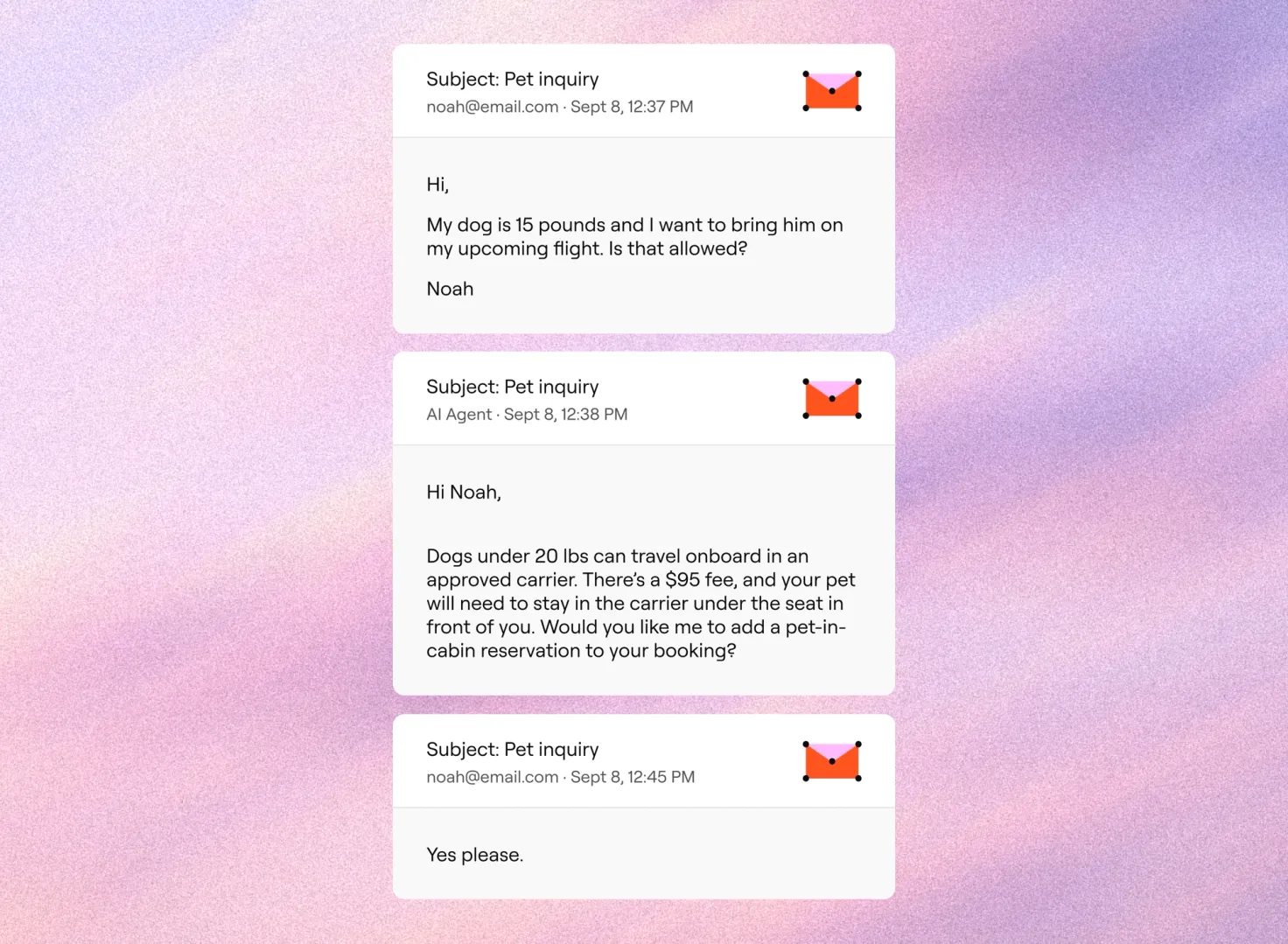
Agentic AI: Complete resolutions, not just faster replies
What's emerging now is a shift from optimizing for efficiency toward optimizing for outcomes. Agentic customer experience (ACX) is designed to do exactly that.
Agentic AI in customer service refers to AI customer service agents that can reason across constraints, take action within defined guardrails, and complete outcomes from start to finish—not just generate a response and hand the work back to a human.
With the right AI customer service platform for travel, this is what allows AI to move from partial resolution to complete resolution, reducing operational overhead while improving the customer experience at the same time. Nowhere is that shift more visible than when a real-world travel disruption hits.

How AI customer service agents handle real-world disruptions
In practice, resolving a customer request requires more than a single step. It means working across systems, applying business rules, and completing a sequence of actions accurately and in real time.
What’s emerging now is a shift from optimizing for efficiency toward optimizing for outcomes. Agentic customer experience (ACX) is designed to do exactly that.
Agentic AI in customer service refers to AI customer service agents that can reason across constraints, take action within defined guardrails, and complete outcomes from start to finish.
In travel, that difference is immediately visible. Instead of informing a passenger that their flight has been cancelled, an AI agent can evaluate their booking, validate eligibility, present policy-compliant alternatives, and confirm a rebooking—before the passenger reaches the gate.
That’s because AI customer service agents powered by ACX can:
- Evaluate real-time customer and booking data,
- Apply fare rules, policies, and eligibility criteria,
- Execute actions in core systems, and
- Confirm outcomes within the same interaction.
But achieving this in a single use case is only the starting point. The real challenge is delivering that level of resolution consistently, across every interaction and multiple use cases, at scale.

What this looks like in practice
As travel brands adopt AI agents, customer experience shifts from reactive and fragmented to proactive, personalized, and consistent.
In practice, that means:
- Proactive disruption management: AI agents monitor for delays and cancellations, then engage affected passengers before they reach out, offering confirmed alternatives in real time.
- Loyalty-aware decisioning: Elite status and fare rules are recognized instantly, with waivers and prioritization applied automatically.
- Personalized engagement: Offers, upgrades, and recommendations are based on actual travel history versus static segments.
- Consistent omnichannel experiences: Customers receive the same level of service across chat, voice, messaging, and email.
This is where customer service begins to shift roles, from a reactive support function to an active driver of retention and revenue.
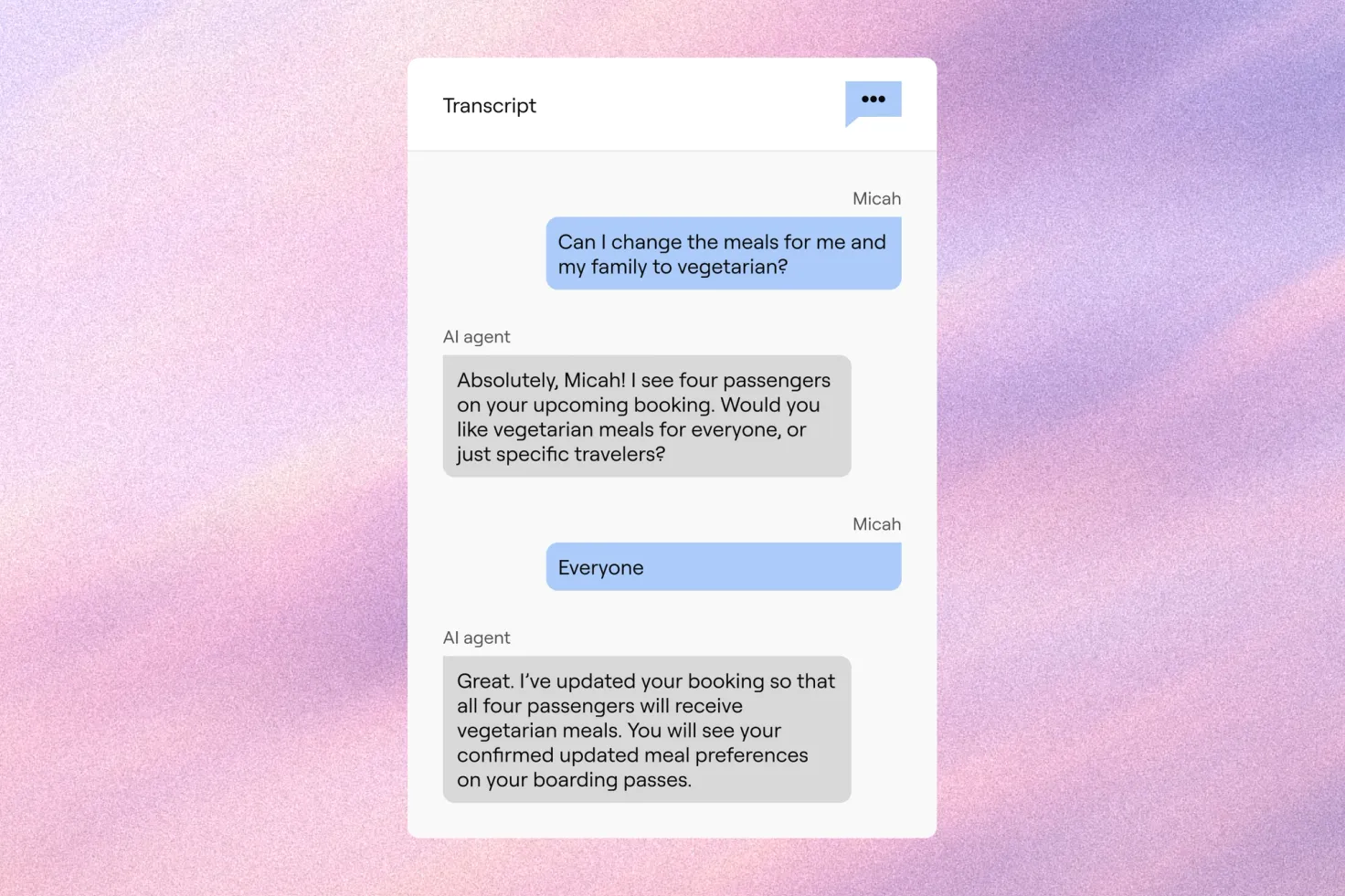
Boosting customer lifetime value through personalized experiences
AI customer service agents increase customer lifetime value (CLTV) by turning service interactions into loyalty-building experiences, particularly in the moments when something goes wrong.
Consider a frequent flyer affected by a weather cancellation. An AI agent verifies their elite tier, applies a waiver within the fare protection policy, presents confirmed alternatives, and flags upgrade eligibility—all without the passenger needing to call or repeat their situation.
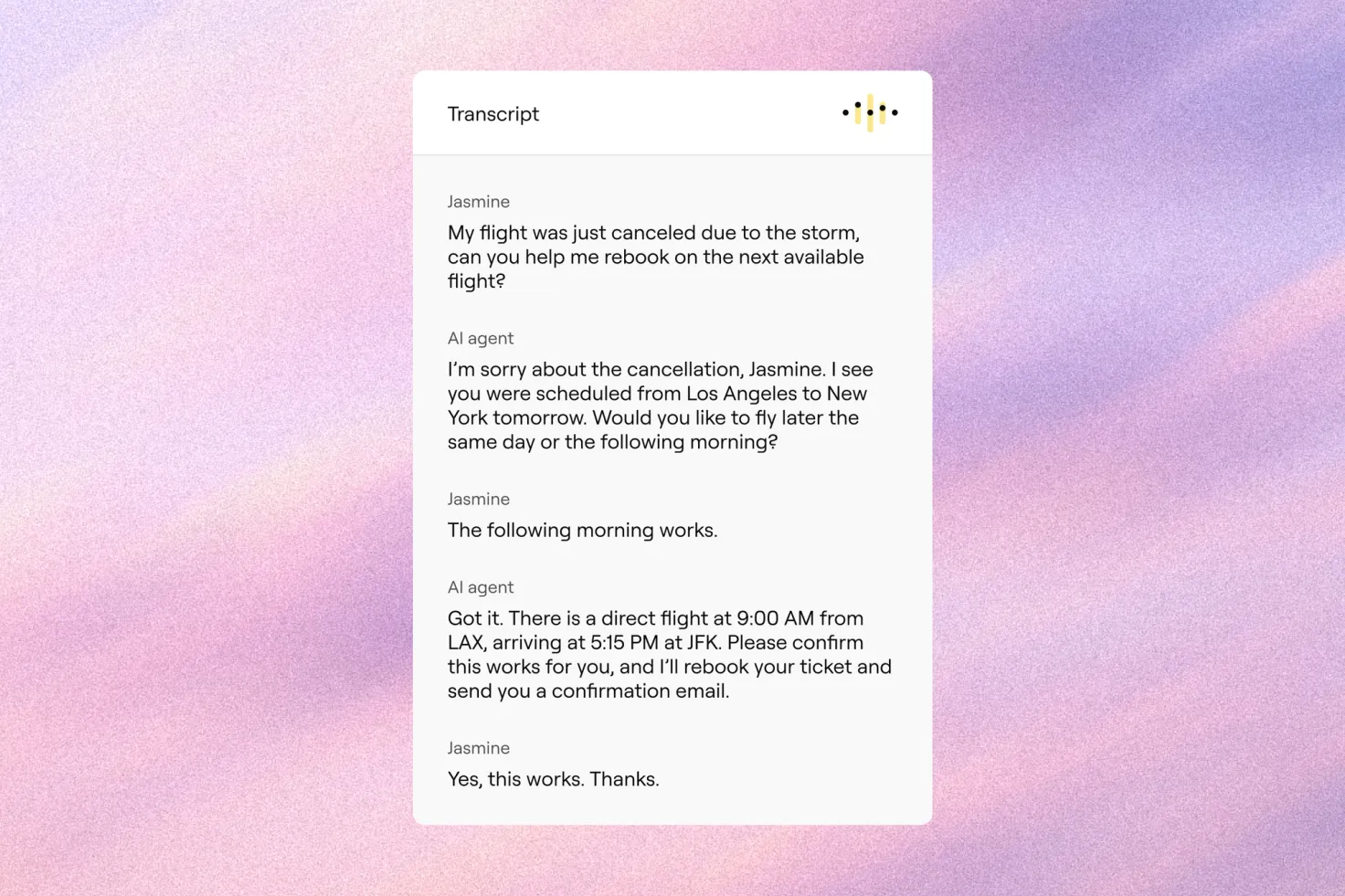
Moments like this don’t just solve a problem. They reinforce why a customer chooses one airline over another.
For enterprise travel leaders, this is the real business case for AI: both what AI saves and what it earns.
Inside Cebu Pacific’s AI customer service strategy
Cebu Pacific offers a clear example of what happens when an airline commits to this model.
Their Ada-powered AI agent, Charlie, serves as the primary point of contact for millions of customers, handling inquiries across channels, prioritizing high-urgency cases in under a minute, and escalating with full context when human support is needed.
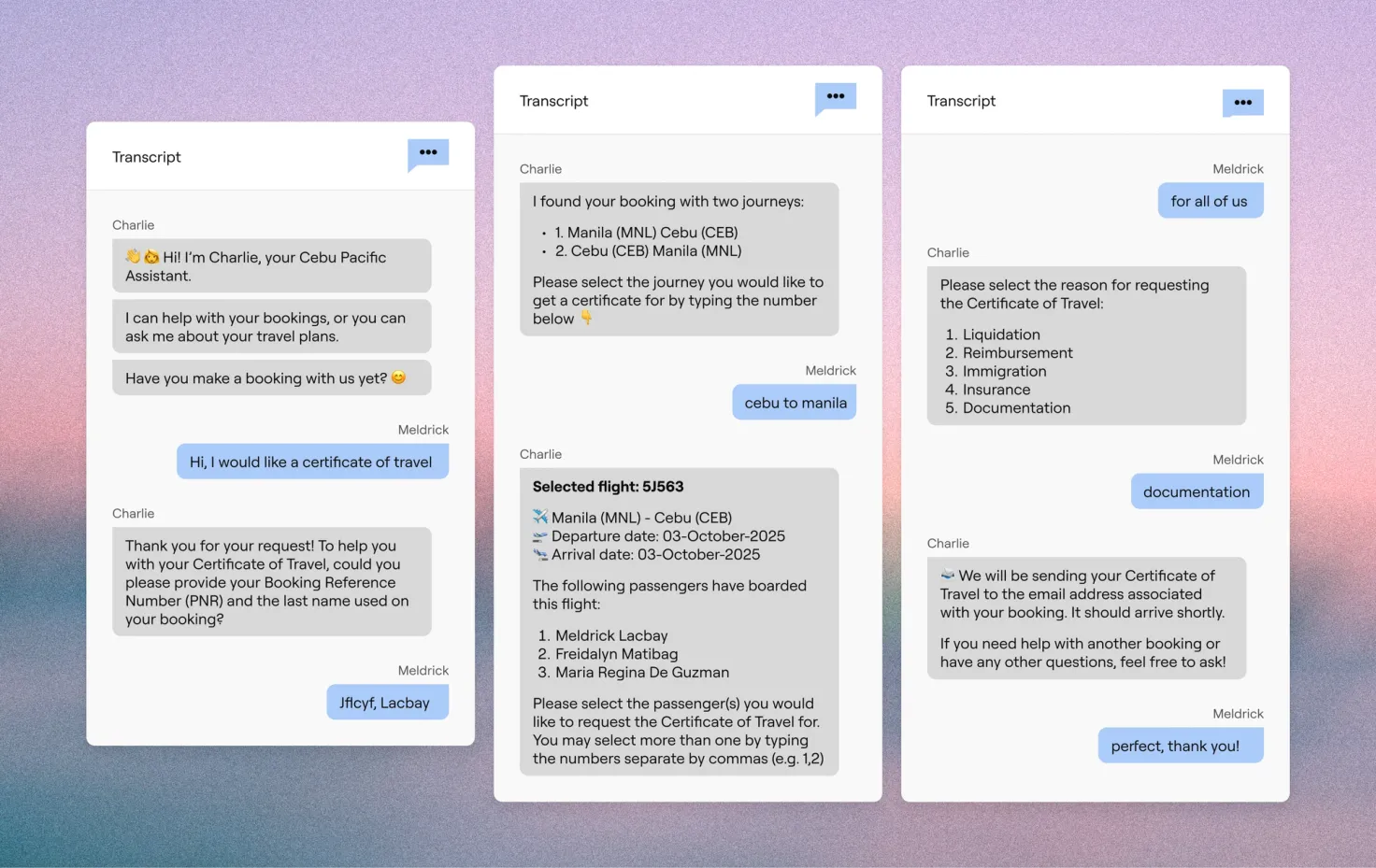
The results:
- 34% increase in automated resolution rate
- Over 50% improvement in CSAT
Cebu's results didn't come from the technology alone. They came from building the operating discipline to run it: daily performance reviews, clear internal ownership, and a continuous improvement cadence that kept Charlie getting better over time.
When AI agents are designed to resolve, not just respond, both efficiency and experience improve together.
Inside Cebu Pacific’s AI customer service strategy
Cebu Pacific partnered with Ada to bring an AI agent into their customer care team, taking another step forward in their innovation journey.
Learn moreWhy AI resolution requires an operating model
Achieving resolution in a single interaction is only part of the challenge. Sustaining and scaling it across the organization is where most teams struggle.
92% of businesses expect to increase AI investment in customer service over the next 12 months. But increased investment doesn’t automatically translate into better outcomes. The issue isn’t whether AI can resolve requests. It’s whether organizations are set up to consistently improve and scale that capability.
Most teams follow a familiar pattern:
- An AI agent is launched and delivers early gains.
- New use cases are added quickly.
- Performance becomes inconsistent across workflows.
- Improvements slow down and become harder to measure.
Over time, resolution rates plateau or decline because the system around the technology isn’t designed to support continuous improvement. The issue is whether organizations are set up to improve and scale that capability consistently.
This is the difference between deploying AI and operating it.
How ACX enables continuous improvement
Reaching enterprise-scale performance requires more than technology. It requires an operating model designed to continuously improve AI over time.
Ada ACX is the operating model for agentic customer experience, connecting technology, methodology, and expertise into a unified system for building and scaling high-performing AI agents.
It brings together three core components:
- ACX Platform: A unified system to deploy, manage, and scale AI agents across every channel and language.
- ACX Practice: A structured methodology for continuously analyzing and improving performance through a Build → Deploy → Analyze → Optimize cycle.
- ACX Experts: Strategic partners who help organizations build internal capability and scale success over time.
Together, these components create a closed-loop system for continuous improvement, ensuring AI agents launch successfully and continue improving with every interaction.
This is what enables travel brands to move from early experimentation to sustained, compounding performance.
The competitive divide is opening now
The shift to agentic customer experience is already underway. The real divide isn’t between companies that have adopted AI and those that haven’t. It’s between those that can improve it and those that can’t.
Most businesses still lack the visibility required to do that. More than half can’t clearly measure how their AI agents are performing, making consistent improvement structurally difficult.
That’s the constraint. Not access to AI. Not even capability.
It’s the ability to see what’s working, understand what’s not, and systematically improve resolution over time.
This is where agentic customer experience (ACX) becomes critical—not as a technology layer, but as the operating model that turns isolated automation into a system that improves with every interaction.
The travel brands that build that capability won’t just deploy AI. They’ll continuously improve it. And that’s what separates incremental gains from sustained advantage.
Agentic CX in 2026: What consumers expect and most enterprises miss
There’s a common assumption that consumers are skeptical of AI in customer service. The data says otherwise. Our 2026 report surveyed 2,000 consumers to understand how people actually experience AI in customer service today.
Read report