

Travel isn’t just complex. It’s unpredictable.
Passengers don’t reach out during calm, routine moments. They contact airlines and travel brands when something changes: a delay, a cancellation, a missed connection, a booking mistake, or a loyalty question right before boarding.
These moments are time-sensitive. Emotional. Revenue-critical.
That’s why travel customer experience isn’t a “nice to have.” It’s operational infrastructure. It’s also why the conversation around AI in the travel industry has shifted from experimentation to execution.
Leaders aren’t looking for novelty. They’re looking for workflows that hold up during disruption, across channels, on a global scale.
This post is part of our AI agent in the field series: a look at how real AI agents support real customer service teams in production. In this edition, we’re spotlighting five high-impact travel use cases that airlines and travel brands are automating right now.
These five workflows sit at the core of modern travel customer experience. When they fail, queues spike, costs rise, and loyalty erodes. When they work, customers barely notice, and that’s exactly the point.
What are the most valuable AI use cases in travel customer service?
In travel, the highest-volume conversations are often the highest-stakes. Think about what your customers actually ask:
- “Is my flight on time?”
- “Can you rebook me after this cancellation?”
- “I need to update my meal preferences.”
- “How many points do I have?”
- “Can you book a flight for me?”
Each one touches revenue, loyalty, or brand trust.
But in many organizations, these moments still rely on manual lookups, long queues, and fragmented systems. When disruption hits, the cracks show.
With the right AI customer service platform, these interactions become structured, governed workflows—not one-off tickets. AI agents authenticate, retrieve real-time data, enforce policy, apply changes, and confirm updates across voice, messaging, and email.
This is where conversational AI in travel moves beyond scripted responses and starts delivering impact.
Here are the five use cases travel brands should prioritize first.

5 AI customer service use cases for airlines and travel brands to prioritize now
These aren’t random automation opportunities. These are the workflows that spike first when something goes wrong and quietly drive cost even when everything goes right.
If you modernize these five, you don’t just automate. You stabilize.
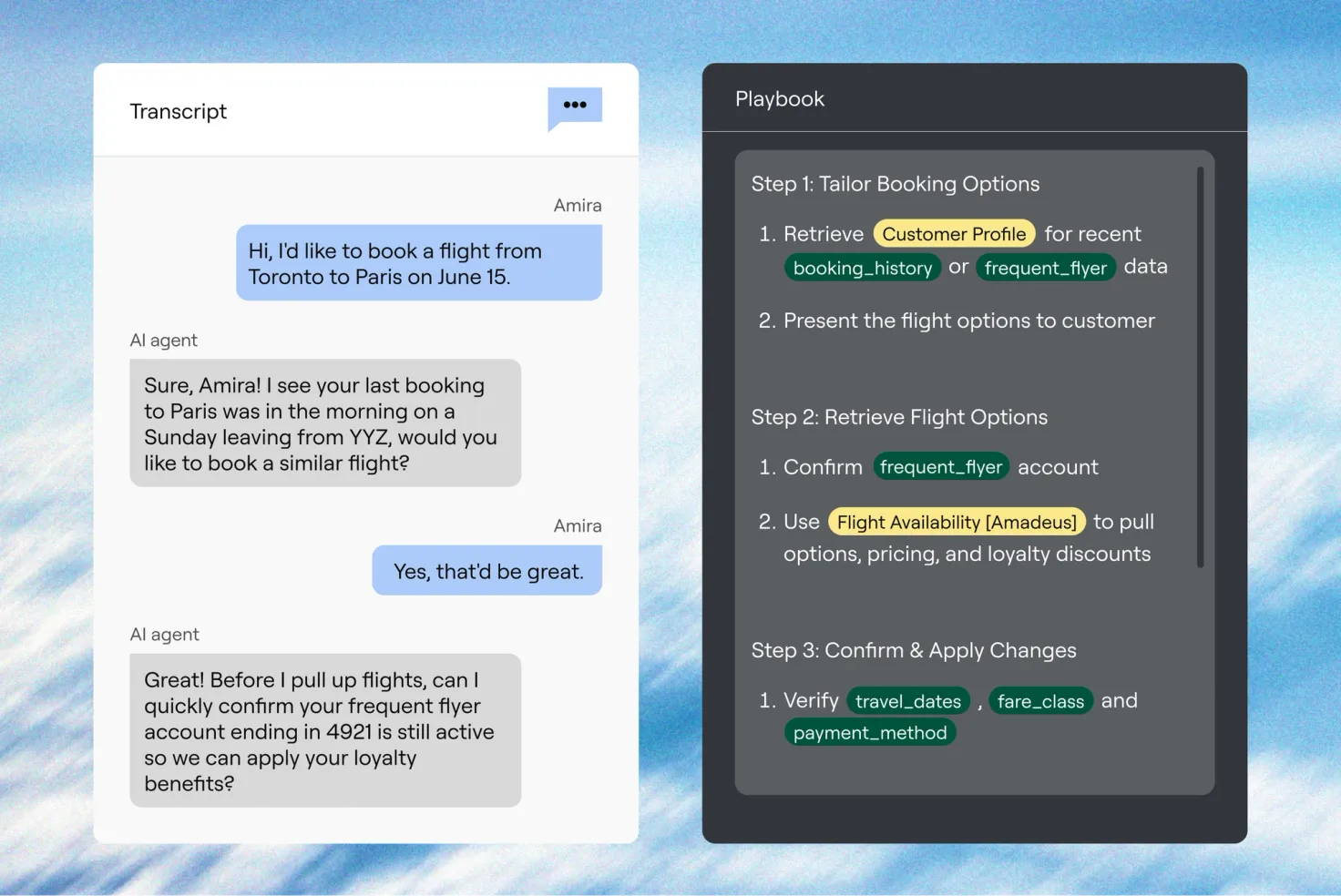
1. Booking flight tickets
Booking is your revenue moment. It’s also where complexity hides.
From the traveler’s perspective, it’s simple: “I need to get from Toronto to Paris next Friday.” Behind that request sits real operational nuance like fare rules, loyalty benefits, seat class logic, code shares, pricing differences, and payment validation.
When customers hit friction here, they abandon. When they call for help, your cost-to-serve rises.
When handling booking flight tickets, the AI agent doesn’t just answer availability questions. It guides the decision-making process while enforcing structure.
An AI agent can:
- Retrieve booking history or loyalty status,
- Search for real-time flight availability via airline APIs,
- Present fare options with pricing and class details,
- Confirm preferences and payment method,
- Apply eligible loyalty rewards, and
- Generate and send a booking confirmation.
Instead of routing customers through multiple screens or queues, the AI agent guides them step-by-step through the booking flow. This reduces friction, improves conversion rates, and enables revenue-generating workflows to operate 24/7 without added headcount.
For travelers, it feels like someone understands how they prefer to travel. This is automation that touches the top line.
2. Flight status inquiries and real-time updates
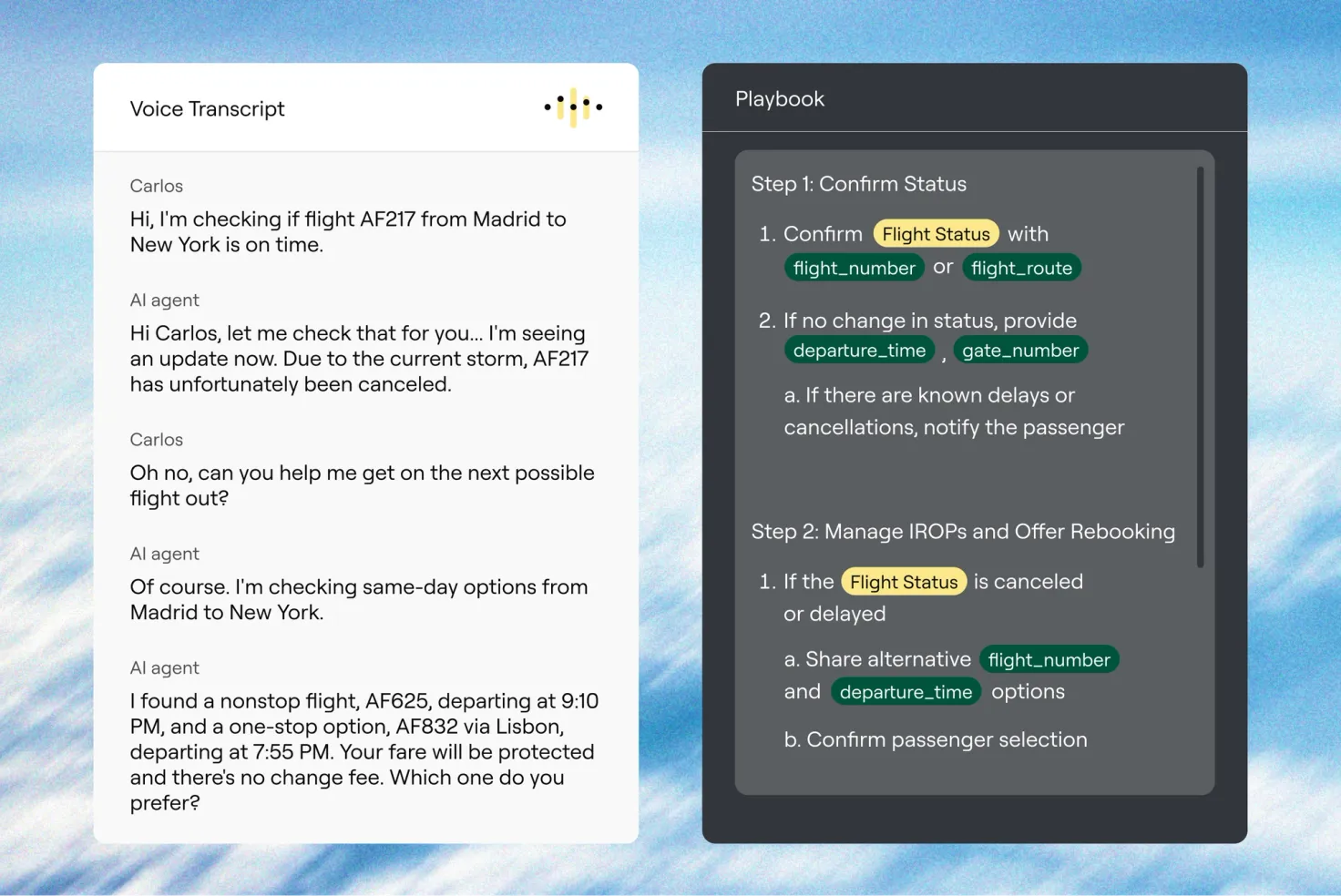
Flight status checks are constant. During disruption, they multiply instantly. Passengers ask:
- “Is flight AF217 from Madrid to New York on time?”
- “What gate is my flight departing from?”
- “Has my flight been cancelled?”
When answers aren’t immediate, they escalate to calls. When calls spike, service levels drop.
When resolving flight status inquiries, an AI agent handles these questions with precision. It retrieves real-time data and communicates clearly.
An AI agent can:
- Look up flights by number, route, or confirmation code,
- Retrieve real-time departure and arrival data,
- Provide gate numbers, terminal information, and boarding times,
- Notify customers of delays or cancellations,
- Share baggage claim details upon arrival, and
- Display connection details for multi-leg journeys.
These are structured, repeatable interactions that are ideal for automation.
And because passengers reach out across channels, this workflow must perform consistently across messaging, email, and AI voice agents alike. The experience should remain accurate and consistent, regardless of how the traveler chooses to engage.
For operations teams, this reduces repetitive inbound volume at exactly the moment queues would otherwise explode. For passengers, it replaces uncertainty with clarity.
3. Flight change or rebooking
Flight changes and rebooking are where loyalty is either reinforced—or lost.
During irregular operations, rebooking requests surge. Customers aren’t looking for empathetic scripts. They’re looking for action. They want to know:
- “Can you move me to the next available flight?”
- “Is there a change fee?”
- “Can I use my travel credit?”
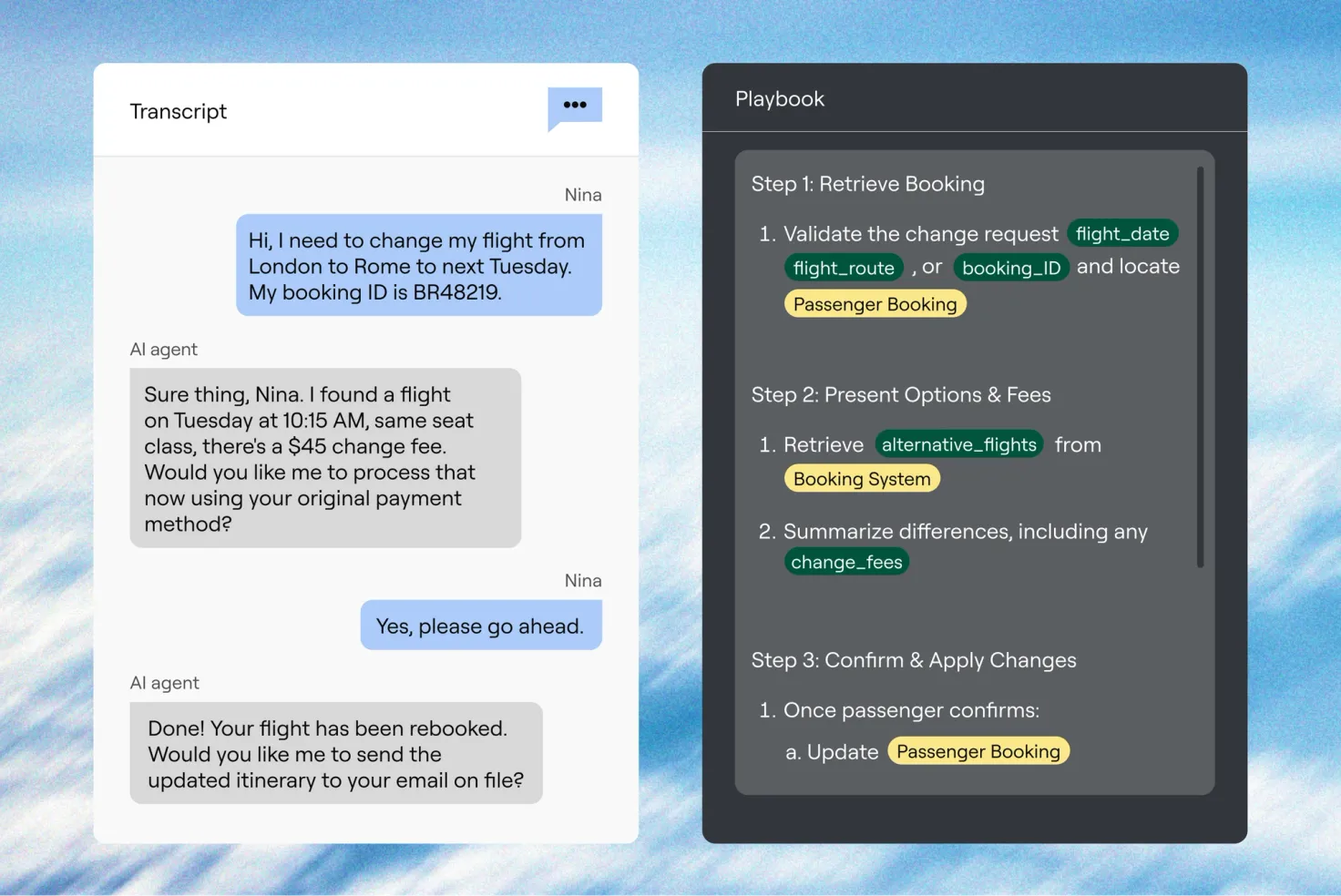
When executing flight changes or rebookings, the AI agent operates within clearly defined guardrails. It doesn’t improvise, it follows fare logic, availability rules, and policy constraints.
An AI agent can:
- Retrieve and verify the existing booking,
- Present alternative flights based on availability,
- Clearly communicate change fees or fare differences,
- Apply eligible credits or loyalty points,
- Confirm the updated booking, and
- Send a revised itinerary instantly.
For airlines, this prevents operational bottlenecks during disruption. For customers, it turns chaos into resolution.
4. Loyalty program inquiries
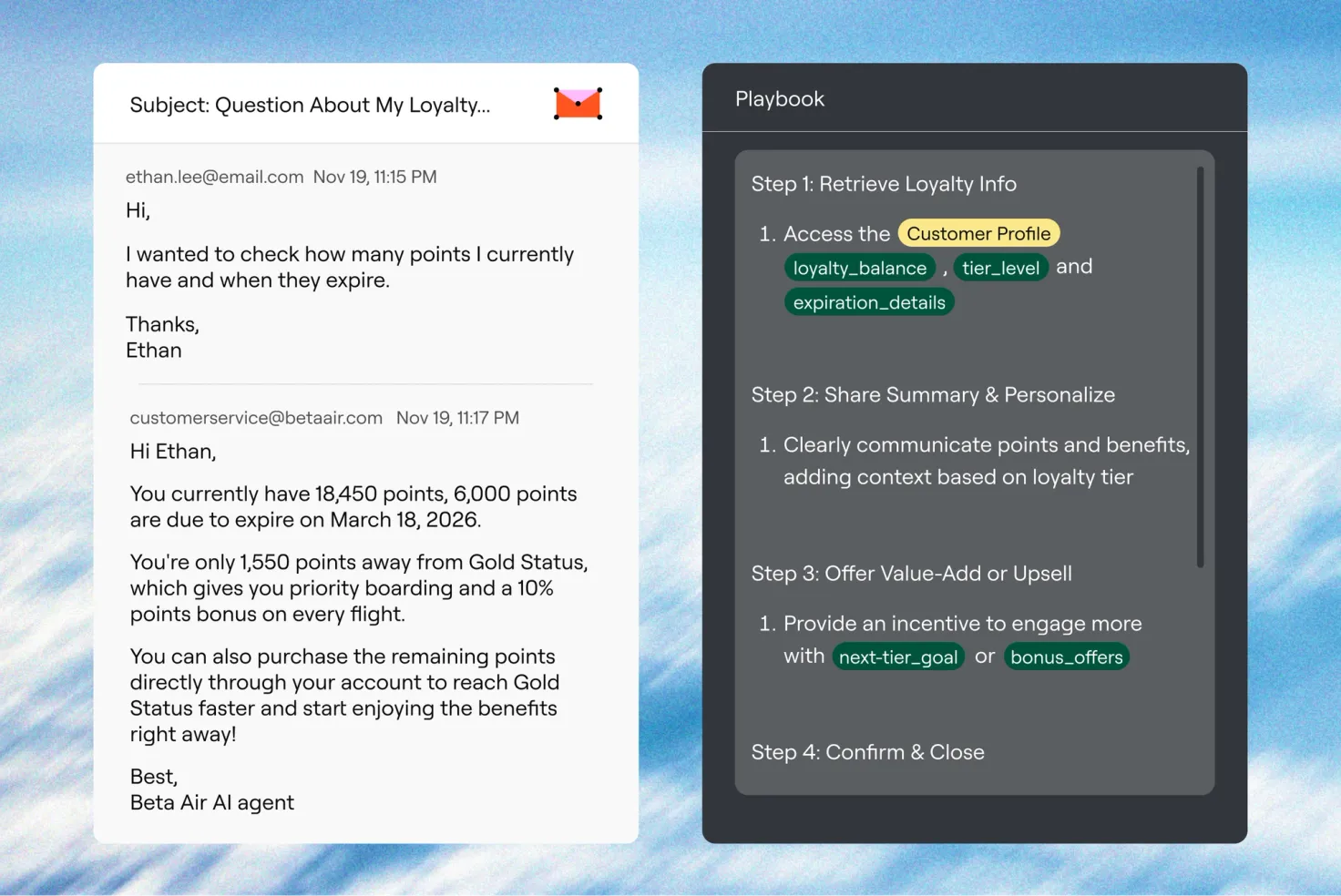
Loyalty programs are where long-term growth is built, but only if customers can access, understand, and consume their benefits. Travelers regularly ask:
- “How many points do I have?”
- “When do my points expire?”
- “What benefits do I get at my tier?”
- “How do I redeem my rewards?”
When answers require digging through portals or waiting on hold, engagement quietly declines. The AI agent makes rewards transparent and actionable.
An AI agent can:
- Retrieve loyalty balance and tier level,
- Display expiration dates and upcoming milestones,
- Explain tier benefits in clear terms,
- Highlight how many points are needed to reach the next level, and
- Suggest redemption or upgrade opportunities.
This isn’t just about reducing tickets. It’s about increasing engagement. Clear loyalty visibility strengthens retention and increases customer lifetime value without adding operational strain.
5. Managing or updating bookings
Managing a booking is one of the most common—and high volume—use cases. Seat changes. Meal preferences. Contact updates. Minor itinerary corrections.
Individually, they’re simple. At scale, they quietly consume an enormous amount of agent time, especially during peak travel seasons.
Passengers don’t want to call to change a seat. They expect control. They’ll say things like:
- “I need to change my meal preference.”
- “Can I update my contact information?”
- “I want to select a different seat.”
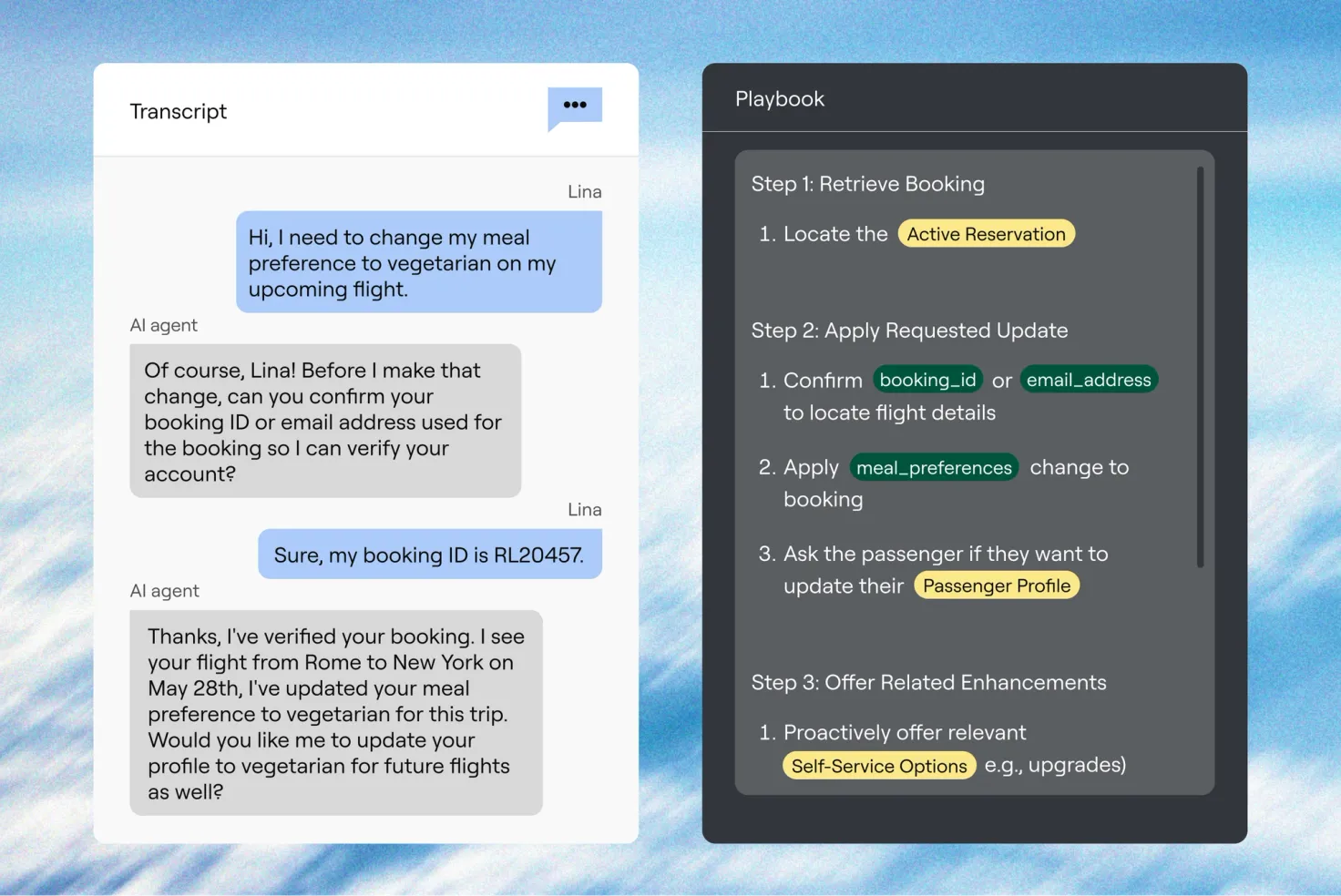
When managing booking updates, the AI agent treats these interactions as structured actions rather than open-ended conversations.
An AI agent can:
- Retrieve and verify the active reservation,
- Apply seat, meal, or contact updates,
- Confirm passenger details,
- Offer related enhancements (like seat upgrades), and
- Send updated confirmation emails.
For operations leaders, this reduces repetitive workload without sacrificing control. For passengers, it restores autonomy over their trip. They make a change. It’s confirmed. It’s done.
And because the workflow follows defined guardrails, you maintain policy compliance and consistency across every channel.
Turn travel AI use cases into measurable results with Playbooks
Travel will always be dynamic. Weather shifts. Aircraft rotate. Demand spikes without warning. You can’t eliminate disruption.
But you can design how your operation responds to it. That’s where mature adoption of AI in the travel industry makes the difference. Not in surface-level automation, but in structured workflows that stabilize service when pressure is highest.
That’s where Playbooks come in.
Playbooks turn high-volume service interactions into defined workflows with clear steps, system integrations, and escalation logic. They ensure that when an AI agent books a flight, rebooks a disrupted passenger, or updates a seat assignment, it follows the same operational guardrails every time—across voice, messaging, and email.
This isn’t about scripting answers. It’s about operationalizing outcomes.
The travel brands leading in customer experience aren’t experimenting with automation at the edges. They’re embedding structure into the interactions that drive their volume, cost, and customer sentiment.
When your highest-frequency workflows are governed, scalable, and continuously improved, your entire service model becomes more resilient. And in travel, resilience is a competitive advantage.
Unlock more complex AI resolutions
Browse real examples of AI agents using plain-language instructions to automate multi-step processes with speed and precision.
Explore Playbooks Library