

Most enterprise teams don’t struggle to understand what AI anymore. That question has largely been answered.
AI can resolve issues, personalize interactions, and operate across channels in ways that weren’t possible even a few years ago. The more interesting question now is something else entirely: why do so many AI initiatives show early promise, only to slow down when they try to scale?
If you look closely, the pattern is consistent. A team launches an AI customer service agent, sees strong initial results, and expands into new use cases. Then the friction begins.
Performance varies across channels. Updates take longer than expected. Improvements become harder to measure.
What once felt like progress starts to feel like coordination.
At some point, the realization sets in. The challenge isn’t what the AI can do. It’s how the organization is set up to run it. This is the problem Ada’s agentic customer experience (ACX) model is designed to solve—a framework built to help enterprises run AI, not just deploy it.

Agentic customer experience (ACX): An operating model for a different kind of AI
For most of the past decade, AI for customer experience has been treated as an extension of existing systems. It reduced workload, handled repetitive requests, and improved efficiency at the margins. The underlying operating model stayed intact.
Agentic AI changes that relationship. Agentic AI in customer experience refers to AI agents that can understand intent, make decisions, and take action to resolve customer needs across systems and channels without predefined flows.
That means an AI customer service agent is no longer confined to answering questions. It can:
- Authenticate users,
- Enforce policies,
- Retrieve and update data,
- Complete multi-step workflows, and
- Maintain context across an omnichannel customer experience.
In effect, it behaves less like a tool and more like a customer-facing employee.
How leading brands expand without breaking CX
In Part 1 of our webinar series, learn how leading brands deliver consistent, connected service across voice, chat, email, social and more.
Watch on-demandOnce AI reaches that level of responsibility, the expectations around it change. You don’t just deploy it and measure output. You need to manage its performance, improve it over time, and ensure it operates consistently across the business.
ACX exists to make that possible, and to give enterprises a way to operate agentic AI in customer experience as a core capability, not just a set of use cases.
ACX approaches the problem from a different angle. Instead of asking how to deploy AI more effectively, it asks how to operate it as a core part of customer experience.
At a high level, ACX is the operating model for managing AI agents across the enterprise. It brings together the platform, the methodology, and the expertise required to build, deploy, maintain, and coach AI agents over time.
That combination is what makes it distinct. Most approaches focus on one or two of these elements; ACX treats them as a system.
The philosophy behind it is straightforward (even if the implications are not): the organizations that see the most value from AI will be the ones that develop the capability to run it themselves. They understand their customers, their operations, and their business context better than anyone else.
But they don’t have to do it alone. With the right structure, tools, and proven expertise, they can build that capability faster and more effectively than starting from scratch. The ACX Operating Model, in practice
To understand how ACX works, it helps to look at the three components that define it: ACX Platform, ACX Practice, and ACX Experts. Together, they solve the organizational challenges that cause most AI initiatives to stall.
ACX Platform: A single system for how AI works
In many organizations, AI is deployed in pockets. One team owns messaging, another owns voice, and a third manages knowledge. Updates are made locally, not globally. As complexity increases, the effort required to keep everything aligned grows with it.
The result is a fragmented experience:
- AI behaves differently across channels.
- Context is lost between interactions.
- Logic is duplicated across systems.
- Policy enforcement becomes inconsistent.
This is where most teams start to feel the limits of their approach.
The ACX Platform is designed to solve this at the foundation, giving enterprises a unified system to run agentic AI in customer experience across channels, systems, and workflows.
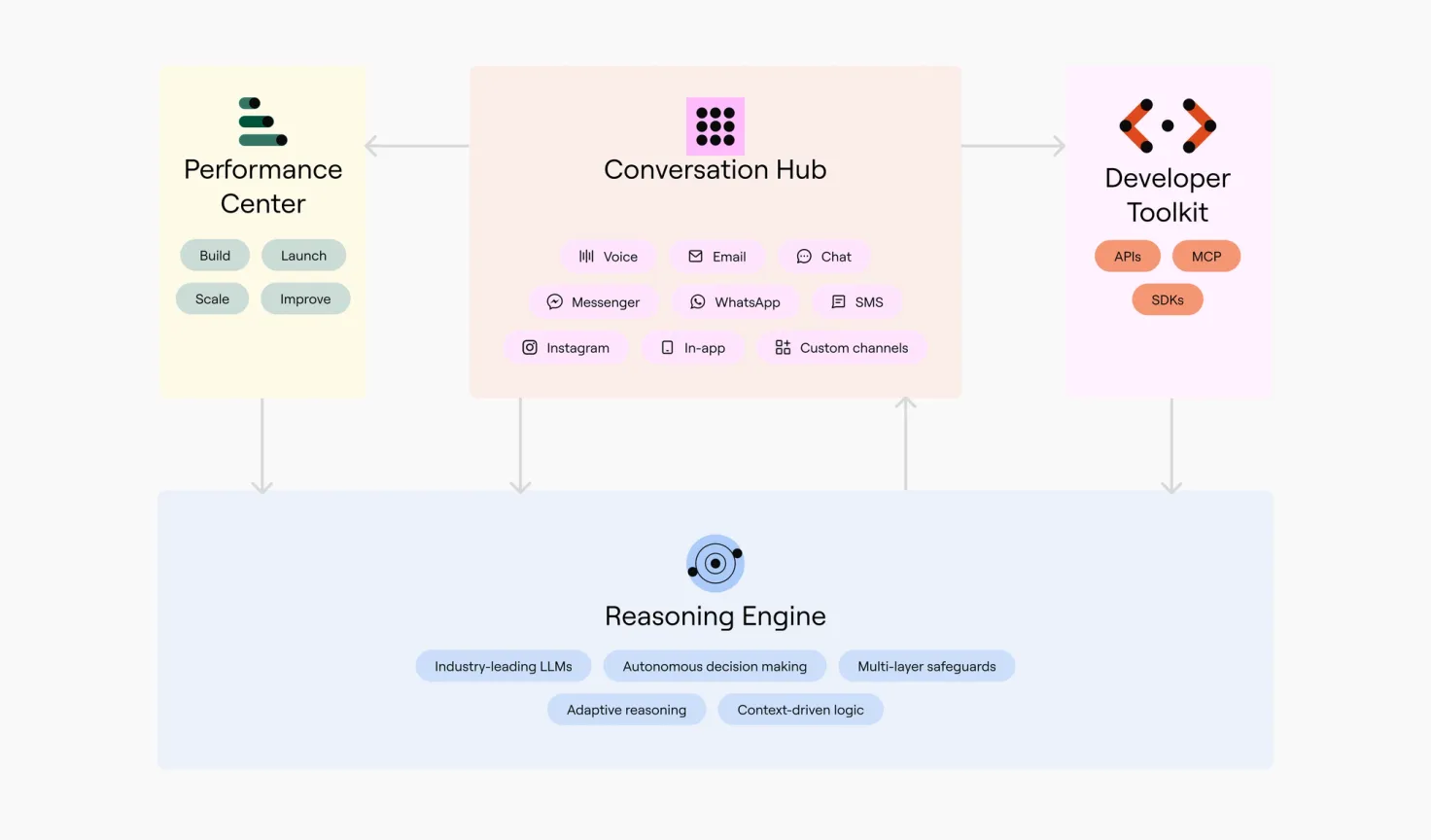
It’s where AI agents are created, deployed, and improved. But more importantly, it provides a unified system for how those agents operate across channels and use cases. In practice, this means an AI agent can:
- Move from answering a question to resolving an issue.
- Access and act on real-time customer and business data.
- Maintain context across channels and touchpoints.
- Apply policies and safeguards consistently.
This is what enables a true omnichannel customer experience. Not just availability across channels, but continuity between them.
Agentic AI enhances customer experience by resolving issues faster, maintaining context across interactions, and delivering more personalized outcomes at scale.

ACX Practice: A defined way to improve over time
AI customer service initiatives often plateau because improvement is reactive rather than systematic.
Teams fix issues as they arise, but lack a consistent way to measure performance, prioritize changes, and drive progress over time. Knowledge is updated inconsistently. Metrics are tracked in isolation. There is no shared cadence for improvement.
These patterns are common:
- Knowledge exists, but it isn’t structured for how AI reasons and acts.
- Improvements happen sporadically, not systematically.
- Performance is measured at the interaction level, not across journeys.
ACX Practice addresses this directly. It introduces a structured approach to improvement through the ACX Blueprint. This is not a theoretical framework. It’s a practical methodology built from real deployments, designed to help teams understand where they are and how to progress.
At its core is a repeatable cycle:
- Build your AI agent using structured knowledge and defined behaviors.
- Deploy it into real customer interactions.
- Analyze performance across outcomes like resolution and customer satisfaction.
- Optimize through continuous coaching and refinement.
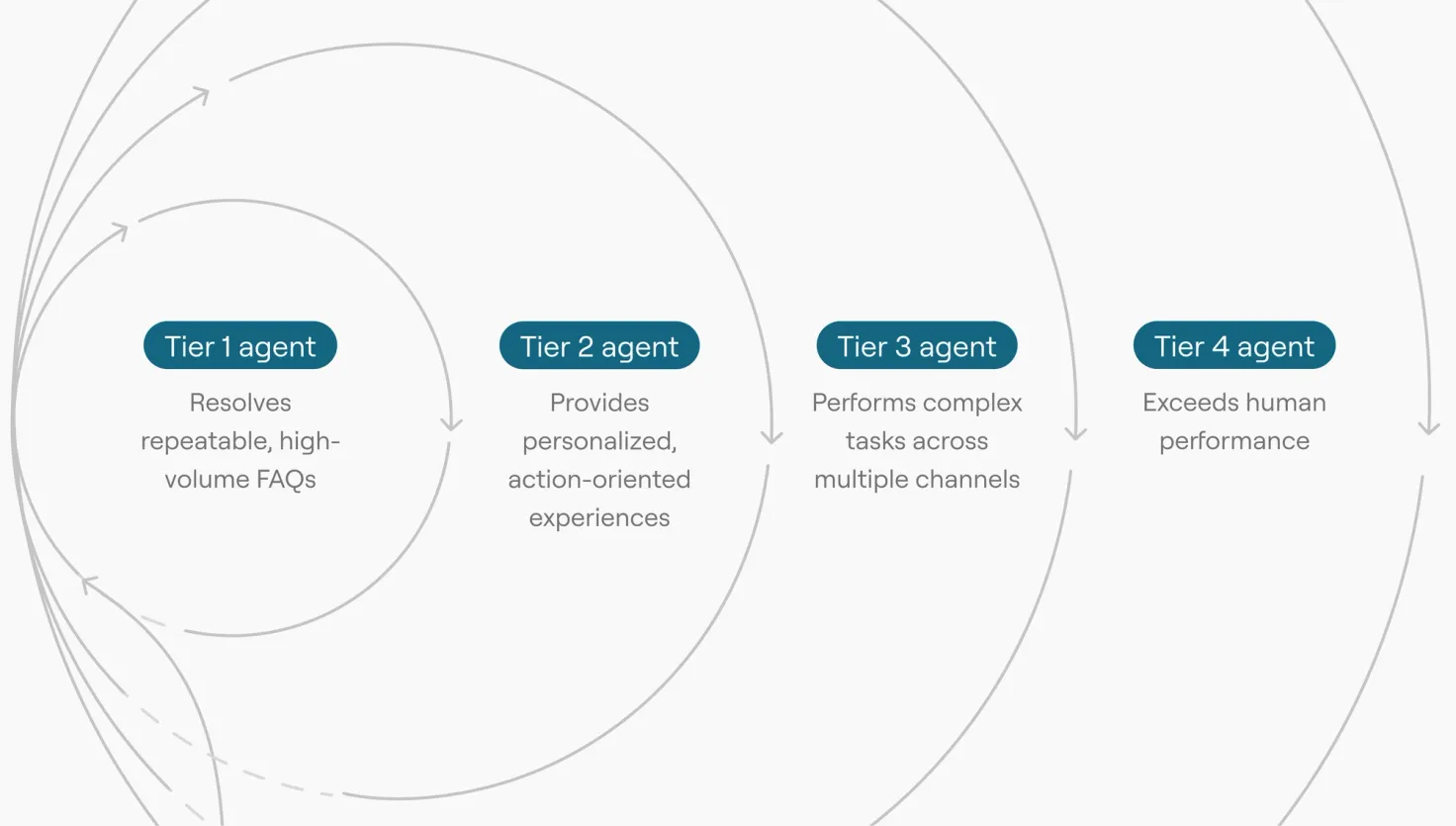
This cycle creates a cadence that replaces reactive work with intentional progress. The Blueprint also makes maturity visible. Organizations evolve from handling high-volume, repeatable inquiries to delivering personalized, action-oriented experiences, and eventually to managing complex workflows across channels at scale.
Instead of guessing what to do next, teams have a clear path forward.
ACX Experts: Building the team that makes it work
Another common constraint appears as organizations scale: dependency on external teams.
Forward-deployed engineers often step in to map knowledge, configure workflows, and manage performance. This can accelerate early progress, but it introduces long-term friction:
- Knowledge and system logic live outside the business.
- Iteration depends on external timelines and priorities.
- Scaling requires more resources, not better systems.
This limits how quickly teams can improve and expand. ACX takes a different approach.
Running AI effectively requires a different set of roles and skills than traditional customer support. It requires people who understand how to structure knowledge, interpret performance data, and continuously improve how AI agents behave.
That includes:
- Knowledge mapping and AI-ready content structure.
- Operating model design and governance.
- Performance analysis and optimization strategies.
The goal is capability transfer. ACX Experts are focused on helping organizations develop their own internal ACX teams.
These teams sit at the intersection of customer experience, operations, and technology. They are responsible for how AI agents perform, how they improve, and how they scale.
Their responsibilities include:
- Structuring and maintaining knowledge for AI.
- Defining and refining agent behavior.
- Monitoring performance across full customer journeys.
- Continuously coaching and improving outcomes.
This creates a fundamental shift:
- From relying on external teams to internal ownership,
- From slow iteration to continuous improvement, and
- From linear scaling to compounding progress.
This creates a system where every interaction generates insight, every insight informs improvement, and every improvement applies across the customer experience.
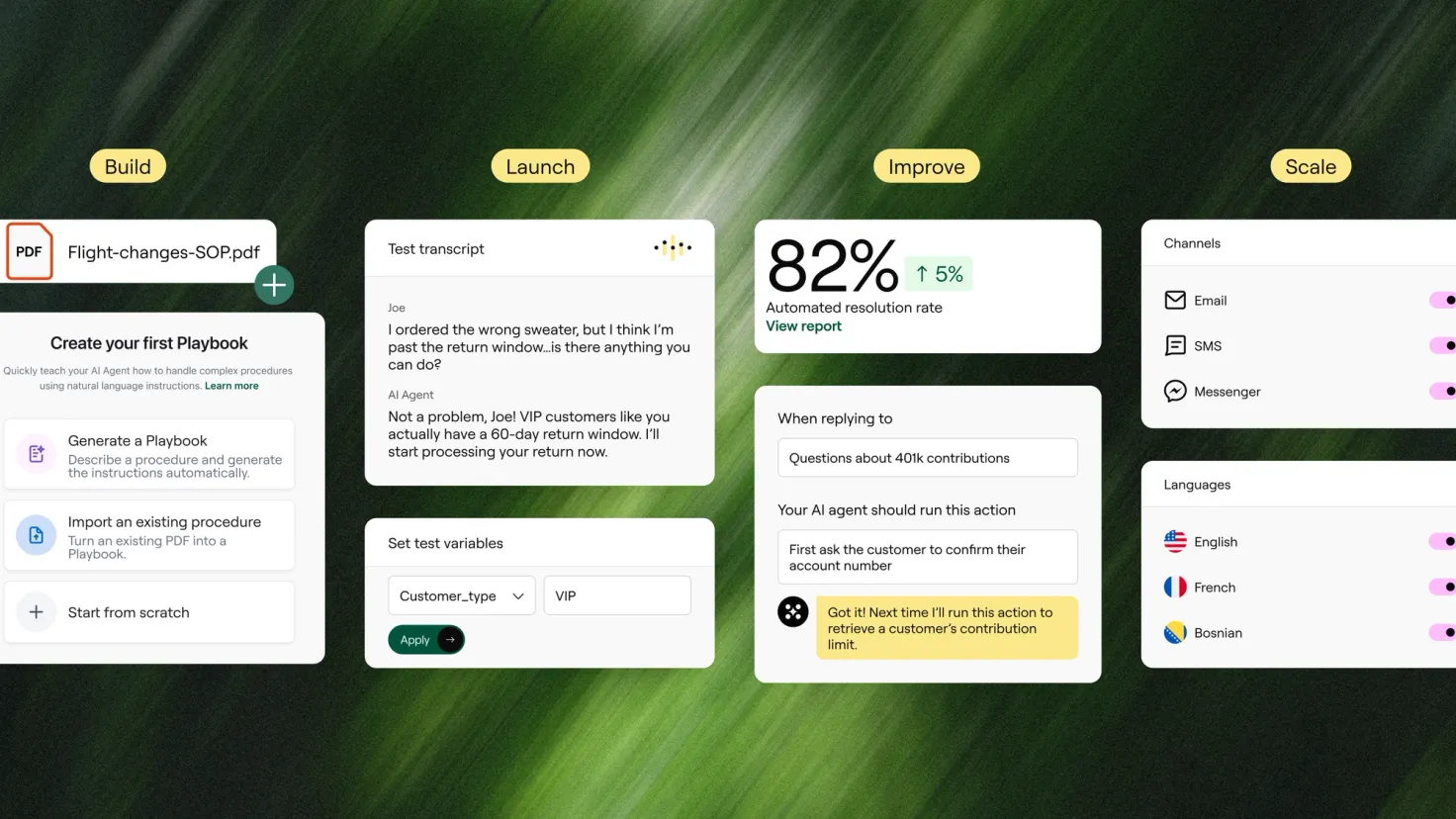
This is where the ACX Operating Model becomes real—not as a framework, but as a capability embedded inside the business.
A different way to evaluate AI for customer experience
As agentic AI for customer experience becomes more central to enterprises, the criteria for evaluating it need to change. It’s still important to understand what the technology can do. But it’s just as important to understand what your organization will be able to do with it.
That means asking:
- Can our team build, deploy, and improve AI agents independently?
- Do we have a clear methodology for continuous improvement?
- Are we creating a unified system, or adding to fragmentation?
- Will this scale across our entire omnichannel customer experience?
- Are we building capability inside the business, or dependency outside it?
The answers to these questions determine whether AI becomes a long-term advantage or a short-term win.
How to choose AI technology for enterprise customer service
To help you evaluate AI agents for customer service with clarity, we’ve distilled those insights into a practical framework. Discover the seven essential categories every enterprise RFP should include.
Learn moreThe takeaway
Agentic AI in customer experience is already changing how enterprises interact with their customers. The next phase of that change will be defined less by what the technology can do and more by how it is operated.
ACX provides a model for doing that well. It connects the platform, the practice, and the expertise required to turn AI into a disciplined, continuously improving capability.
For organizations that adopt it, the impact goes beyond efficiency. Customer experience becomes more consistent, more personalized, and more adaptable over time. And perhaps most importantly, it becomes something the organization can actively shape, rather than something it struggles to keep up with.
The AI customer service platform built for enterprise
The ACX Platform puts your team in full control. Manage and evolve AI agents that resolve inquiries autonomously, while staying on-brand, compliant, and personalized at every touchpoint.
Learn more