

Most airlines and travel brands already have some form of AI in production. But deploying AI isn’t the same as operationalizing it.
In travel, customer experience unfolds in conditions that change quickly: weather events, crew rotations, shifting inventory, alliance agreements, and regulatory constraints. A single disruption can affect thousands of passengers within hours. Every service decision sits inside fare rules, loyalty tiers, and operational policies.
Choosing the right AI customer service platform requires a different lens.
As AI in the travel industry matures, evaluation criteria are shifting. The question is no longer whether AI can answer common inquiries. It’s whether it can execute reliably inside the operational constraints that define travel, especially during moments of disruption.
That shift reframes how airlines evaluate AI technology for enterprise customer service.
How to choose AI technology for enterprise customer service
This guide breaks down the seven essential categories every agentic CX RFP should include and what to look for in each.
Get the guideFrom automation to agentic customer experience (ACX) in travel
Most AI deployments in travel begin at the edge of customer service: answering FAQs, deflecting common tickets, and routing calls more efficiently.
That’s a starting point.
But enterprise travel operations require more than surface-level automation. Airlines operate inside structural volatility and revenue-sensitive constraints. AI must reason within guardrails, execute multi-step workflows, and adapt as policies and demand evolve.
This shift—from automation to agentic customer experience (ACX)—changes how platforms should be evaluated.
Because agentic systems are built on unified reasoning, giving the AI customer service agent the ability to interpret policy, customer context, and operational constraints before determining the next action.
No static scripts. It evaluates eligibility, selects appropriate workflows, applies guardrails, and executes actions within defined parameters.
This architectural foundation enables:
- Consistent policy enforcement across channels
- Reliable completion of complex service workflows
- Controlled escalation when human judgment is required
- Continuous improvement based on measurable performance
Technology alone, however, is not enough.
Enterprises that scale AI customer service successfully pair platform capability with operating discipline. An ACX operating model formalizes that approach: aligning technology, methodology, and expertise into a structured operating model for managing high-performing AI agents.
With that foundation in place, the evaluation criteria become clear.

What airlines should look for in an AI customer service platform
Enterprise AI evaluation in travel is not a feature comparison exercise.
Airlines aren’t choosing between chat interfaces. They’re evaluating whether an AI customer service platform can operate inside policy constraints, complete high-risk workflows, remain consistent across channels, and improve over time.
That evaluation requires looking beyond conversational polish or automation rates. It requires examining how the platform executes, governs, reasons, and evolves under real operating conditions.
Here are the five capabilities that determine whether an AI customer service platform can support enterprise travel operations.
1. Execution depth: Can the AI customer service platform complete complex workflows?
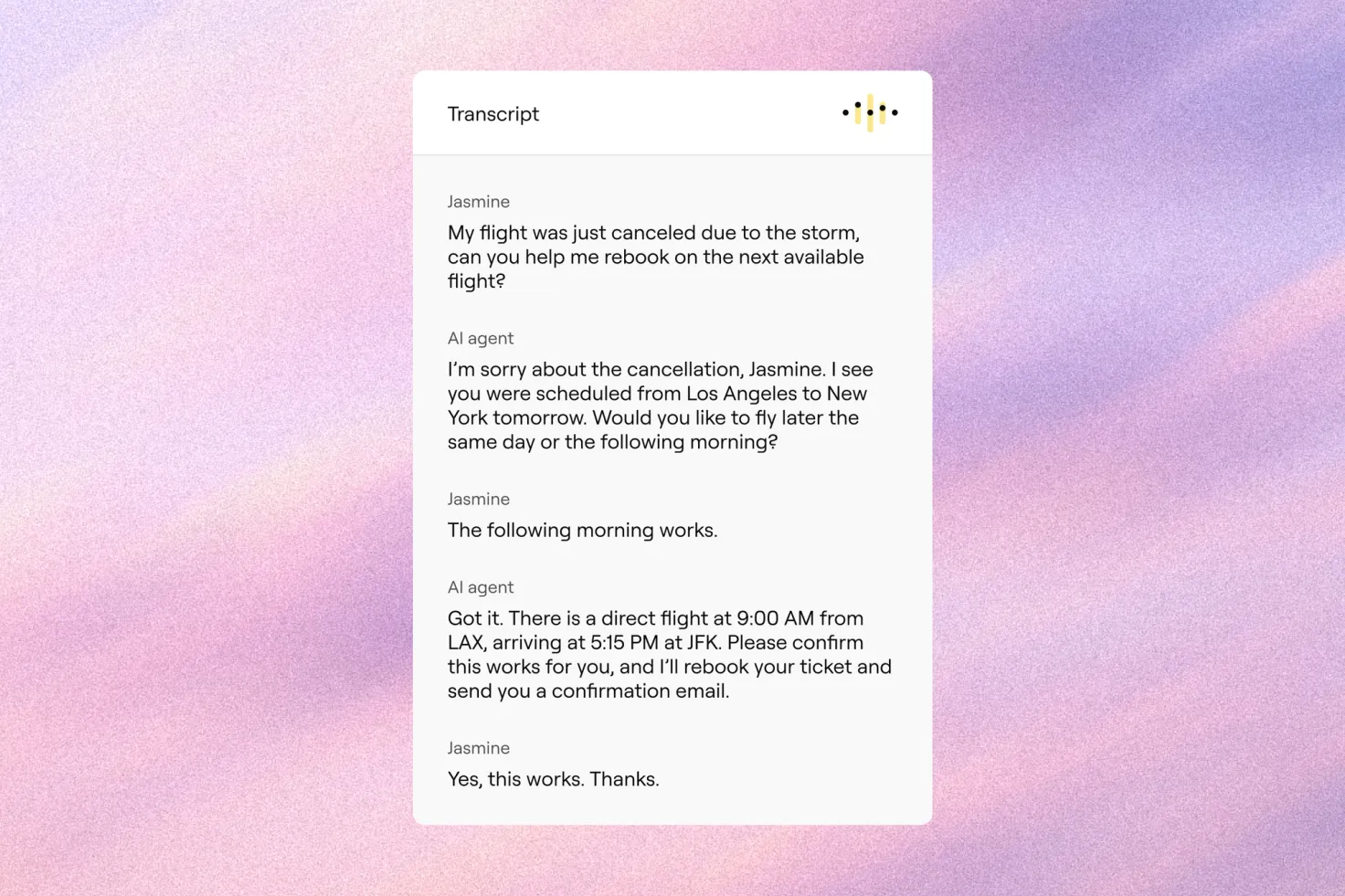
In travel customer service, the moments that matter are rarely informational. For example, when a passenger asks to move to the next available flight, they’re not looking for an explanation of policy. They want that change completed on their behalf.
That request requires more than a conversational response. It requires the AI customer service agent to navigate many variables within defined guardrails to:
- Retrieve and verify the booking,
- Confirm eligibility under fare rules,
- Identify valid alternatives,
- Apply credits or waivers when appropriate,
- Update the reservation, and
- Confirm the revised itinerary, all within a single interaction.
If the AI customer service agent can only surface information or suggest next steps, the work still shifts to a human agent to finish the transaction.
Execution depth determines whether AI truly resolves the request or simply routes it more efficiently. Enterprise evaluation should focus on whether the platform can carry high-risk, revenue-sensitive workflows from request to confirmed outcome without deferring execution to service teams.
2. Policy-first governance: Can the AI customer service platform apply rules consistently at scale?
Travel operates on structure. Fare rules, alliance agreements, loyalty tiers, baggage policies, and regional regulations define what is allowed in every interaction.
An AI customer service platform must apply those rules consistently, before options are presented and before changes are made.
When policy enforcement is inconsistent:
- Ineligible options may be offered
- Waivers may be applied unevenly
- Fare differences may be calculated incorrectly
- Follow-up work shifts back to service teams
These issues are rarely dramatic, but they accumulate over time, and small inconsistencies create measurable gaps between customer-facing decisions and revenue rules.
When evaluating an AI customer service platform, airlines should assess:
- Whether fare logic is centrally governed
- Whether guardrails are enforced before actions are executed
- Whether policy updates can be made without rebuilding workflows
- Whether automated decisions are transparent and reviewable
At enterprise scale, governance directly influences revenue accuracy, compliance integrity, and customer trust.
 The ultimate guide to AI in the travel industry: Building resilient customer service at scale
 3. Unified reasoning: Does the logic stay consistent across channels?
Travel customers don’t stick to one channel. A passenger may check flight status in the app, call when a cancellation hits, message from the airport, and respond to a rebooking email hours later.
From the passenger’s perspective, it’s one journey.
An AI customer service platform must ensure that voice, messaging, and email apply the same business logic. That means that fare rules, loyalty policies, and disruption handling shouldn’t change depending on where the interaction begins.

When logic differs across channels:
- Context may not carry forward
- Answers may vary by entry point
- Escalations increase
- Customers receive conflicting guidance
Airlines evaluating an AI customer service platform should assess:
- Whether reasoning is centralized across channels
- Whether escalation rules are aligned
- Whether performance is measured holistically
Voice is often evaluated separately in airline RFPs, but it shouldn’t operate as a separate logic layer.
AI voice agents for customer service should operate on the same unified reasoning foundation as digital channels. The best voice AI platform for customer service in travel applies consistent policy logic across every interface.
Unified reasoning supports predictable outcomes across messaging, email, and voice without fragmenting business logic.

4. Operating model: Who owns AI agent performance after launch?
Launching an AI customer service platform is the beginning, not the finish line.
Fare structures evolve. Loyalty programs change. Disruption policies are updated. New edge cases emerge as volume scales. Without structured ownership, performance will drift.
An AI customer service platform should support:
- Clear accountability for AI performance within the CX organization
- Regular review of automated resolution, CSAT, and escalation trends
- Structured testing before policy updates go live
- Defined processes for refining guardrails and workflows
Without this discipline, automation rates plateau, inconsistencies increase, and internal confidence declines.
Sustained performance requires operational cadence.
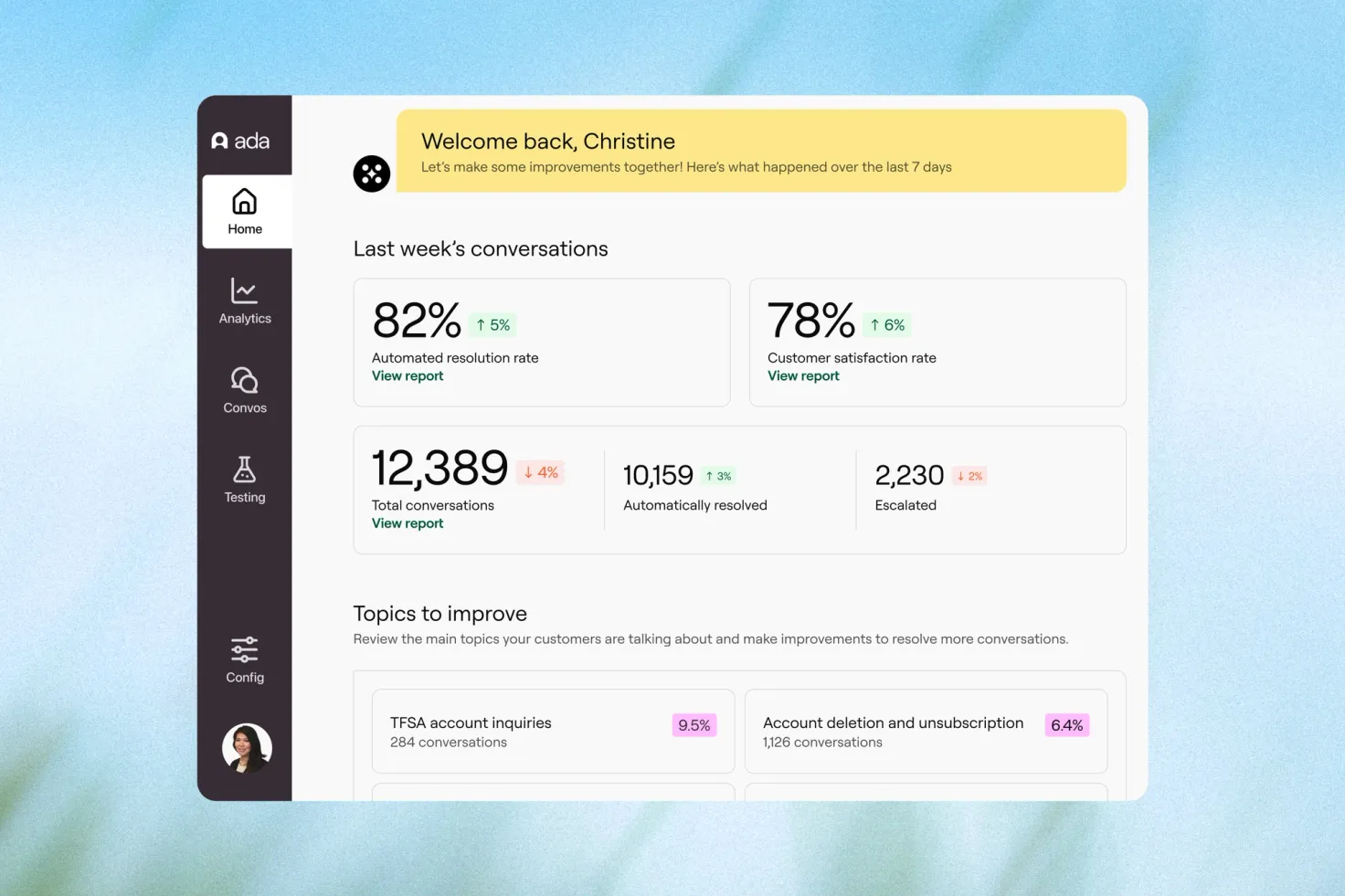
AI’s role in enhancing travel analytics and reporting becomes critical as volume grows. Structured visibility into performance trends allows teams to identify workflow gaps, adjust policies, and connect resolution metrics to business outcomes.
Enterprise evaluation should include how the platform enables ongoing refinement, ownership clarity, and structured performance management.
5. Measurable business impact: Does AI move financial and operational outcomes?
Automation rate alone does not define success. Enterprises evaluate AI impact across four dimensions:
- Cost-to-serve stabilization: Absorbing repeatable interactions before escalation reduces overtime and smooths staffing volatility.
- Customer satisfaction (CSAT): Immediate, policy-aligned resolution during high-stress moments strengthens trust and supports best airline customer service at scale.
- Revenue protection: Consistent enforcement of fare logic minimizes exception-driven leakage.
- Customer lifetime value (CLTV): Contextual loyalty visibility and upgrade eligibility support retention and incremental revenue within policy constraints.
Resolution metrics should connect directly to financial reporting. When performance maps clearly to cost savings, margin protection, and retention, AI becomes embedded in operating strategy.
Enterprise AI initiatives gain internal support when impact is measured in financial, operational, and customer terms.
Choosing AI in travel is choosing an operating model
Selecting an AI customer service platform is ultimately a decision about how your service organization functions under constraint.
The platforms that succeed in travel execute reliably within policy guardrails, operate consistently across channels and regions, and support structured improvement over time. When AI is embedded into the service model—governed, integrated, and measured—it becomes part of the operating foundation of customer experience.
In the travel industry, that foundation determines how effectively your organization absorbs disruption, protects revenue, and delivers consistent service at scale.
Inside Cebu Pacific’s AI customer service strategy
Cebu Pacific partnered with Ada to bring an AI agent into their customer care team, taking another step forward in their innovation journey.
Learn more