

Most enterprises have now deployed AI for customer experience. The question now is whether that AI is actually taking steps to resolve customer issues or simply answering questions.
According to Ada's 2026 Agentic CX Report, only 24% of consumers say an AI agent fully resolved their issue without human involvement. More concerning, 56% say AI couldn't handle the complexity of their request at all.
These aren't customers rejecting AI. They're customers who need action, not information.
That's where many customer service automation programs break down. They can answer questions, surface knowledge articles, and direct customers to the right resources. But when a customer needs a refund processed, a booking changed, an account updated, or a payment issue resolved, the experience often falls back to a human queue.
Resolution is the next frontier of customer service automation, and the companies making the most progress are approaching that challenge differently. Instead of treating AI as a tool for answering questions, they're using it to automate complex customer service workflows, from address changes and payment support to ride closures and travel disruptions.
This post covers how three leading brands are doing it.
Agentic CX in 2026: What consumers expect and most enterprises miss
There’s a common assumption that consumers are skeptical of AI in customer service. The data says otherwise. Our 2026 report surveyed 2,000 consumers to understand how people actually experience AI in customer service today.
Read reportHow companies automate complex customer service workflows with AI
A modern customer service AI agent can do far more than retrieve information. When connected to business systems, an AI agent can understand customer intent, gather the required information, verify eligibility, access backend systems, and complete transactions in real time.
That could mean updating an account, processing a refund, rebooking a trip, generating a return label, modifying an order, or closing a transaction without requiring a human handoff.
The challenge is that customer issues rarely follow a predictable path. A cancellation request may require identity verification, policy checks, eligibility validation, account updates, and payment adjustments before it's resolved. Human agents follow a process to complete those tasks. AI agents need a process too.
That's the role Playbooks serve.
Playbooks are structured workflows that translate customer service SOPs into actions an AI agent can execute autonomously. Rather than scripting every response, a Playbook defines the business outcome, the rules that govern it, and the systems required to complete it.
A typical Playbook might:
- Verify customer identity
- Check eligibility criteria
- Gather missing information
- Trigger backend actions
- Confirm resolution
- Escalate only when necessary
The most effective Playbooks mirror the way experienced CX teams already work. They combine customer context, business rules, and connected systems into repeatable workflows that can scale across thousands of conversations.
The companies seeing the strongest results aren't simply automating answers. They're operationalizing the processes beyond those answers.

Three examples of customer service processes AI can automate end-to-end
Endy: The address change that changed company policy
Every Black Friday, Endy sees a surge of customers who realize their order is heading to the wrong address. For years, a warehouse constraint limited the window in which an address could be modified. Customers who missed it were stuck. If they discovered the error too late, the order shipped anyway.
Endy's address-change Playbook transformed that experience. When a customer reaches out, the AI agent:
- Verifies their identity against Shopify records,
- Confirms whether the order remains within the modification window,
- Collects the updated address, and
- Executes the change directly through Shopify.
The operational impact was obvious. Customers received immediate resolutions during one of the busiest periods of the year. The more interesting outcome came later.
Endy's playbook for multi-brand AI CX at scale
Endy's AI agent automatically resolves customer interactions across messaging and email for three brands, driving lower costs, stronger CSAT, and impact that reaches well beyond customer service. This is the story of how they got there.
Read Endy's storyFor years, the CX team had argued that customers needed more time to correct address mistakes. The warehouse team wasn't convinced. Once the AI agent began processing requests at scale, Endy could see exactly how many customers were attempting to update addresses after the cutoff window had passed.
The data settled the debate.
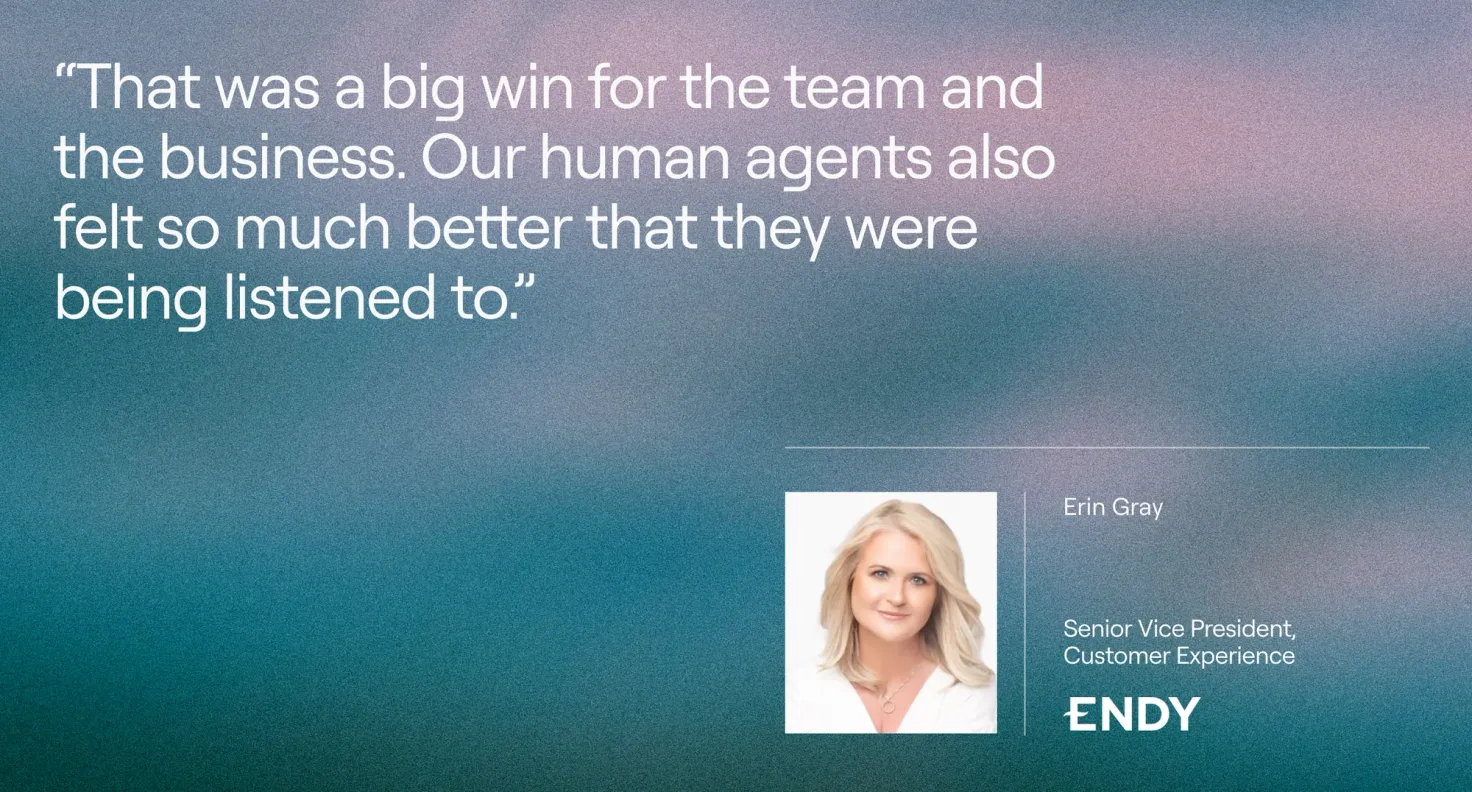
"We had data to show how many were coming in," says Erin Gray, SVP Customer Experience at Endy. "The AI agent processes address change tickets instantly, which demonstrates that the customer needs more time. We were able to double the length of that window."
The Playbook didn't just automate a workflow. It generated the evidence needed to improve the customer experience itself.
Dott: Closing rides when the app can't
For Dott, customer service is part of the product experience. The micromobility company operates across more than 400 cities and handles approximately two million customer contacts every year. Its AI agent runs 25 API-powered automations covering refunds, vehicle checks, and real-time trip management.
One workflow illustrates the value particularly well. When riders finish a trip, the app relies on GPS data to confirm they're in an approved parking zone. Most of the time, that works seamlessly. Sometimes it doesn't.
During a period of satellite disruption in Dubai, vehicles appeared in the wrong location. Riders couldn't end their trips. The meter kept running.
A traditional support queue couldn't solve that problem quickly enough. Dott's AI agent could.
How Dott’s AI-first CX provides instant resolutions on the go
The European micromobility operator went from a 32% to 77% automated resolution rate by treating AI not as a support tool, but as a product requirement.
Read Dott's storyWhen riders contacted customer service, the AI agent identified the issue, determined the required action, and triggered the API call needed to close the ride directly. The interaction took seconds.
Today, Dott has increased automated resolution from 32% to 77%.
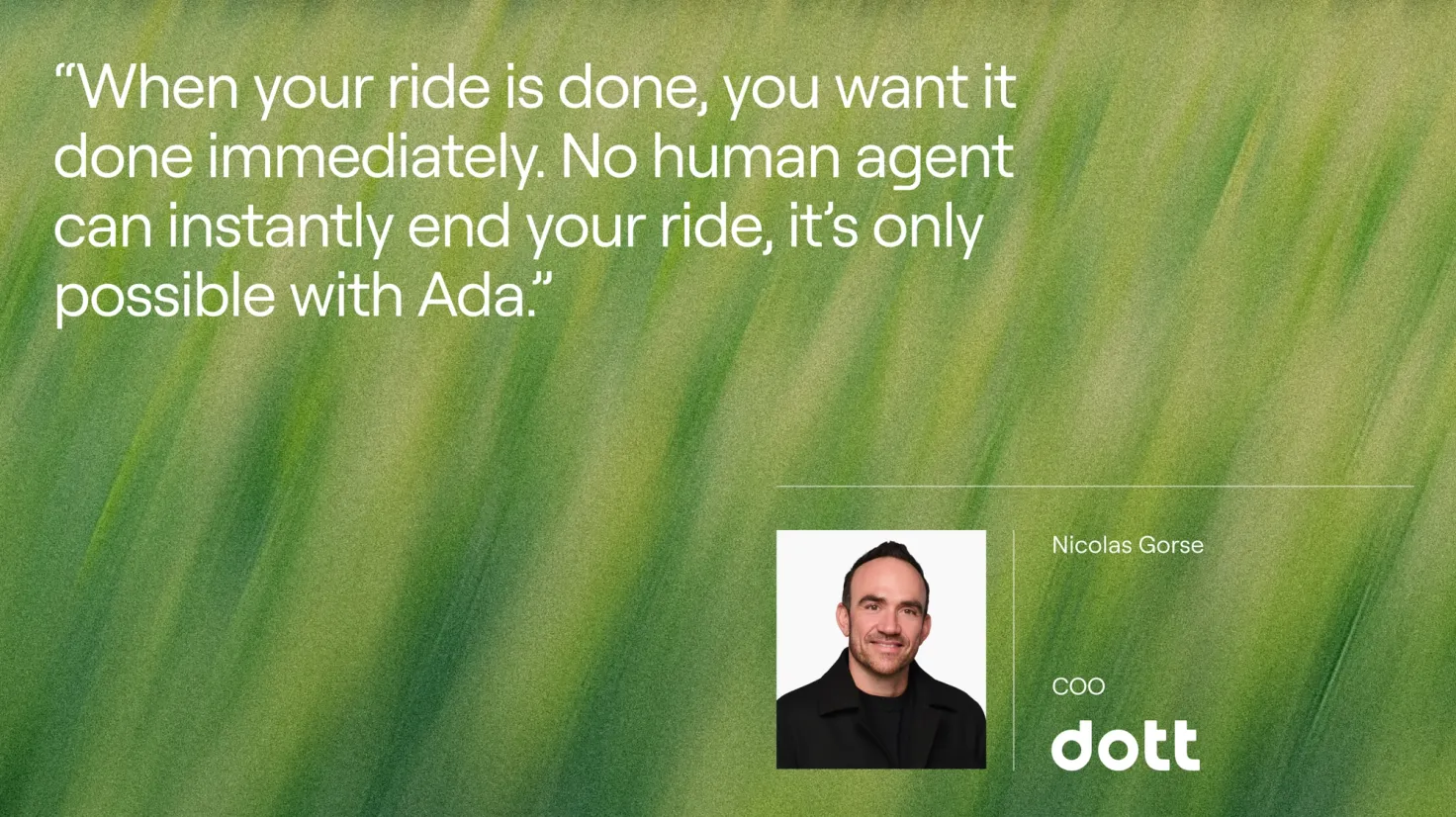
What's notable is that the AI agent isn't acting as a service layer around the product. In many cases, it has become part of the product experience itself, completing actions customers need in real time.
eSky: Boosted CSAT 17 percentage points in five weeks
Travel CX is uniquely complex. Customers contact customer service when flights are delayed, itineraries change, documents need updating, or travel plans suddenly fall apart. Every interaction carries urgency.
For eSky, serving travelers across more than 50 markets means handling some of the most complex customer service workflows in any industry. The turning point came when the team adopted Playbooks.
Within a week, automated resolution increased by 10 percentage points. Over the following weeks, it increased another seven points. AI agent CSAT improved by 19 points during the same period.
What makes the story especially valuable is how the team approaches workflow development.
How eSky scaled AI customer service across brands, channels, and markets
When travelers are stranded at the airport, they don't want scripted responses. They want answers. See how eSky built AI that actually resolves issues, delivering a 17-point jump in automated resolution and 200% ROI.
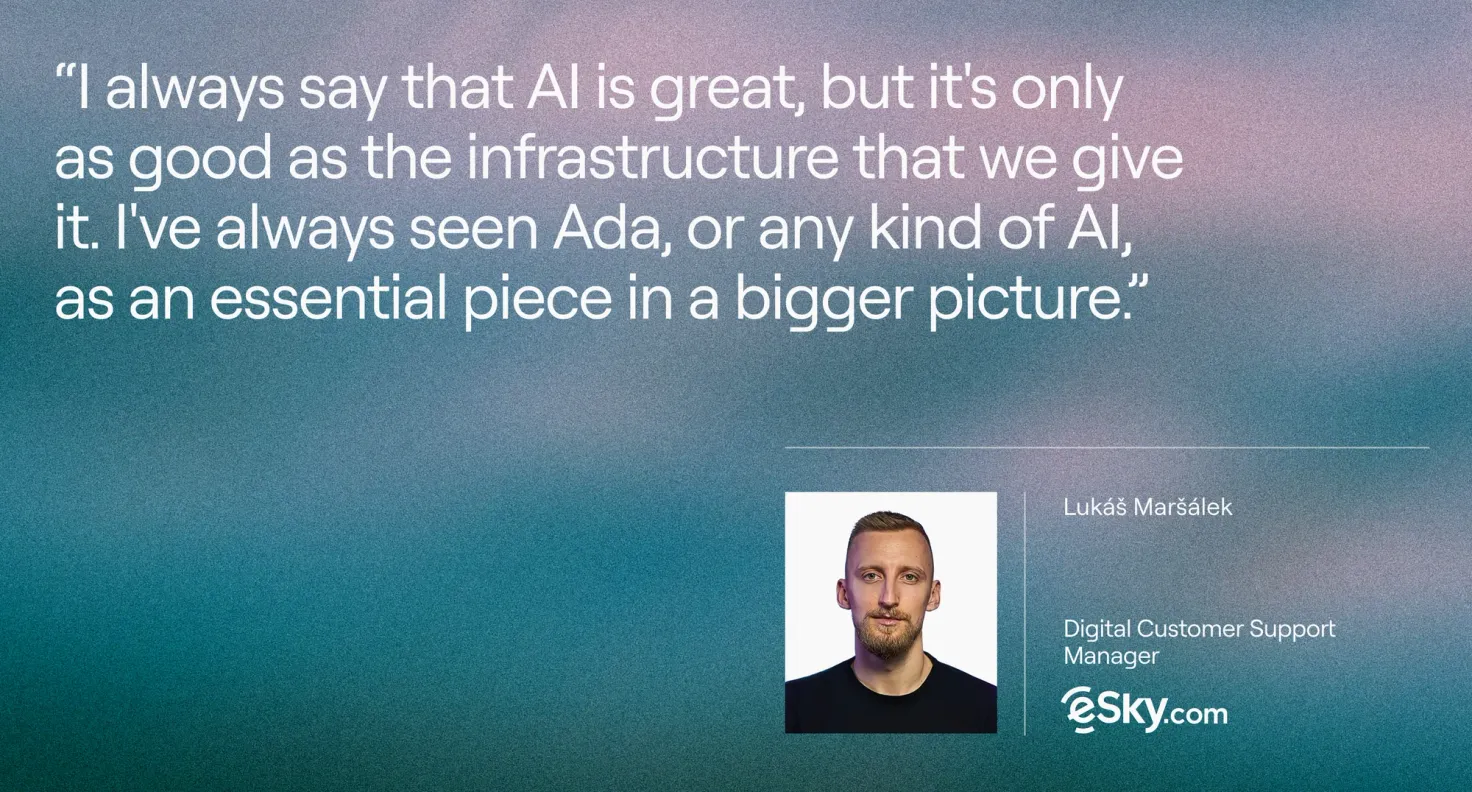
Read eSky's story"Whenever I create a new Playbook, I experiment with it in the sandbox environment and check how it behaves," says Lukáš Maršálek, Digital Customer Support Manager at eSky. "Every time we're launching a big update, I put it in front of other teams and ask them to break it. We iterate almost every day."
The company also uses Playbooks to improve interactions that ultimately require human involvement. Before a handoff occurs, the AI agent gathers intent, verifies details, structures the request, and collects the information a human agent will need. By the time the conversation reaches a person, the groundwork is already done. The result is a better experience for customers and a more efficient workflow for CX teams.
For eSky, Playbooks became more than an automation tool. They became the operating layer that allowed the company to scale AI consistently across brands, channels, markets, and customer journeys.
What leading customer service automation programs have in common
These three companies operate in different industries. They serve different customers, manage different workflows, and measure success in different ways. Yet the pattern is remarkably consistent.
Three characteristics show up across the most successful customer service automation programs:
- Connected systems: AI agents have access to the systems where work actually happens. Customer records, order systems, payment platforms, and operational tools allow them to take action, not just provide information.
- Repeatable workflows: The best Playbooks don't invent new processes. They capture the logic experienced CX teams already use and turn it into scalable, repeatable workflows.
- Continuous improvement: Playbooks are tested, refined, expanded, and measured over time. The strongest programs treat AI agents as an operational capability that requires ongoing management and optimization.
Endy, Tilt, Dott, and eSky each started with a specific workflow: address changes, payment support, ride closures, travel disruptions. But the pattern is bigger than any single process.
Each connected its AI agent to the systems where work happens, translated support expertise into repeatable Playbooks, and built an ongoing practice for testing, improving, and expanding what the AI agent can resolve. That's the shift Ada calls agentic customer experience (ACX), an operating model that brings together technology, methodology, and expertise so businesses can manage AI agents as a core part of how customer experience is delivered.
The companies highlighted here are showing what's possible when customer service automation is designed around outcomes from the start. Customers who needed action got it—in seconds, at scale, without a queue.
Unlock more complex AI resolutions
Browse real examples of AI agents using plain-language instructions to automate multi-step processes with speed and precision.
Explore Playbooks Library