
Dott
- 77%automated resolution rate
- 17 point increasein CSAT
- 400 citiesserviced by the AI agent
- 2M customer contactsper year
No rider left waiting: how Dott’s AI-first CX provides instant resolutions on the go
When you rent a scooter in Rome or Paris or Dubai, you're not thinking about customer support. You're thinking about getting somewhere, on time, without friction. That's Dott's promise: fast, reliable urban mobility across 400+ cities and 20 countries. And when something goes wrong—a GPS glitch, a ride that won't end, a battery that dies mid-journey—the tolerance for waiting is close to zero.
"When your ride is done, you want it to be done. Not in five minutes, not in thirty seconds, immediately," says Nicolas Gorse, COO of Dott, who has been with the company for seven years. That expectation makes world-class customer service a product requirement. And it's why Dott has built one of the most sophisticated Agentic Customer Experience (ACX) operations in its category.
From 6 hours to 3 seconds
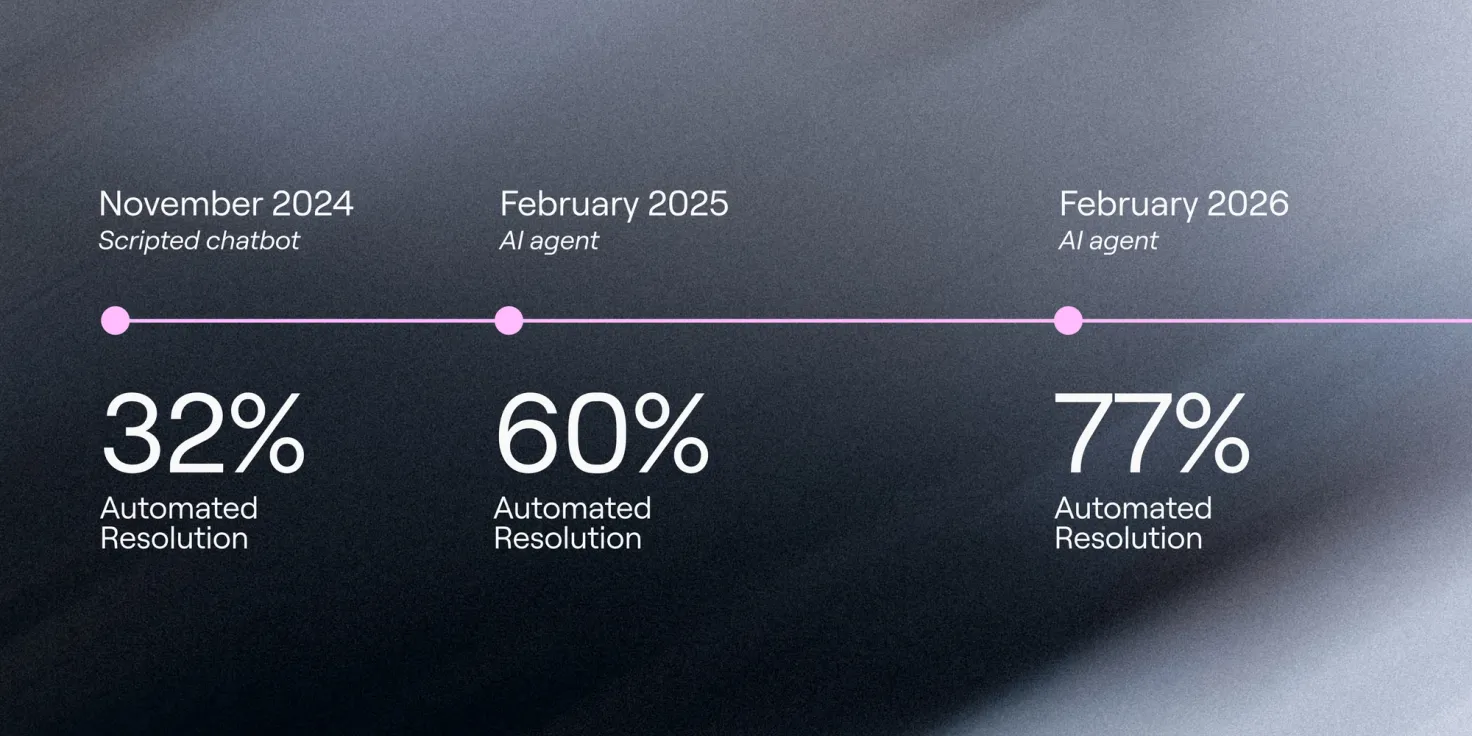
In 2019, when Nicolas joined as General Manager for France, Dott’s first response time target was 80% of tickets resolved within six hours. To manage volume, Dott launched a scripted chatbot that automated just over 30% of ticket resolutions, leaving the rest for human agents, with roughly half the team outsourced. The team now running Dott's ACX operation were managing tickets back then.
The model worked, until it didn't. Customer expectations moved faster than chatbots could handle, and what felt ambitious became inadequate. "Six hours in 2026 is absolutely unacceptable," Nicolas says. "Now it's less than three seconds."
In November 2024, Dott launched an Ada-powered AI agent. By February, automated resolution had jumped from 32% to 62%. The difference was context: where the scripted bot followed a decision tree, the AI understood what a rider was actually asking, in any language, and responded accordingly.
By 2026, that number had climbed to 77%, driven by 25 API-powered automations connecting Ada directly to Dott's backend—handling refunds, vehicle checks, and real-time trip management without escalation.
Dott receives approximately 2 million contacts a year. The internal team that once cleared a ticket queue now manages the AI agent and the ACX program: knowledge architecture, quality improvement, and embedding the support experience into the product itself.
This shift in how the team works mirrors a broader change happening across Dott. What started as an ACX transformation initiative has become a template for how the whole company thinks about AI. And the CX team, having gotten there first, is now focused on what's next.
"Every day, my colleagues are innovating with AI. CX was the pioneer at Dott. Now everyone is catching up."


When the app can't, Ada can
The clearest proof that Dott's AI agent is a product feature—not just a support layer—is the end-ride workflow.
Micromobility runs on GPS. When a rider tries to end their trip, the app checks their location against a map of authorized zones. Usually, it works, but GPS is imperfect, and the connection between a scooter and the platform isn't always reliable. In Dubai, for example, during a period of significant disruption, satellite positioning was unreliable enough that vehicles registered in locations they weren't, and rides couldn't close.
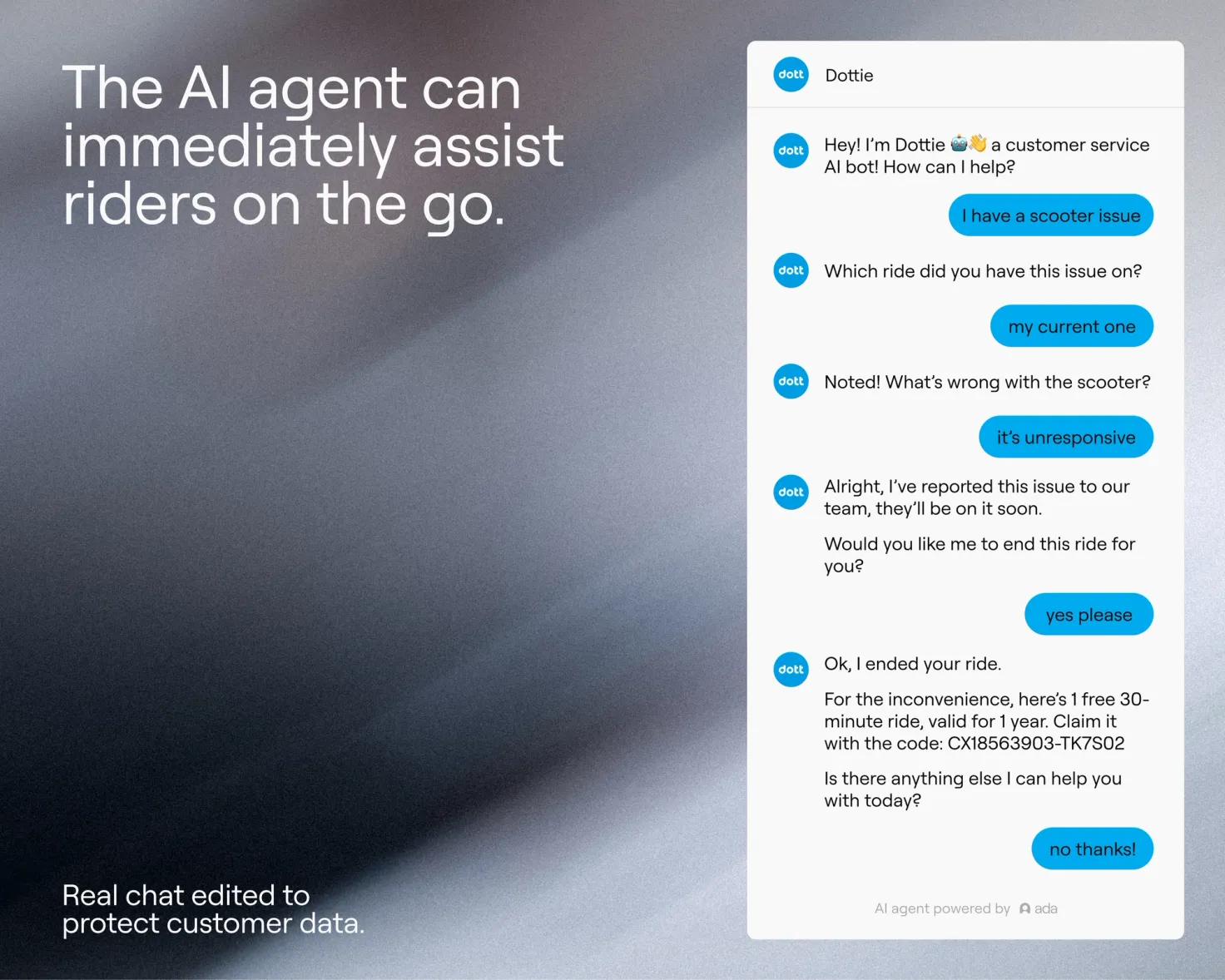
A human agent working a ticket queue can't fix that in real time. But Ada can. When a rider contacts support and is unable to end their trip, the AI agent interprets the request in any language, determines what's needed, and triggers the API call to close the ride directly. The rider is free to go. The interaction takes seconds.
This wasn’t a workaround, but a strategic design decision. "That's only possible with this system," Nicolas says. "No human can instantly end your ride."
By connecting Ada directly to Dott's internal systems, the AI agent can take action, not just provide information. The same logic runs across all 25 automations: Ada handles refunds, vehicle issue checks, and real-time trip management by pulling what it needs from the backend and resolving without escalation.
"When your ride is done, you want it done immediately. No human agent can instantly end your ride, it’s only possible with Ada."

From noise to precision diagnosis with MCP
For a long time, improving CX meant manually reading customer conversations to uncover insights and opportunities. The Dott team could review around 50 per day—a drop in the bucket when you're handling thousands of contacts daily. They knew CSAT was lower than it should be. They had hunches about why. But they couldn't prove any of them.
"Reviewing conversations to identify issues at scale now feels like the past," Nicolas says. "We just knew we had a problem, and we were blaming it on the vehicle, the experience, the bot, without being able to really pinpoint where it was coming from. We were struggling to distinguish the noise from the true symptoms."
MCP changed that. While MCP connects Ada to Dott's broader data ecosystem and AI tools, the more significant shift was what it unlocked on top of the agentic automation already in place: quality at scale. Where the team could review 50 conversations manually, they can now analyze 1,000, with AI surfacing patterns, flagging inconsistencies, and separating signal from noise. The statistical significance that was impossible with manual review became achievable. The AI agent handled the volume and MCP made it possible to continuously improve what it was doing.
The precision revealed something counterintuitive: most problems weren't what they appeared to be. In one market, a surge in refund requests turned out to be a pricing issue. Riders weren't using their allotted minutes before the expiry date, so the fix was moving the expiration date, not improving the refund flow.
In another case, the AI agent appeared to be struggling with a specific topic. Deeper diagnosis revealed that certain knowledge articles were contradicting each other, sending riders into loops. Without the ability to review conversations at scale, that contradiction would have been nearly impossible to catch. A human reviewer would have had to stumble onto exactly the right conversation at exactly the right time.
Precise problems, faster solutions
That level of diagnostic clarity has changed how the team works with Engineering. Before, identifying a problem required enough anecdotal evidence to justify a roadmap conversation, and even then, the request was often too vague to scope cleanly. A support issue would arrive in Engineering as something broad ("we have a problem with refunds") which would trigger discovery, alignment meetings, and two to three sprints before anything shipped. Because the problem wasn't fully understood going in, the solution often needed rework on the way out.
Now, the team arrives at Engineering with a specific, evidence-backed diagnosis: which market, which flow, which edge case, how often it's happening. That precision does two things:
- It compresses the time from problem to fix; a well-scoped request moves through engineering in a fraction of the time.
- It helps the team triage more accurately: some issues that would previously have gone to Engineering can be resolved directly through coaching or knowledge updates, without any development work at all.
The result is a CX organization that spends Engineering time on things that actually warrant it, moves faster on everything else, and wastes very little on fixes that address the wrong problem.
Nicolas is unequivocal: generative AI was the first industry breakthrough. MCP is the second. Together, they changed what it means to run a high-quality ACX operation.
"Gen AI was the first massive breakthrough for CX, and MCP is the second. MCP is quality at scale, in a fraction of the time any human review could achieve."

What comes next
At 91% containment, the automation question has largely been answered. The next challenge is tougher: shifting from faster responses to proactive customer service.
Dott already has the data signals to know when something has gone wrong. The next step is using those signals to proactively reach out first, with an apology and a resolution already in hand, before the rider ever contacts support.
"The dream is that we get your answer before you raise the question," Nicolas says.
He sees this as the next chapter of the partnership with Ada, built on a consistent alignment of values. As one of Ada's most mature implementations, Dott is pushing the boundaries of what's possible, and their ambition is feeding into what Ada builds next—making the relationship less customer-vendor and more collaborative.
"Every conversation starts with the user, not the technology. On that, we are very aligned."