eSky
- 17-point increasein automated resolution rate in four months
- 200%ROI
- 3 channelslive with one AI agent strategy
- 3 distinct brandsmanaged by one team
From point solution to operating model: How eSky scaled AI customer service across brands, channels, and markets
eSky is a leading online travel agency offering flights, hotels, and Flight+Hotel packages (Holidays and City Break), as well as a wide range of ancillary products such as travel insurance, car rentals, transfers, and others. Operating across multiple brands and markets, eSky combines advanced technology with Tourist Guarantee Fund protection to deliver comprehensive, reliable, end-to-end travel booking.
For a travel enterprise operating across more than 50 markets, customer support rarely happens in calm moments. It happens when travelers are under pressure, at the airport, or trying to salvage a trip they have planned for months. And during irregular operations (IROPs)—flight cancellations, diversions, missed connections—contact volumes can spike dramatically within minutes, making it nearly impossible for human agents alone to keep up.
To better support their customers, eSky needed more than automation that simply deflects tickets instead of resolving them. They also needed a better operating model for customer experience: one that could improve service quality, lower cost-to-serve, and scale across the channels customers already use.
Transitioning from flow-based chat to AI customer service
Lukáš Maršálek joined eSky Group as the Digital Customer Support Manager to explore opportunities to that end. “I’ve built a flow-based chat before, and when I joined eSky, I built a flow-based chat again,” Lukáš reflected. “But the experience with flow-based ‘chatbots’ is the same across the board: customers would look for the quickest way to get to a human rather than believing that the chatbot can actually solve their problem.”
At the time, it had become common practice to stand up a flow-based chatbot to manage inquiry volumes by deflecting tickets. “You’re basically trying to manage volume spike and hoping that helps,” he explained. But neither Lukáš nor eSky was satisfied with the status quo. “As an organization, we had to start believing that things can be different. So we decided to go for a proof of concept with Ada.”
Less than a year later, eSky has AI agents delivering personalized customer experiences across three distinct brands (eSky, Thomas Cook and eDestinos), on multiple channels, in multiple languages, markets, and time zones. They have also meaningfully operationalized AI within the organization such that it is connecting siloed efforts, surfacing workflow improvements, and delivering against business goals.
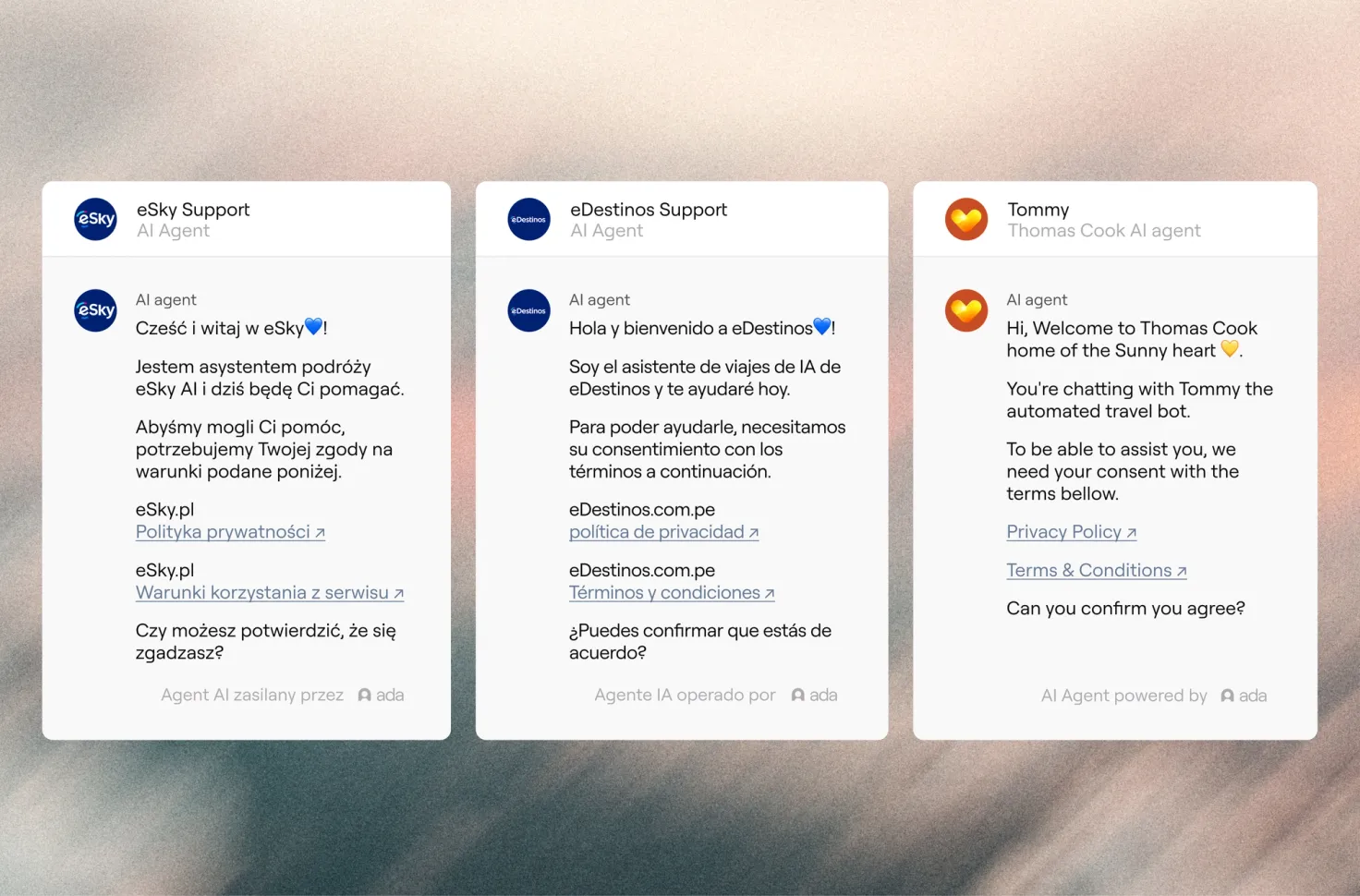
“The moment where we started to believe that we can actually resolve inquiries automatically was a game changer,” Lukáš noted, beaming. “Ada has been a huge contributor to my mission so far. Less than a year ago we were running a proof of concept. Today we're live across three brands, three channels, and dozens of markets. I'm having the best time and we're just getting started."
AI customer service: from point solution to operating model
eSky’s success wouldn’t have been as transformative without Lukáš’s game-changing perspective on AI.
When Lukáš first said his goal was to improve customer experience while reducing costs, people saw a contradiction. Now, they hear “AI” and assume that’s the answer.
“Sometimes it seems like businesses have gone from ‘this is impossible’ to ‘AI will solve everything,’” he said. “And in doing that, they’re overlooking other opportunities for leverage.”
For eSky, the shift wasn't about simply adopting AI. It was a company-wide commitment—backed at the highest level—to rethinking how customer experience is delivered. That meant being deliberate about the approach: AI only delivers real impact when it's applied across the full customer experience, alongside the right systems, processes, and integrations, and when the whole organisation is aligned behind it.
This mindset also put their support team at ease. Lukáš built that confidence by showing—not telling—what AI could take off their plate. By demoing how the AI agent handles repetitive, manual tasks like updating passport details, he made it clear that automation wasn’t about replacement, it was about focus.
As a result, human support agents can spend less time on routine work and more time on complex, meaningful requests. It not only improves the quality of support, but helps prevent burnout in a high-pressure environment.
“AI is not here to take our jobs,” Lukáš said. “It’s here to enhance what we can do, and enhance the customer experience.”
“I always say that AI is great, but it's only as good as the infrastructure that we give it. I've always seen Ada, or any kind of AI, as an essential piece in a bigger picture.”


Growing confidently with operational excellence
With that guiding principle in mind, the eSky team made decisions that considered the entirety of the customer experience, looping in cross-functional collaborators as needed.
Three brands, one team, one platform
The eSky Group operates across multiple brands—eSky, eDestinos, and Thomas Cook—each serving distinct customers with different expectations. Behind it all is a lean team managing the entire operation. So how do they deliver personalized experiences at that scale? They start by simplifying what can be simplified.
eSky centralizes its knowledge base in a single language, English. This keeps content easy to maintain, while Ada’s multilingual capabilities translate each experience in real time based on customer preference. As the team puts it, “we just flip the language, and Ada does the job.”
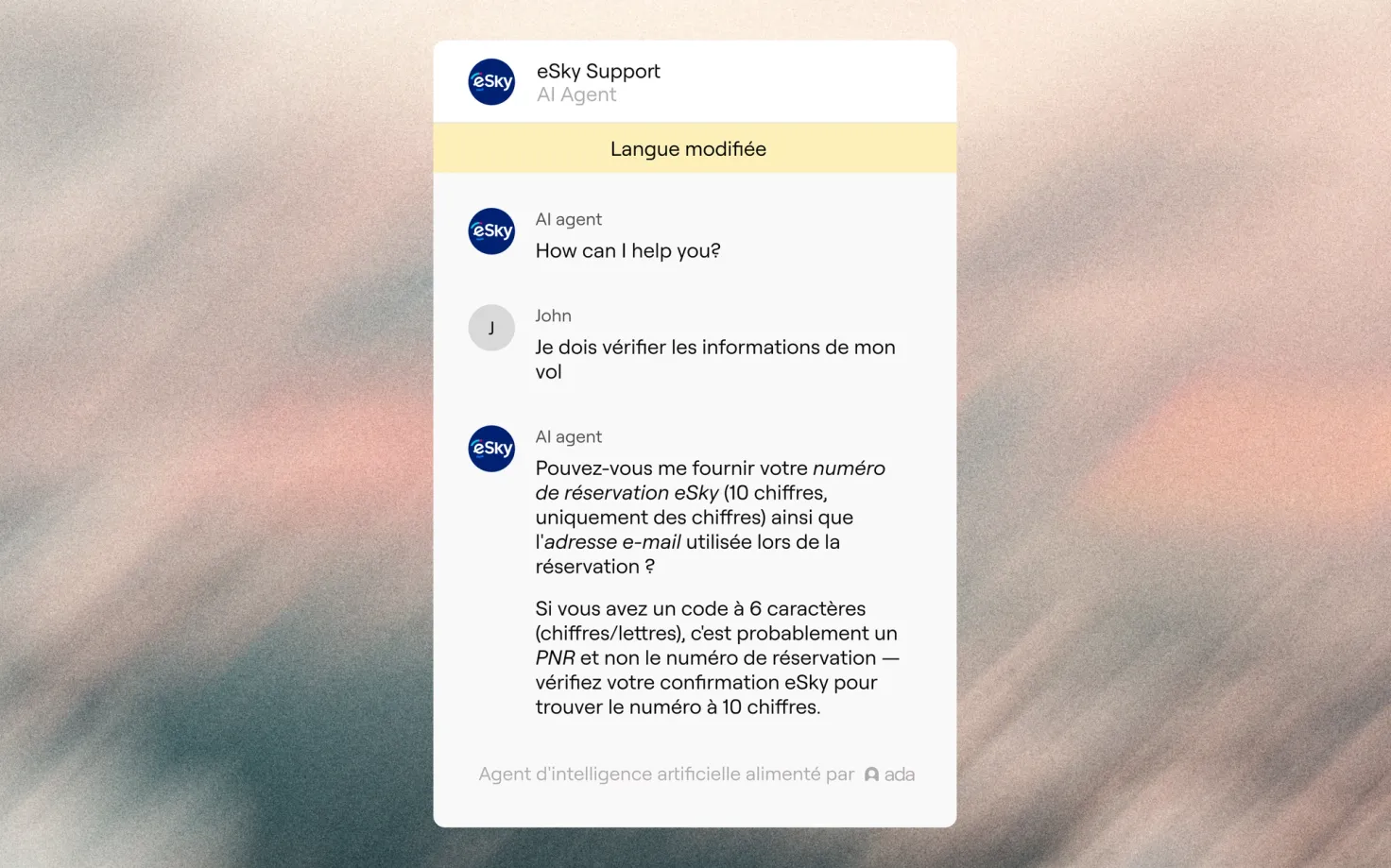
Where personalization matters most, they add control. Instead of forcing a single AI agent to serve every audience, eSky runs a dedicated AI agent for each brand. That decision allows each experience to reflect the nuances of its market without compromise. And it doesn’t add operational overhead. With Ada, all three AI agents are managed from a single platform, with a unified view of performance across brands.
WhatsApp: Meeting customers on their preferred channel
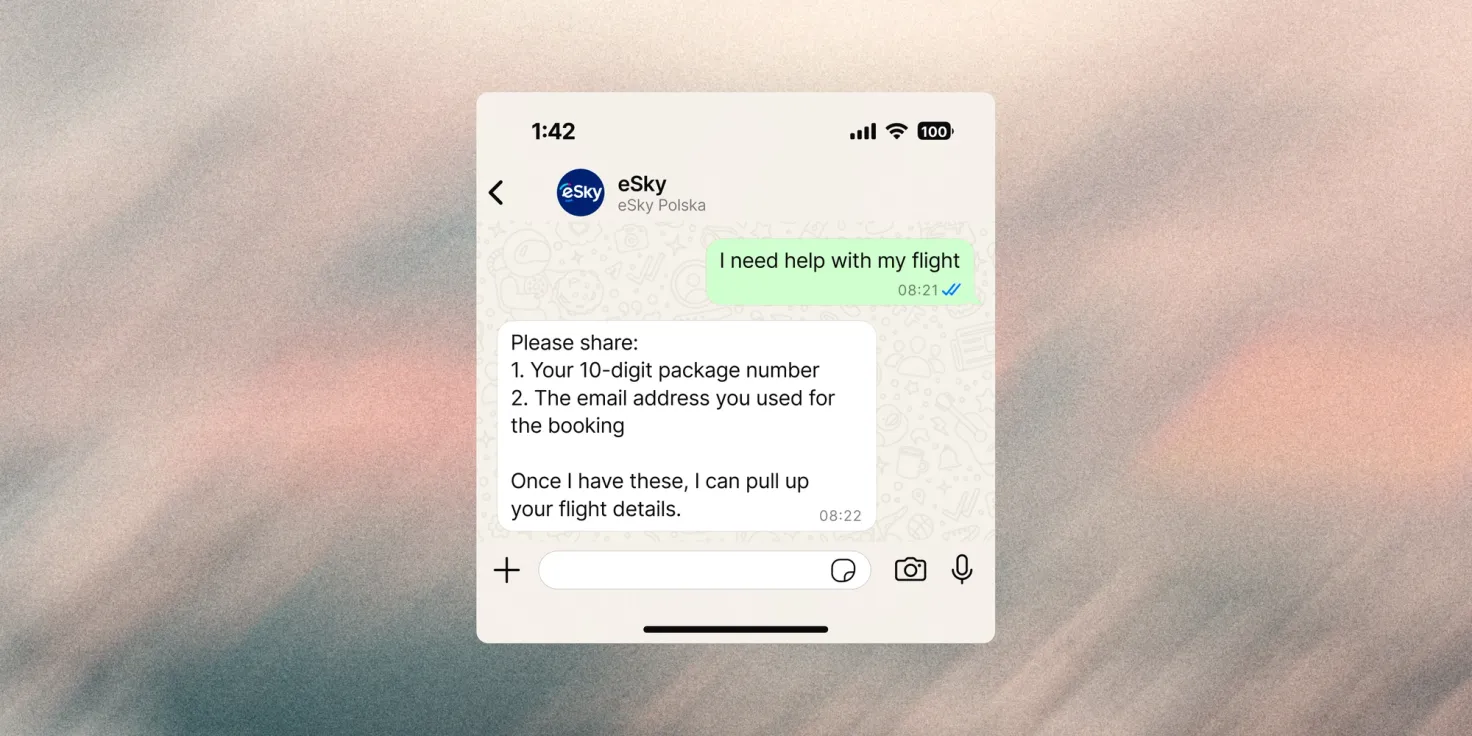
After seeing strong results on web chat, the next step was clear: expand to the channels customers already use. “When we were thinking about a customer that's in distress—they're at the airport, they need urgent support—they’re usually most comfortable with picking up the tool that they normally use for communication,” Lukáš explained. For eSky, that’s WhatsApp.
And it makes sense. WhatsApp is a familiar channel for eSky’s European and Latin American customer base, offering a persistent thread that anxious travelers can return to, revisit, and rely on. It was also a natural extension of how eSky already operates. The team has always focused on chat as a format, not just a channel, and WhatsApp mirrors a similar conversational dynamic.
So the approach was simple: meet customers there, launch the channel, and see how it performs. The team’s bet was a winning one. Customers adopted the channel quickly.
Messenger: Using AI to build a bridge between CX and Marketing
Another chat-based channel that the team was looking to expand to was Messenger, but it presented an unexpected challenge: Marketing.
As part of the Meta ecosystem, Messenger typically falls under the mandate of the Marketing team who use it to engage with their audience. But it’s also a channel that customers often use to reach out to businesses with their issues. “Messenger is an interesting one that I see businesses struggle with because it’s kind of a mixed bag,” Lukáš reflected. “It's a channel where you get engagement from your social posts and also one where customers go to contact you.”
The team knew this was exactly the kind of operational advantage that AI brings to the table. Lukáš approached the Marketing team with a solution: using an AI agent to automatically recognize and resolve customer inquiries, or triage them right to the support team if necessary, and Marketing can still retain full ownership of the channel.
“I showed them what we do on web chat and WhatsApp, and said we could set something similar up on Messenger. They were pretty excited about it,” he said. “It’s perfect because we can handle all kinds of queries under one roof, and it’s all orchestrated automatically.”
“Our AI agent is universal. It can behave like a marketing team member. It can behave like a customer support agent. You don't get that in a human, usually.”

Using AI to guide decision making
Lukáš and his team also use AI to expose operational gaps across the business. “AI magnifies any kind of disconnect,” he explained. Some human-only CX teams face a structural challenge: they may not be aware of knowledge gaps because human agents tend to fill them in conversations with customers. On the other hand, AI will stick to knowledge resources fully and reveal any gaps instantaneously.
“We can see everything. We can see where the points of failure are because they always are manifested in the communication channel,” Lukas said.
By plugging Ada into their enterprise AI infrastructure via Ada's MCP Server, the team can quickly surface the areas that need their attention most. By combining AI, analytics, and manual efforts, they identify improvement opportunities and pinpoint root causes for issues.
“The customers are very straightforward in their feedback and what they think about our service. It enables us to connect with different teams across organizations, prioritize based on impact, and contribute to improving other aspects of the business.”

Redefining success beyond containment
eSky has always been deeply invested in CX, and AI promised real cost savings while delivering even better experiences. The challenge was making sure they measured what actually mattered.
Traditionally, containment rate was a primary focus, but that only tells you how many conversations were deflected, not how many were resolved. It’s not an accurate reflection of the AI agent’s performance.
“I open executive conversations with this,” Lukáš mused, “If you ask me for a 100% containment rate, I can make it happen tomorrow. But it’ll come at the cost of customer experience.”
Instead, Lukáš focuses on automated resolution as his team’s North Star, prioritizing it over scripted empathy. “I'm a big believer in focusing on the solution. If you had a problem and the person helping you wasn't particularly warm but solved it completely, you'd probably prefer that to someone delightful who couldn't. The good news is we don't have to choose. By design, our AI can be both. We focus on getting you to the holiday you've been saving for, and we do our best to reassure you on the way."
In addition to automated resolution, Lukáš shares KPIs such as:
- Post-support customer feedback, separated by AI only, human only, and AI-human hybrid
- What use cases the AI agents could and couldn’t resolve
- The difference between CSAT on all the above
This level of granularity is exactly what’s needed for eSky to know what investments are worth their time.
Shaping the experience before and during handoff
For eSky, improving customer experience doesn’t start at resolution, it starts the moment a conversation begins.
One key insight was how much the pre-handoff experience influences outcomes. If a customer has a frustrating interaction before reaching a human agent, that frustration carries through. “By the time they get connected, the experience is already shaped,” Lukáš explained.
That’s where the AI agent plays a critical role.
As customers engage, the AI agent works in real time to clarify intent, gather the right details, and structure the request using the right knowledge and Playbooks. Even in cases where full resolution isn’t possible, the interaction sets a strong first impression grounded in clarity, speed, and guidance.
The result is a smoother, more effective handoff.
Instead of starting from scratch, human agents receive a complete, structured request and can immediately focus on resolution. That shift not only reduces average handle time, but improves the overall experience whether the AI agent resolves the issue end-to-end or works in tandem with a human agent.
The team behind the transformation
There’s no doubt about it, Lukáš is an innovative fast-mover and an agent of change. Under his guidance, eSky was able to quickly deploy, scale, and mature their AI customer experience, and are reaping the rewards. But if you ask him, it wouldn’t have been possible without the support of the executive team, Ada’s ACX Experts, and the right platform.
Executive sponsorship goes a long way
When Lukáš proposed the idea of AI customer service, eSky Group COO and VP Piotr Woś was immediately on board. He saw the potential, championed Ada to the board, and secured the budget.
After the early success, the rest of the executive team was convinced, and Piotr’s support has only increased. That momentum wasn’t just about the technology, it was a reflection of Lukáš and team’s work. As he puts it, “they believe that if they give CX more resources, we’re going to make more positive things happen, and I recognize the responsibility that comes with this trust.”
Close collaboration with Ada Experts
Whether by making work more agile or providing expert guidance, Lukáš had a lot to say about his partnership with the Ada team, particularly Omar Owaini and Emillee Hernandez.
Omar is their main point of contact, helping the eSky team maximize the value they get from AI customer service. “Having a responsive, capable, and competent customer success manager has been a really big part of our success with Ada,” Lukáš commented. “I can rely on him to help when I need it. He provides all the resources and guidance we need, and that's part of why we are able to learn so quickly. We have enough information and guidance to be confident in what we’re doing. Our customer success manager has been a key player in our transformation.”
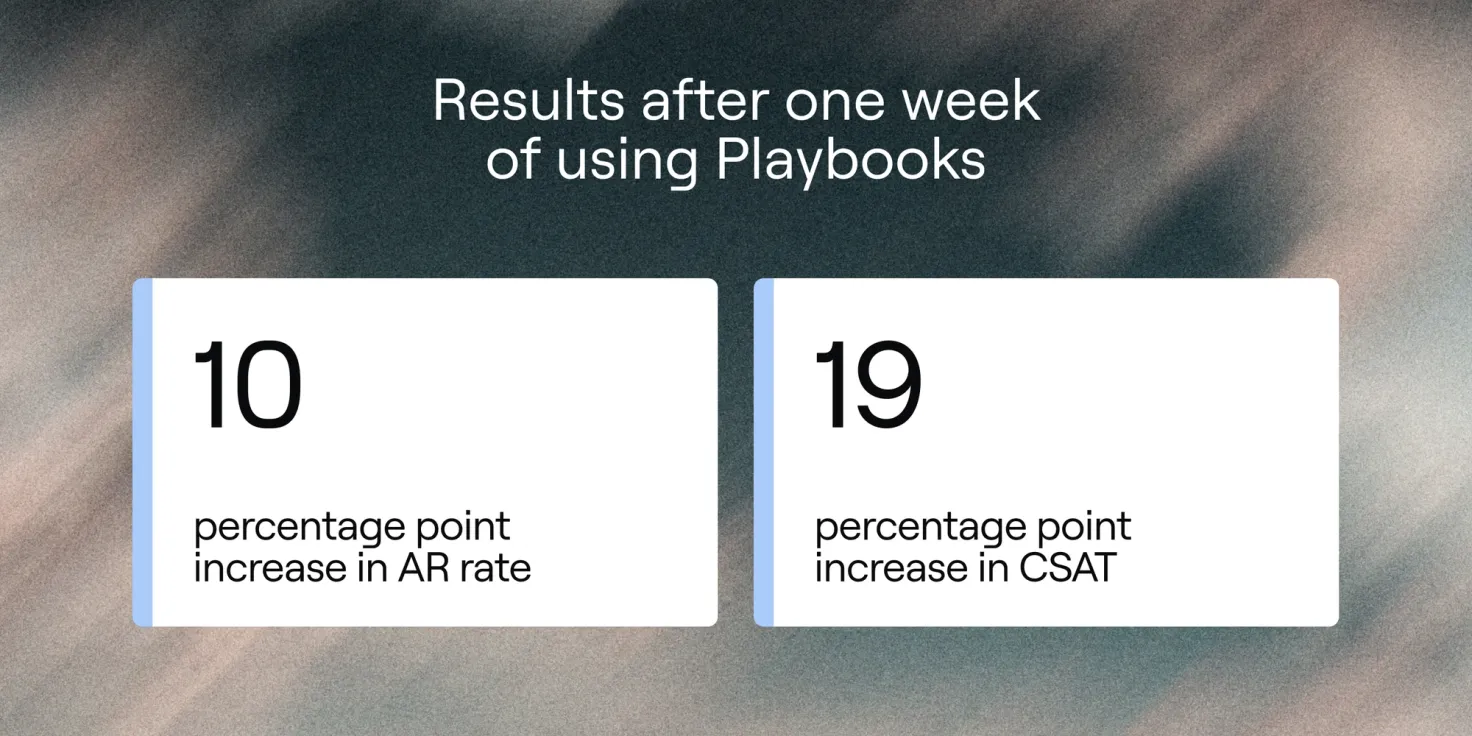
One of Omar's most impactful contributions was his early advocacy for Playbooks. He could see the potential, while Lukáš took a measured approach before committing—and when eSky made the switch, the numbers told the story. In a single week, automated resolution jumped by 10 percentage points, and has since climbed an additional seven percentage points. AI agent CSAT went up by 19 percentage points in that same window.
As a company headquartered in Poland, Lukáš also appreciates that Ada has full time staff in Europe. He noted, “whenever I have an urgent problem and it's the morning here, I reach out to Emillee and she's always ready to help.”
“Everybody that I've been introduced to at Ada has been helpful and capable, so we are having a great experience. We're able to grow, and we always have somebody to ask questions and guide us through the process.”

A platform, not a black box
Of course, as good as the team is, Lukáš didn’t want to depend on them for everything. It was important to him that the platform can be used by his non-technical team, and he found that with Ada.
This agency allows him to move fast and collaborate with almost anyone across the business. He described creating Playbooks to illustrate his point.
“Whenever I create a new Playbook, I experiment with it in the sandbox environment and check how it behaves—this is all very intuitive. And every time that we’re launching a big update, I put it in front of other teams and ask them to break it. And they do, which is great, because then we fix it, and on and on until they can’t break it anymore. We’re quite vigorous about this and we iterate almost every day.”
And when they do require developer assistance, they are able to articulate ROI on the resources needed, and get their tickets prioritized better by Engineering.
"You can have a great team supporting you, but if the platform isn't performing, you may start looking elsewhere. With Ada, we have both: a platform that delivers and a team that's heavily invested in our success. I'm happy with where we're at."

Looking forward
With the success of AI on messaging channels, the eSky team is ready for the next big challenge: Voice.
“For me, personally, I'm just getting started,” Lukáš said. “The results that we have are already great, but I want to do better, and I’m confident that we can. I'm looking forward to it.”