

In customer service, teams have never had more data at their fingertips, or less clarity about what to do with it.
Your AI customer service agent is resolving thousands of conversations every week. You’re watching metrics like CSAT, automated resolution, and escalation rates. But when something changes—CSAT drops, resolution dips, or handoffs spike—there’s still one question you can’t easily answer: why?
To get that answer today, most teams have to stitch together data from dashboards, BI tools, exports, and transcripts, and then hope someone has the time and expertise to interpret it. It’s manual. It’s slow. And it’s reactive.
In short, we’ve outgrown the dashboard era.
Enter conversational analytics, a faster, more intuitive way to explore AI agent performance and customer experience health. Instead of clicking through static reports, you ask questions in natural language. And your data talks back.
This post explores what conversational analytics is, why it matters now, and how Ada’s new MCP Server is making it a reality for CX teams everywhere.
Why dashboards aren’t enough anymore
Dashboards do their job: they surface metrics. But for modern, AI-powered CX teams, that’s only half the story.
Here’s what dashboards miss:
- Root cause visibility: Dashboards can show you a drop in CSAT, but they can’t explain that the drop was driven by a recent update to your onboarding flow, which confused new users and triggered more escalations.
- Cross-functional accessibility: Most dashboards live inside analytics tools. But your product team, your marketing team, and even your executive team need insights too. When only analysts can pull the right data, the rest of the organization is flying blind.
- Iteration speed: Diagnosing performance issues often takes days. In the meantime, your AI agent continues to operate with the same blind spots.
As your AI customer service agent handles more conversations on the front line of your customer service, your visibility into its performance needs to evolve, too.
When visibility breaks down, so does improvement. That’s why more CX teams are turning to conversational analytics.
What is conversational analytics for customer service?
Conversational analytics enables the ability to explore and analyze customer service performance data using natural language. As a form of conversational AI analytics, it helps teams ask real questions and get actionable answers, without the need for dashboards, filters, or code.
You simply ask:
- “What’s our CSAT trend over the past 7 days?”
- “Why did the AI agent escalate more conversations this week?”
- “What knowledge gaps are contributing to low resolution rates?”
You ask a question, and get back the insights you need, pulled from live conversations, transcripts, and performance metrics.
This makes it easier to understand not just what changed, but why, and most importantly, what to do next.
How conversational analytics improves customer experience performance
Conversational analytics helps CX teams respond faster, translating questions into improvements in minutes, not weeks. That speed drives measurable improvements in CX automation performance, resolution, and experience.
Here’s how teams are using it to drive faster decisions and better outcomes across the customer journey:
- Find the “why” behind CSAT and resolution drops. No more waiting on analysts or manually combing through transcripts. When something changes, just ask, and get answers tied to real interactions and outcomes.
- Spot issues before they affect CX. By exploring performance trends in natural language, teams can proactively uncover low-performing intents, content gaps, or coaching issues before they escalate.
- Optimize your knowledge base at scale. Understand which articles are being used, where customers are still getting stuck, and what updates will improve resolution rates across channels.
- Make customer insights accessible across your organization. Because insights are accessible through simple questions, teams across the business—product, marketing, leadership—can explore the same data as CX, without needing new tools or training.

What customer service teams can do with conversational analytics
The power of conversational analytics isn’t just in the data. It’s in how it enables better decisions across every team that touches the customer experience.
AI Managers
- Diagnose performance issues without reviewing hundreds of transcripts
- Identify optimization opportunities with clear, contextual evidence
- Iterate on flows, coaching, and knowledge in real time
Product Managers
- Discover how customers describe product issues in their own words
- Validate roadmap decisions with real-world conversation data
- Uncover feature requests and friction points hidden in transcripts
Executives and CX Leaders
- Get a high-level view of customer experience health
- See the impact of your AI agent on business goals
- Align CX performance with broader company strategy
Across all these roles, the shift is clear: teams aren’t just tracking data. They’re working with it—conversationally, intuitively, and with clarity.

Why conversational analytics is a strategic advantage
This isn’t just about making data easier to access. It’s about redefining how your organization engages with AI customer service.
Conversational analytics reflects a broader shift, from treating AI customer service agents as isolated automation tools to managing them as integrated, high-performing employees. Employees who generate insights, influence decisions, and require continuous improvement.
With the right conversational analytics capabilities, organizations can:
- Align CX operations with strategic business goals
- Drive faster, insight-led improvements
- Break down silos between service, product, and leadership
- Empower teams to work smarter—not harder—with AI
How Ada brings conversational analytics to life
To make conversational analytics real, accessible, and enterprise-ready, Ada built the MCP Server: a secure, scalable way to explore your AI agent’s performance data using natural language.
Instead of navigating dashboards or exporting reports, your team can ask questions inside the tools they already use—like ChatGPT, Claude, or Microsoft Copilot—and get answers grounded in real Ada data.
Powered by the open-standard Model Context Protocol (MCP), Ada's MCP Server responds in real time with structured, permissioned data: CSAT trends, conversation summaries, unresolved intents, knowledge usage, and more.

Here’s what that unlocks.
Ask performance questions, instantly
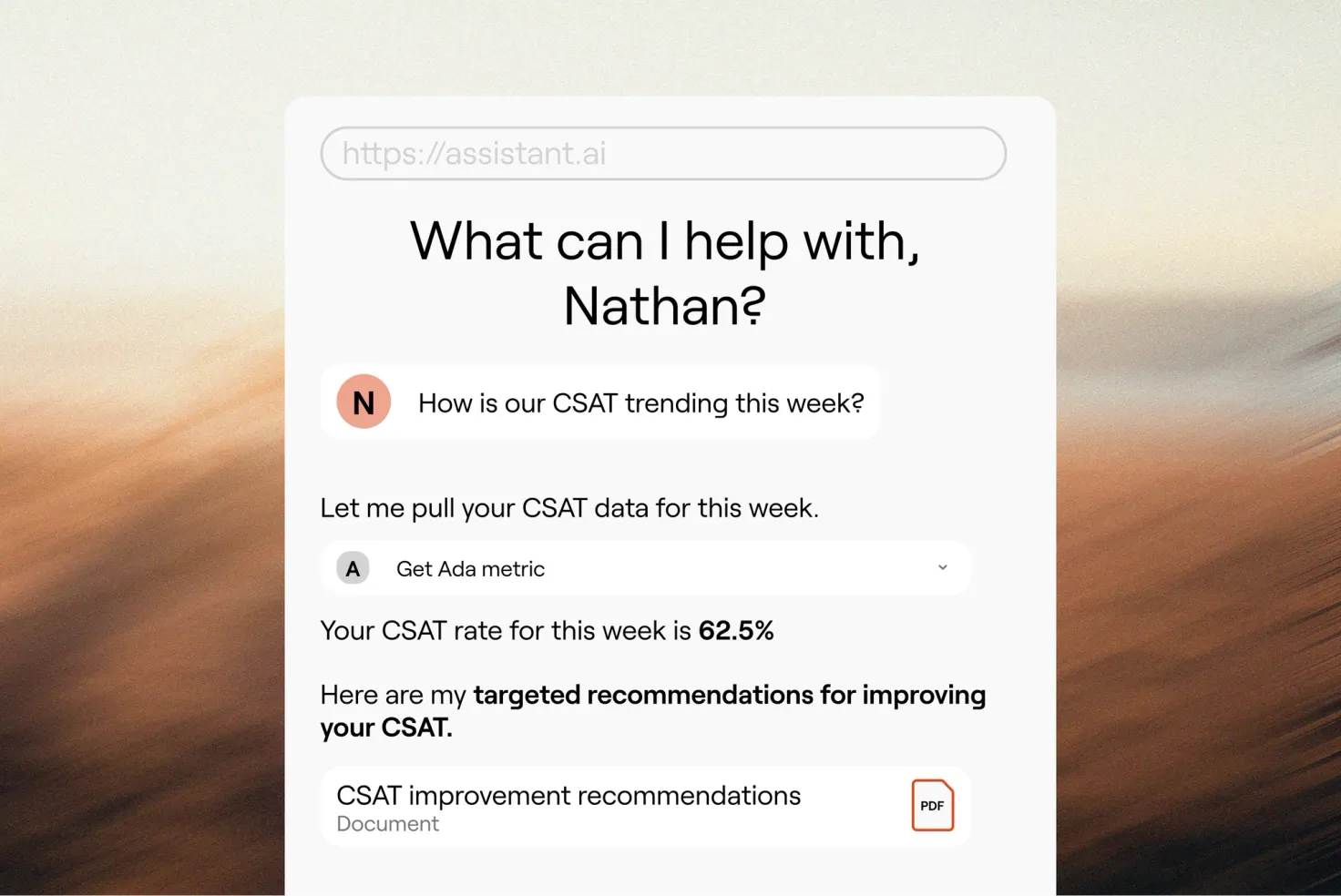
- “How’s our CSAT trending this week?”
- “Did our resolution rate drop after launching the new flow?”
- “Which intents are driving the most handoffs?”
Dig deeper into the ‘why’
- “Show me conversations where customers expressed frustration about billing.”
- “Which coaching configurations need improvement?”
- “Where is the agent failing to resolve onboarding questions?”
Spot content and coverage gaps
- “What knowledge articles are being used most often?”
- “Where are we missing the mark on content coverage?”
- “What updates would improve resolution for voice conversations?”
In every case, you’re not toggling between tools or searching through filters. You’re having a conversation with your data.
How it works (under the hood)
When someone asks a question in ChatGPT, Claude, or another supported tool, that AI assistant sends a secure MCP request to Ada. The MCP Server checks who’s asking, confirms what they’re allowed to access, and returns only the scoped data needed to answer the question.
That might include:
- CSAT and resolution metrics
- Summarized transcripts
- Structured conversation metadata
- Knowledge article usage
The AI assistant then turns that data into a natural-language answer—fast, accurate, and contextual. Your team gets what they need to move forward, without waiting on reports or pulling in analysts.
It’s secure by design. Scalable by default. And always under your control.
The answers are already in your data—it’s time to unlock them
Your AI agent doesn’t just power conversations, it captures rich data in every interaction. Data that can surface insights and improvements across your customer experience.
But metrics alone don’t drive change. Insight does.
Conversational analytics bridges the gap between raw numbers and real understanding. It gives authorized teams the ability to explore Ada data in natural language and share insights that drive meaningful action across the business.
Ada’s MCP Server makes this possible at scale. It brings your customer data into the tools your teams already trust, without adding friction or complexity. You get enterprise-grade control with consumer-grade simplicity.
This is what the future of AI-powered CX looks like: intuitive, transparent, and built to move your business forward.
Explore Ada’s MCP Server capabilities
Discover how Ada connects with tools like Claude and ChatGPT to power conversational analytics. Get the technical details on how MCP makes it possible to query your AI agent data in real time, securely and at scale.
Learn more