

The cancellation notice goes out. Hundreds of passengers are suddenly stranded—at gates, in lounges, in the middle of long-haul connections. Every one of them opens an app, types into a chat window, or calls customer service looking for help.
Moments like these, especially airline irregular operations (IROPs), create an immediate customer experience challenge: support volumes spike all at once, customers need answers quickly, and wait times can spiral fast.
Increasingly, AI customer service is part of how companies respond.
On a normal day, an AI agent can help handle common requests like baggage policies, check-in questions, or flight status updates. But disruptions raise the stakes. Customers whose flights have been cancelled don't want information about the rebooking process, they want to be rebooked before the remaining seats disappear.
The same dynamic plays out in insurance. When severe weather hits, policyholders don't need a summary of the claims process. They need to file a claim immediately and understand what happens next.
These moments reveal an important difference between AI customer service that can answer FAQ questions and an agentic customer experience (ACX) that can help customers complete urgent workflows under pressure.

Why disruptions change what AI customer service needs to handle
Disruptions expose the gap between the types of customer interactions most AI customer service systems were originally designed to handle and the workflows customers need help with during high-pressure moments.
For many organizations, that's the difference between answering routine FAQs and helping customers navigate urgent, time-sensitive situations in real time.
Traditional AI customer service was built for routine interactions
Most AI customer service programs start with the same goal: automate repetitive, high-volume conversations.
In travel, that often means helping customers with questions like:
- Flight status updates
- Baggage policies
- Check-in questions
- Seat changes
In insurance, it might include:
- Coverage questions
- Policy renewal information
- Billing inquiries
- Claims status updates
This delivers real value. They reduce wait times, lower support costs, and help customer service teams manage routine volume more efficiently.
Disruptions create a different kind of customer need
Many AI customer experiences are still built primarily around retrieval: finding the right answer from a knowledge base and presenting it conversationally. That works well when customers are looking for information.
But during a disruption, customers often need more. A stranded traveler wants to know:
- What flights are still available?
- Do they qualify for compensation?
- Has their hotel voucher been issued?
- How quickly can they get home?
A policyholder dealing with flood damage doesn't want a list of claims steps. They want to start the process immediately and receive confirmation that recovery is underway.
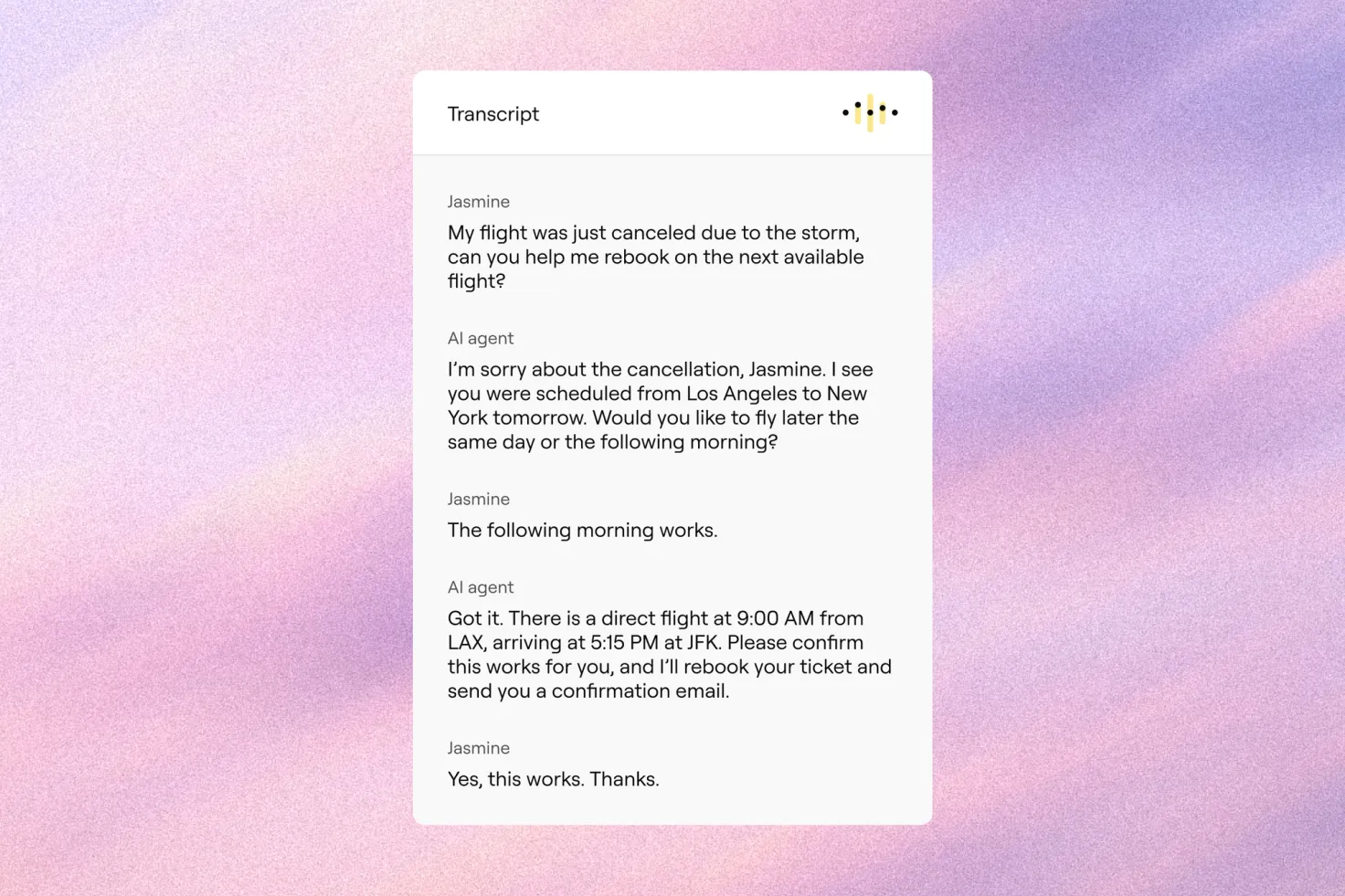
These are dynamic workflows, not static FAQ interactions.
And when AI can't help customers resolve those issues, support teams end up absorbing the operational pressure manually through escalations, callbacks, and long wait times.
Customers notice the difference quickly; 28% of travelers say a single bad AI experience during a disruption would make them switch airlines entirely, and 32% say they've already lost trust in airlines to manage disruptions effectively.
During high-pressure moments, customers aren't judging whether AI sounds conversational. They're judging whether it can actually help.
Agentic customer experience: The difference between answering and resolving
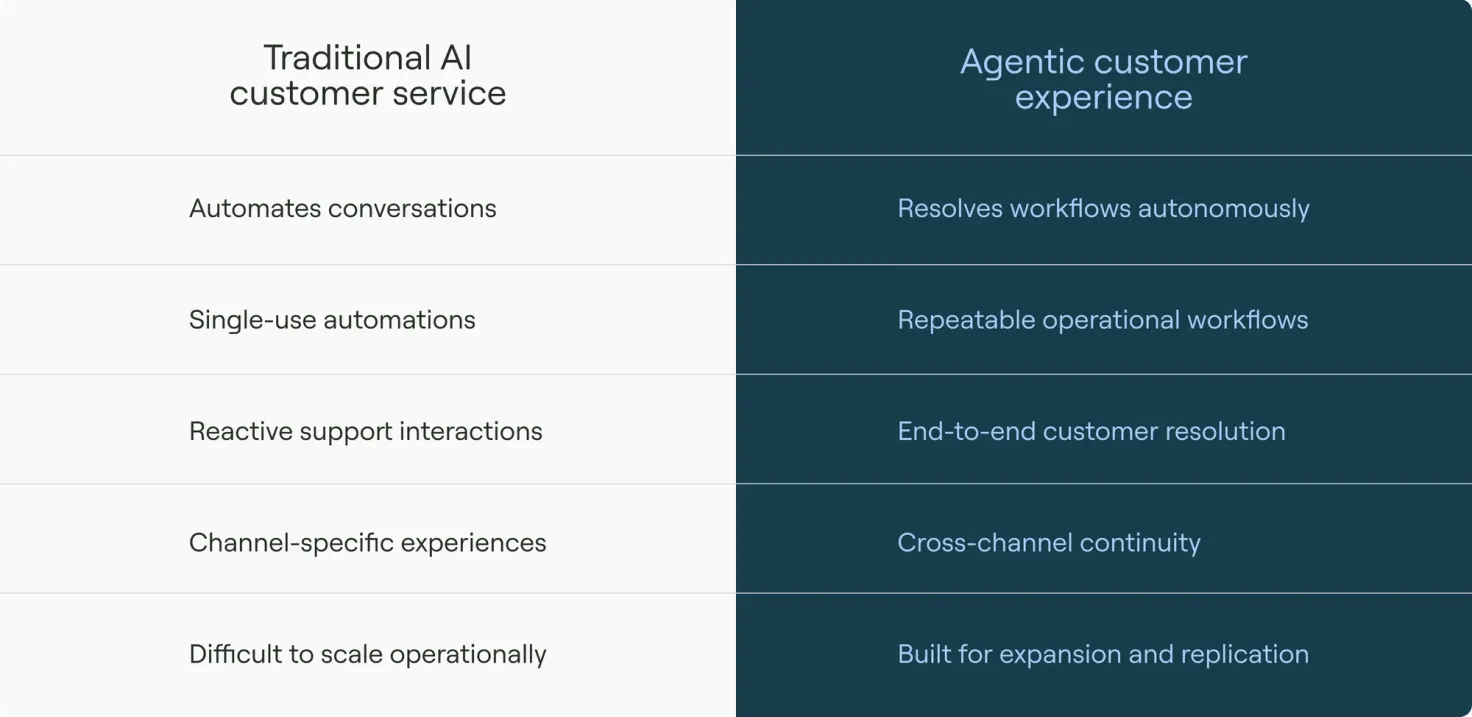
The companies handling disruptions most effectively are using AI differently. Instead of treating AI as a conversational layer designed to answer routine questions, they're using AI agents to help customers complete real workflows during high-pressure moments.
That's the shift from AI customer service toward a more mature agentic customer experience approach.
Traditional AI customer service is typically designed around retrieval: surfacing information from a knowledge base and routing more complex situations to human teams. Disruptions create operational problems that customers need to be resolved quickly, like rebooking a canceled itinerary, verifying compensation eligibility, or initiating an insurance claim during an active weather event.
Those workflows require AI agents that can securely connect to enterprise systems, maintain context across conversations, and take action in real time. Agentic AI in customer experience gives organizations a way to help customers move through urgent workflows faster during high-pressure moments.
For airlines, that can include:
- Rebooking disrupted passengers
- Surfacing personalized travel options
- Verifying compensation eligibility
- Updating itineraries in real time
For insurers, it might involve:
- Initiating claims
- Collecting required documentation
- Confirming policy information
- Guiding customers through next steps immediately
The goal isn't to replace human teams. It's to help organizations continue delivering fast, coordinated customer experience during moments when operational pressure spikes suddenly and customers need immediate resolution.
That also means knowing when human support is still necessary.
During disruptions, some situations require empathy, judgment, or exception handling. Customers may need reassurance, special accommodations, or help navigating unusually complex scenarios.
Well-designed AI agents reduce friction before that handoff happens. They gather context, preserve conversation history, and route customers to the right teams with the relevant information already attached, so customers don't have to restart the conversation during already stressful moments.
57% of consumers say they would abandon a brand's AI service entirely if no human escalation option existed.
- Agentic CX in 2026: What consumers expect and most enterprises miss
The strongest AI customer service programs combine automation with faster, more informed human support when it's needed most.
What this looks like in practice
The organizations seeing the strongest results during disruptions are using AI to help customers move through urgent workflows faster, not just answer questions at scale.
That shift looks different across industries, but the underlying goal is the same: reduce operational pressure while helping customers get the support they need quickly during high-stress moments.
Cebu Pacific: Reducing disruption wait times to under one minute
For teams evaluating AI in the travel industry, Cebu Pacific, the Philippines' largest airline, is a strong example of how AI agents can help manage operational pressure during disruptions.
When Cebu upgraded from a scripted chatbot to an Ada-powered AI agent, they had one clear goal during irregular operations: reduce wait times for disrupted passengers to under one minute.
The airline achieved:
- More than 34% improvement in automated resolution
- More than 50% increase in CSAT
- Wait times under one minute for high-priority disruption cases
The improvement came from enabling the AI agent to help customers move through disruption workflows directly—including rebooking requests, disruption updates, and compensation eligibility—rather than simply answering policy questions.
Scaling support and improving CSAT
Cebu Pacific partnered with Ada to bring an AI agent into their customer care team, taking another step forward in their innovation journey.
Learn moreNeptune Flood: Maintaining customer experience during Hurricane Ian
Ahead of Hurricane Ian, Neptune Flood evacuated its Florida-based employees before the storm made landfall. This event is a powerful example of how conversational AI in insurance can help organizations maintain customer experience continuity during large-scale disruptions.
While teams relocated safely, the company's Ada-powered AI agent remained available to policyholders throughout the event. Customers could submit claims, ask questions, and understand next steps without waiting for support operations to stabilize. During Hurricane Ian:
- 30–35% of all claims were submitted directly through the AI agent
- Claims workflows continued operating throughout the disruption
For Neptune Flood, AI helped maintain customer experience continuity during a moment when both customer demand and operational pressure increased simultaneously.
Neptune Flood serves customers during natural disaster
Neptune Flood’s goal when they launched Ada was to achieve 30% containment within 90 days. Instead, they got there within 30 days.
Learn moreeSky: Scaling resolution across high-volume travel support
For global travel platform eSky, the challenge wasn't a single disruption event. It was managing high volumes of complex customer requests across multiple brands, channels, and markets while maintaining resolution quality at scale.
Instead of optimizing primarily for containment, eSky focused on automated resolution: whether customers actually got the help they needed without requiring human intervention.
Within four months of rebuilding its AI measurement framework around resolution, eSky achieved:
- A 17-point improvement in automated resolution
- A 19-point increase in AI CSAT
- 200% ROI
Those gains accelerated further after the company adopted Ada's Playbooks to guide AI agent behavior across specific customer scenarios.
For eSky, the shift wasn't just about automating conversations. It was about creating an AI customer service experience capable of resolving increasingly complex travel workflows consistently at scale.
How eSky scaled AI customer service across brands, channels, and markets
Managing three global brands, eSky Group uses Ada to deliver personalized, multilingual support across channels. The result: higher automated resolution and a lower cost-to-serve.
Learn moreThe moments customers remember
For industries like travel and insurance, disruptions are inevitable. Delays happen, flights get canceled, and severe weather events overwhelm operations and drive sudden spikes in customer demand.
The companies that handle these moments well are giving customers a faster path to resolution when urgency is highest.
That can mean helping travelers rebook quickly during irregular operations, guiding policyholders through claims workflows during a storm, or reducing wait times when support volumes surge unexpectedly.
As organizations move toward agentic customer experience, the role AI plays during disruptions is changing, too. AI agents are helping companies keep customer experience moving during high-pressure moments by guiding customers through urgent workflows faster and reducing operational pressure on support teams.
Because when disruptions happen, customers remember how quickly they got help.
Discover how Playbooks unlock more complex AI resolutions
Explore real-world examples of AI agents using plain-language instructions to power multi-step workflows with speed and precision.
Explore Playbooks