

Your flight gets canceled at 6 a.m. You're watching 200 other passengers orbit the same gate agent. The app isn't loading, and you've been on hold for 23 minutes. When someone finally picks up, they give you information that contradicts what the automated message said 10 minutes ago.
These are the moments that define customer service: when something goes wrong, time is tight, and the next step isn’t clear.
They're also happening more often. According to Ada's April 2026 consumer survey of 1,000 US travelers, 47% of consumers say travel has become more stressful and unpredictable, and 32% have lost trust in airlines to manage disruptions well.
The same survey found that half of travelers don't care whether the resolution comes from a human or an AI. They just want their issue fixed. But 28% say one bad AI experience would make them switch airlines entirely.
That combination defines the opportunity and the risk. Travelers aren't anti-AI customer service. But they have given it a conditional green light: it has to work.
That's what makes AI in the travel industry one of the highest-stakes CX investments companies can make right now, and how you build it matters.
 The ultimate guide to AI in the travel industry: Building resilient customer service at scale
 How is AI used in the travel industry?
Travel is one of the most demanding environments for AI customer service.
Interactions are time-sensitive by nature. Demand is unpredictable, spiking sharply during disruptions that affect hundreds or thousands of passengers at once. And the emotional register is high: customers contacting an airline mid-disruption aren't in a neutral state. They're stressed, often traveling far from home, and making decisions that affect real plans.
That complexity is why AI in the travel industry has evolved well beyond basic chatbots.
Airlines, online travel agencies, and hospitality brands now deploy AI agents across messaging, voice, and email to handle everything from pre-trip booking support and itinerary changes to real-time disruption management and post-trip resolution—24/7, across languages, at a scale that human teams alone can't sustain.
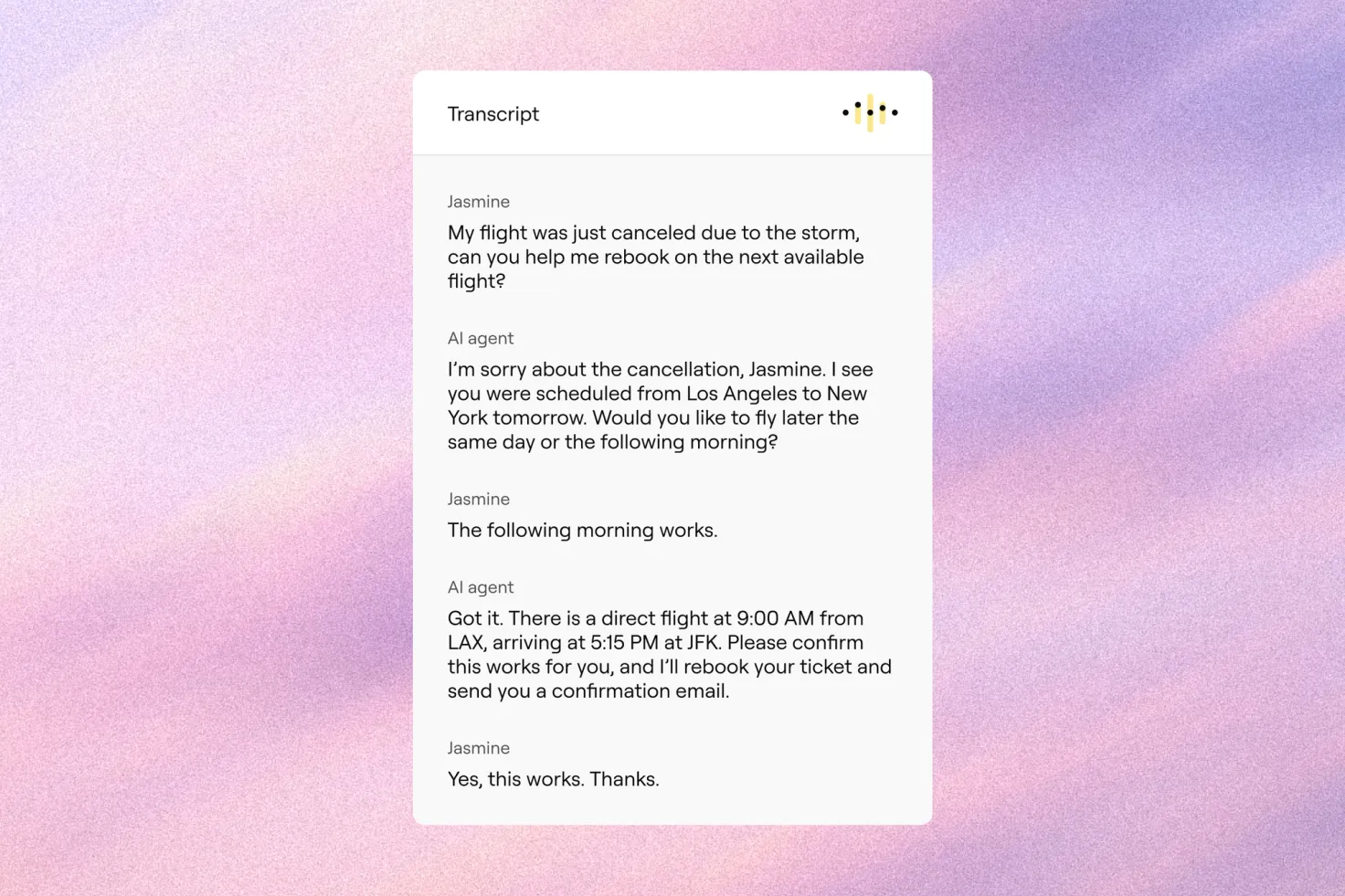
During irregular operations (IROPs), that capability becomes most visible. AI agents can monitor booking data and proactively notify affected travelers before they reach the gate, surface rebooking options, communicate policy changes, issue travel credits, and answer follow-up questions, all without routing customers through a queue.
For airlines managing hundreds of affected passengers simultaneously, this isn't a marginal improvement. It's a structural one.
It's also exactly the kind of capability shift that's redefining the future of travel customer experience and raising the stakes for what happens when it falls short.

The loyalty cost of getting AI customer service in travel wrong
Most customer service failures are inconvenient. In travel, they're consequential. The emotional context changes the calculus for AI customer service entirely.
A frustrated interaction at a call center is a bad experience. A frustrated interaction at a gate, with a flight boarding in 20 minutes, is something else.
How AI customer service interactions affect airline loyalty
39% of travelers say AI interactions carry more weight than equivalent human interactions, positive or negative:
- 24% of travelers say that 24/7 AI customer service would increase their loyalty to an airline.
- 24% say a positive AI experience improves their perception more than a positive human interaction would.
- 28% report that a single bad AI interaction would reduce their confidence in the brand.
AI done well builds loyalty faster in travel than almost anywhere else, but it works in both directions, making the margin for error narrower than most travel brands account for.
The airlines getting this right—like Cebu Pacific, which saw a 34% increase in automated resolution rate and wait times drop to under one minute—are compounding an advantage that's hard to close.

Where travelers want AI (and where they don't)
The survey data doesn't paint a picture of blanket AI enthusiasm or blanket resistance. It points to something more specific: travelers have a clear sense of where AI earns its place, and where it doesn't.
The frustrations driving demand
Before asking where AI fits, it helps to understand what's broken. The top frustrations travelers report today are:
- Long wait times (46%)
- Interactions that don't resolve the issue (34%)
- Lack of clear, timely communication (28%)
- Incorrect or incomplete information (28%)
Where AI has permission to play
When asked which issues they'd prefer AI to handle, responses concentrated around a specific, consistent set of use cases for travel customer service:
- 41% favor AI over human support for completing quick tasks like checking real-time flight status
- 30% prefer AI answering pre-flight questions about document requirements or baggage allowances
- 28% would rather AI handle in-flight adjustments like seat selection or upgrades
During disruption, that preference becomes even more specific:
- 38% want AI delivering real-time updates
- 32% want AI to provide proactive guidance about potential delays or cancellations
- 31% want AI to quickly surface rebooking options
Travelers consistently point to time-sensitive, information-heavy interactions, especially those tied to disruption. The takeaway: in the moments where delays, uncertainty, and next steps intersect, show up fast and accurately.

A hybrid model is a requirement, not a compromise
Travelers are pragmatic about AI, but pragmatism cuts both ways. They'll use it when it works, and they'll remember when it doesn't.
What travelers actually want during a disruption
When asked what type of support they'd prefer during a travel disruption, the breakdown was clear:
- 44% prefer a human agent, even if it takes longer
- 43% prefer a mix of AI and human support
- 13% prefer AI that can instantly resolve the issue
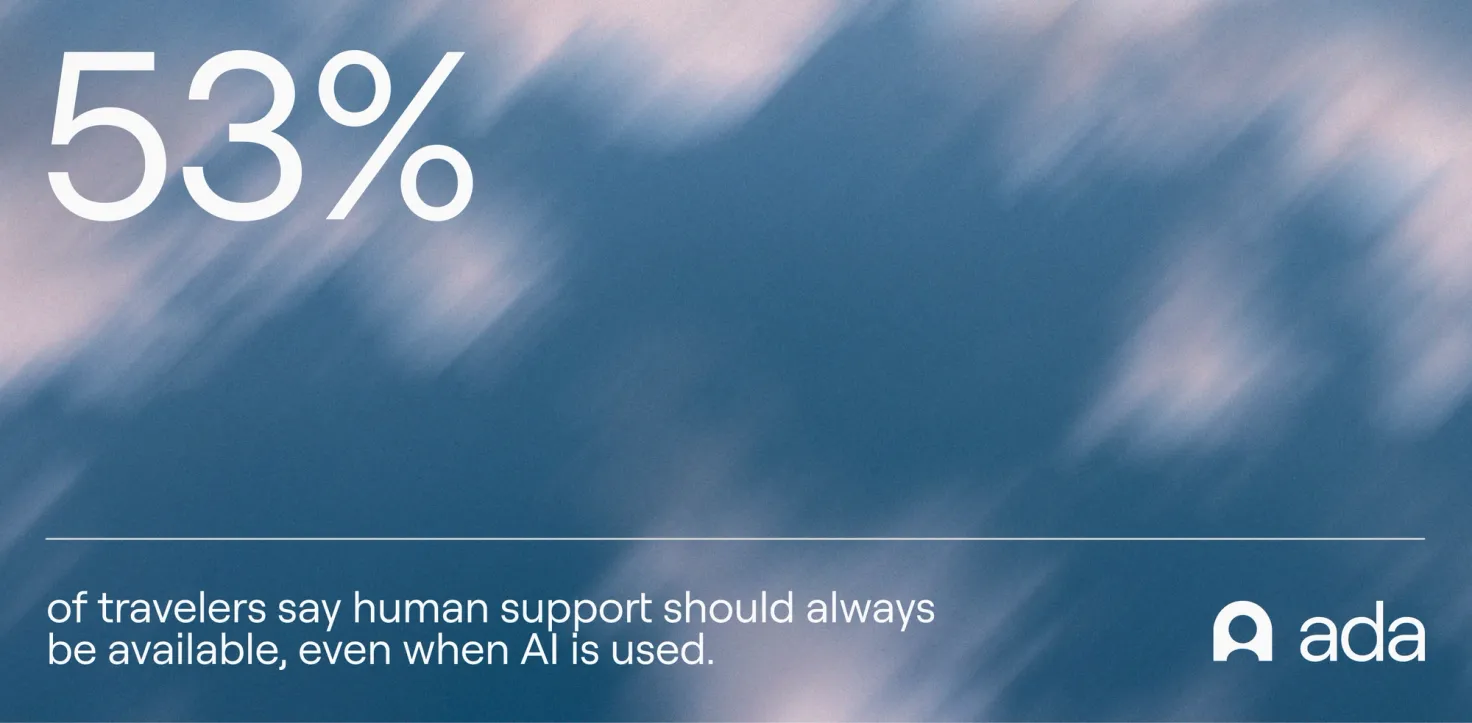
- 53% say human support should always be available, even when AI is used
The majority want either a human or a hybrid model. This isn't resistance to AI, it's a clear design specification.
Travelers are comfortable starting with AI when it's fast and capable. What they won't accept is a travel customer experience with no exit.
Why escalation is a trust signal, not a fallback
Brands that treat human escalation as a workaround are building the wrong product. A visible, frictionless path to a human agent is the safety net that makes AI trustworthy enough to use in the first place.
Remove it, and you don't just frustrate travelers. You erode the trust that makes AI adoption possible at all.
How can AI improve airline customer service?
AI improves airline customer service by eliminating the specific bottlenecks that frustrate travelers most, starting with wait times, which no amount of human hiring can fully solve at scale during peak disruption.
Three principles determine whether a travel AI deployment actually delivers on that promise.
Build for resolution, not deflection
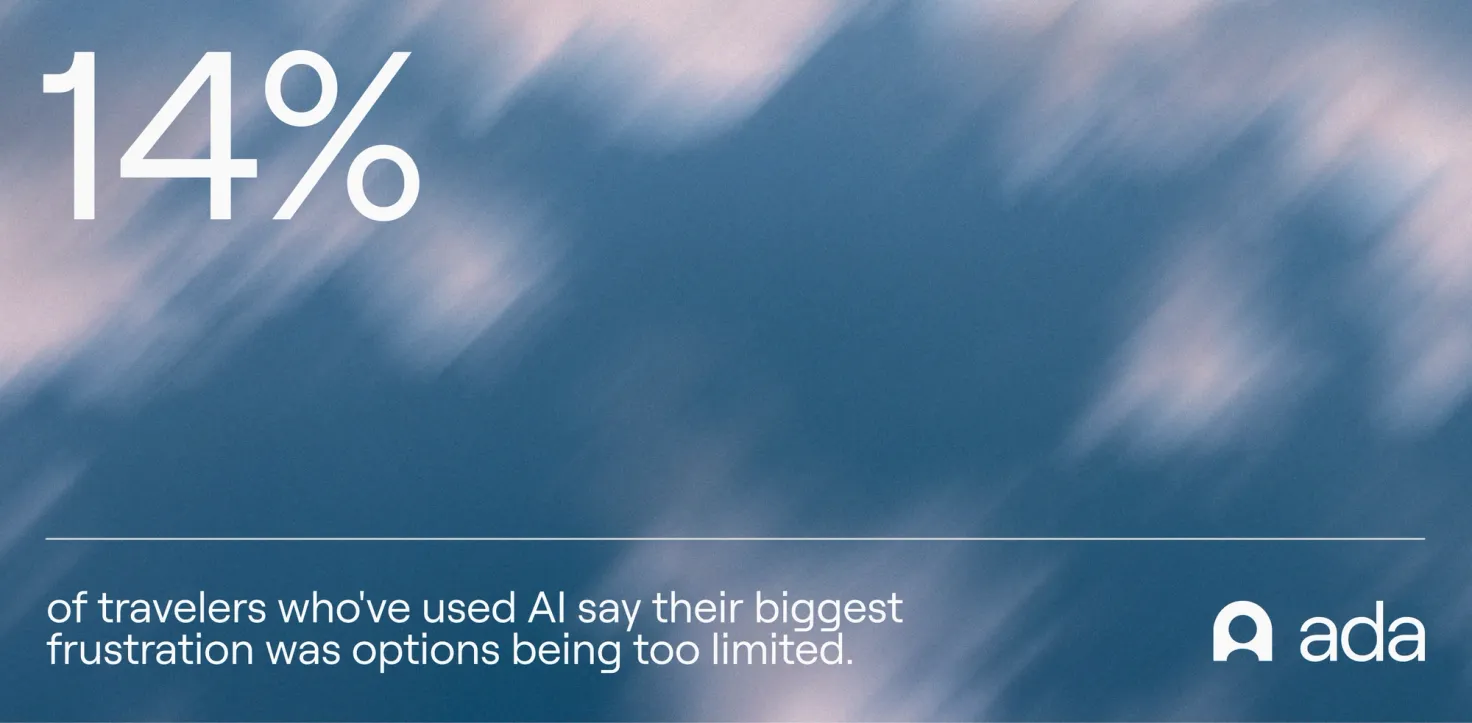
Under-built AI is the real barrier to adoption in travel, not consumer skepticism. Airlines need to deploy AI agents with genuine capability: live access to booking systems, the ability to rebook and issue credits, and the capacity to surface alternatives in real time.
Deflection isn't resolution. Travelers know the difference.
Keep the escalation path visible and frictionless
Travelers want AI agent support alongside human support, not instead of it. More than half hold this as a firm expectation, making it a non-negotiable design requirement.
A clear escalation path is a trust signal that makes the rest of the AI experience safer to deliver. Remove it, and you undermine the confidence that makes AI adoption possible at all.
Measure AI performance separately
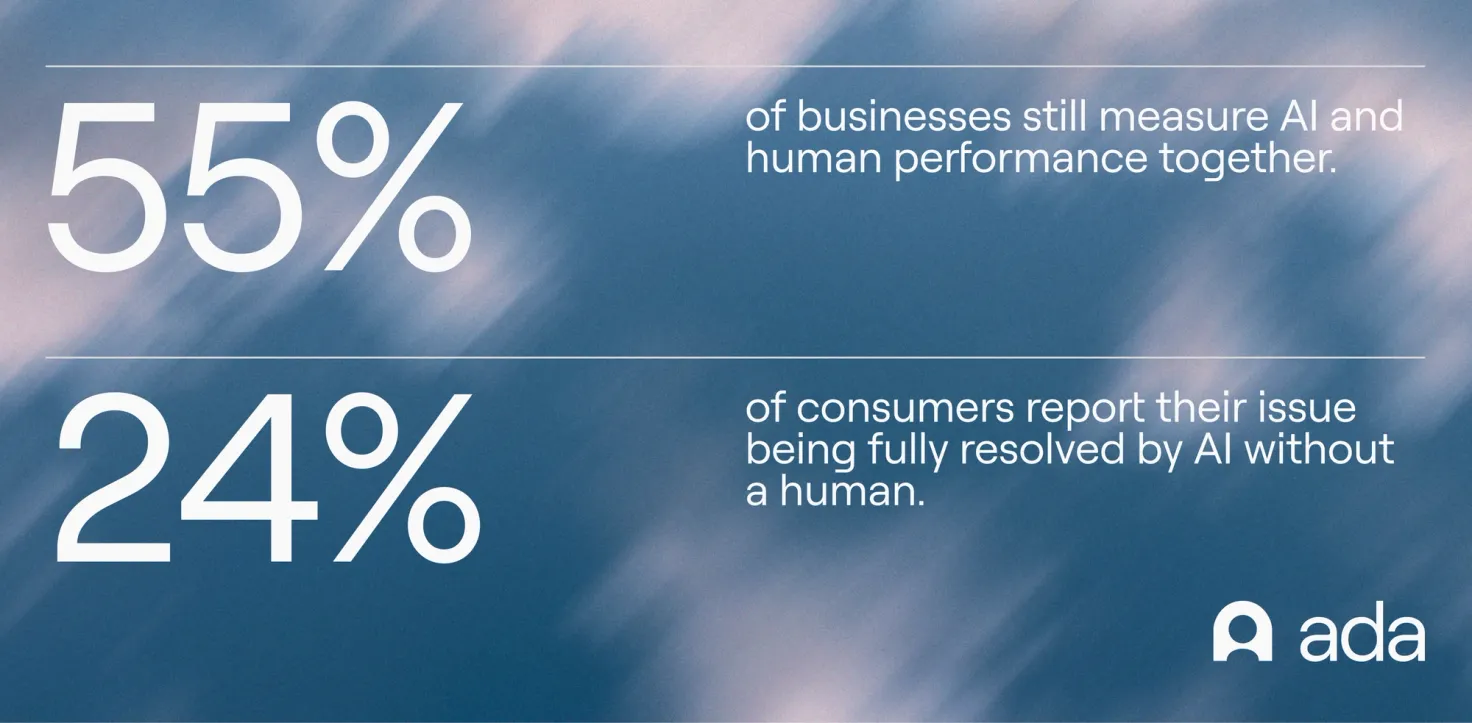
Most businesses assume their AI performs better than it does because they're measuring it alongside human performance rather than independently. Without that separation, there's no way to isolate where the gaps are, and no way to close them.
The result shows up directly on the consumer side. A fully resolved interaction without human involvement remains the exception rather than the rule, per Ada's 2026 Agentic CX report. The businesses positioned to change that are the ones tracking AI-specific resolution rates, escalation triggers, and post-interaction satisfaction separately.
You can't optimize what you can't isolate.
Knowing what to build is necessary. Knowing how to sustain and improve it over time is what separates a successful deployment from one that stalls.
Agentic CX in 2026: What consumers expect and most enterprises miss
There’s a common assumption that consumers are skeptical of AI in customer service. The data says otherwise. Our 2026 report surveyed 2,000 consumers to understand how people actually experience AI in customer service today.
Read reportWhat the industry is building toward
The question of whether travelers will accept AI in travel customer service is settled. Half already say they don't care who resolves the issue, only that it gets resolved.
The question now is which travel brands will build AI that's actually capable of meeting that condition, and how much of a head start they're willing to give the brands that already have.
The gap between AI that works and AI that doesn't is becoming a competitive one. Speed, accuracy, and resolution aren't just service metrics in travel, they're loyalty drivers. In an industry where 27.9% of travelers would switch airlines over a single bad AI experience, under-investing in quality isn't a neutral decision.
The brands that get this right aren't just improving travel customer experience. They're compounding an advantage that gets harder to close the longer it runs.
Travelers are done waiting, and indifferent to who fixes it
Ada's new research survey of 1,000 U.S. consumers shows passengers have moved past AI resistance, and prioritize fast solutions over the method of customer service delivery.
Learn more