

AI agents are increasingly being trusted with customer interactions that involve verification, transactions, compliance requirements, and other business-critical workflows.
A bank customer disputing a fraudulent charge. A traveler rebooking a flight after a schedule disruption. A retailer resolving a multi-item order involving returns, exchanges, and damaged goods.
These aren't simple question-and-answer exchanges. They're complex, multi-step workflows that require decisions, actions, and the ability to adapt as conversations evolve.
Today, we're introducing the latest evolution of Playbooks, giving ACX managers precise control over how AI agents execute workflows, with lower latency, stronger adherence, and more reliable handling of complex customer interactions across every channel.
Those outcomes address one of the biggest challenges in enterprise AI today: execution.
As AI agents take on more responsibility, performance is no longer defined solely by whether an agent can produce the right answer. It's defined by whether it can execute the right process, at the right speed, with the right outcome. The bar is full resolution: the customer's issue is handled from start to finish.
That's where enterprise AI deployments tend to break down.

Why enterprise AI gets harder at scale
Only 24% of consumers report their issue was fully resolved by an AI agent without human involvement, yet 59% actively prefer AI when it can actually solve their problem. The gap between those two numbers is largely an execution problem.
As AI agents move deeper into business-critical workflows, three challenges emerge repeatedly:
- Latency: Complex workflows require decisions, actions, and reasoning across multiple steps. When reasoning isn’t scoped to each step, delays accumulate. On voice, where customers experience conversations in real time, even small pauses can disrupt the natural flow of an interaction and erode trust.
- Adherence: Enterprise SOPs are designed to reduce variability, manage risk, and ensure customers are served consistently. As AI agents take on more complex, multi-step workflows, maintaining alignment between what's authored and what runs in production becomes increasingly difficult. Small gaps in execution can compound across millions of interactions, creating drift between the intended customer experience and the one customers actually receive.
- Customer behavior: Workflows are designed around an expected path. Customers rarely follow one. They ask unrelated questions, revisit earlier steps, change direction, and introduce new topics in the middle of a conversation. Human agents navigate those moments naturally. AI agents need an architecture that allows them to do the same.
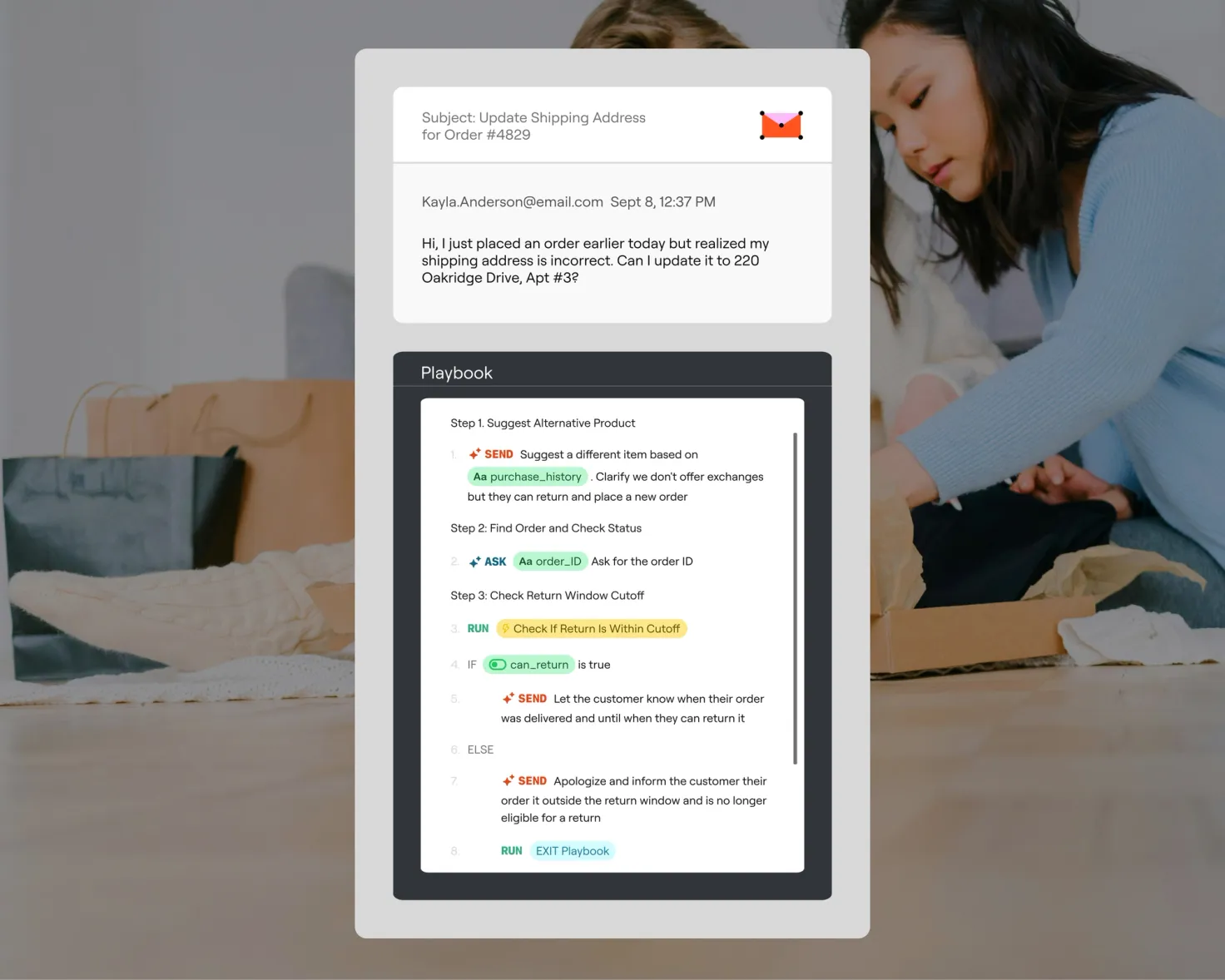
Playbooks: Eliminating the tradeoff between speed, control, and flexibility
The three challenges of enterprise AI—latency, policy adherence, and anticipating customer behavior—often appear unrelated. In practice, they determine the same outcome: whether an AI agent can reliably execute a workflow from start to finish.
Traditional approaches force teams to make tradeoffs. The more sophisticated a workflow becomes, the harder it is to maintain conversational speed, consistent execution, and adaptability at scale.
The challenge isn't choosing between depth of reasoning and performance; it's applying the right model to the right step, with the right scope. ACX managers have precise control over how every step executes, with every use of AI applied intentionally. The result is an AI agent that delivers deep resolution at the speed and consistency enterprise workflows demand.
Every use of AI is intentional, scoped, and defined to the task being performed. That's the foundation that enables everything that follows.
Latency: Conversations need to move at conversational speed
Why do AI voice agents feel slow in complex workflows? When every step receives the same level of processing regardless of complexity, delays accumulate, and customers feel the pause as uncertainty, not as a technical limitation.
But complex workflows shouldn't feel complex to customers. Rather than applying the same level of processing to every step, Ada’s Playbooks matches execution to the nature of the task. The result is lower latency across long, multi-step workflows while preserving the depth of reasoning required to resolve complex issues.
That matters most on voice, where conversational speed directly shapes customer trust and engagement.
Customers don't experience latency as a technical issue. They experience it as uncertainty. Execution speed is not just a performance metric, but a trust signal.
Adherence: What the ACX manager authors should be what runs
How does enterprise AI stay compliant with authored workflows at scale? Maintaining adherence requires clear execution boundaries, built-in validation, and visibility into how workflows perform in production.
One of the biggest challenges in applying AI for standard operating procedures at enterprise scale is the gap between what gets authored and what actually runs in production. Small deviations become meaningful when they're repeated across millions of interactions.
Playbooks closes that gap from both ends. Before workflows go live, ACX managers can control exactly how each step will execute in production, giving them confidence that the customer experience will behave as intended.
Once live, built-in guardrails enforce AI agent compliance at every step, ensuring the AI agent follows the intended workflow consistently while still responding naturally in conversation. The result is predictable execution at scale, without sacrificing conversational quality or speed.
Customer behavior: Conversations rarely go as planned
What happens when a customer goes off-script with an AI agent? Most agents stall, loop, or escalate. Playbooks adapts while keeping context, so the conversation moves along smoothly.
A customer might ask an unrelated question halfway through a verification flow, realize they provided incorrect information several steps earlier, or return with an entirely different issue. Human agents navigate these moments instinctively because they understand when to answer, when to revisit a previous step, and when to change direction.
AI agents need to do the same. 74% of consumers cite looping, misunderstanding, and getting stuck the moment a conversation leaves the expected path as how AI lets them down. Those moments—the digression, the correction, the topic switch—are where enterprise AI agents most commonly fail.
Playbooks classifies intent throughout the conversation and adapts accordingly:
- The digression: A customer asks an off-topic question in the middle of a workflow. The AI agent answers immediately using referenced knowledge and resumes from the exact step where the workflow was interrupted.
- The correction: A customer updates information from earlier in the conversation. The AI agent returns to the relevant step and continues without replaying the entire process.
- The topic switch: A customer changes direction entirely. The AI agent can transition to a different workflow, channel, or human agent and return to the original task when appropriate.
The result is a more natural customer experience without losing context, restarting workflows, or escalating unnecessarily.
The new standard for enterprise AI
As AI agents take on more responsibility, expectations continue to rise. Customers expect conversations that feel natural, businesses expect workflows to execute consistently, and both expect AI agents to adapt when the conversation doesn't go as planned.
Meeting those expectations requires reliable workflow execution.
That means conversations that move at conversational speed, workflows that run as authored, and AI agents that can navigate the reality of customer behavior without losing context or control.
That's the foundation of the latest evolution of Playbooks.
By giving ACX managers precise control over how workflows execute, Playbooks enables enterprises to expand AI into more complex customer interactions with confidence—across channels, across use cases, and across the business.
Because the question is no longer whether AI agents can answer customer questions. It's whether they can reliably complete the work that comes next.
See what extraordinary looks like
Resolve complex customer problems autonomously. With Playbooks, your AI agent follows your SOPs consistently, responds in real time, and stays on track even when customers don't.
Learn more