

Omnichannel customer experience has entered a new phase.
It’s no longer enough to simply support customers across messaging, email, social, and voice. The real challenge—and dare we say, opportunity—is delivering one consistent, intelligent experience across all of them.
In our recent webinar, “The Omnichannel Super Agent: One Seamless Experience, Every Channel,” we grounded the discussion in a necessary shift for enterprise customer experience: from managing channels to managing intelligence. Organizations can’t just add new channels anymore. They must architect a unified support experience that adapts to the medium, the moment, and the customer’s expectations.
That shift changes everything.
Because once AI begins powering those interactions, each channel stops being just a communication surface. It becomes a place where decisions are made. Where workflows are executed, context is carried forward, and resolution either happens—or doesn’t.
In this session, we brought together CX leaders who have expanded their AI customer service agents across email, messaging, and are moving into AI voice agents—without compromising brand integrity, speed, or quality.
We explored what’s required for omnichannel customer experience at an architectural level, how to govern and measure AI across channels, and what changes operationally when intelligence becomes centralized. We also shared how Ada’s AI agents are designed to support that shift at enterprise scale.
Here are the strategic and operational lessons from that conversation, and what it takes to build an AI customer service strategy that is truly coherent across every channel.

Omnichannel customer experience requires unified intelligence
The most important shift isn’t about adding channels. It’s about consolidating intelligence.
Too many enterprises expand AI channel by channel. A chatbot launches first. Email automation follows. Messaging is layered in. Voice comes later. Each system evolves independently. Each defines resolution differently. Each requires separate updates.
At first, this feels manageable. But as volume grows and expectations rise, the cracks begin to show.
Business rules drift. Logic gets duplicated. Updates must be made in multiple places. A conversation may be marked resolved even if the customer calls minutes later about the same issue. Reporting looks clean. The customer experience does not.
The problem isn’t channel expansion. It’s intelligence fragmentation.
Once AI becomes the primary decision-maker across email, messaging, and voice, fragmentation stops being inefficient. It becomes risky.
Modern AI voice agents: A de-risked path for enterprises
This guide gives you a practical roadmap to move beyond IVR and benefit from the power of AI voice agents for customer service.
Get the guideTrue omnichannel customer experience requires one intelligence layer operating everywhere. Not one agent per channel. One brain powering every interaction.
When an AI customer service agent runs from a unified reasoning layer:
- Business rules stay aligned
- Playbooks apply consistently
- Coaching improvements compound
- Performance reflects full customer journeys
Instead of managing disconnected systems with duplicated logic, teams manage the AI agent in one place, updating policies, workflows, and guidance once and having those changes apply everywhere. This is the foundation of the Agentic Customer Experience (ACX) Operating Model that helps CX teams manage, evolve, and scale AI agents with confidence.
The result is consistency at scale. The AI agent remains fast, aligned, and capable of resolving complex inquiries across channels without fragmenting the experience.
What omnichannel success looks like in practice
Architecture sets the foundation. The webinar made it clear what happens when that foundation meets reality.
I asked both panelists what omnichannel success actually means inside their organizations—not in theory, but in operations.
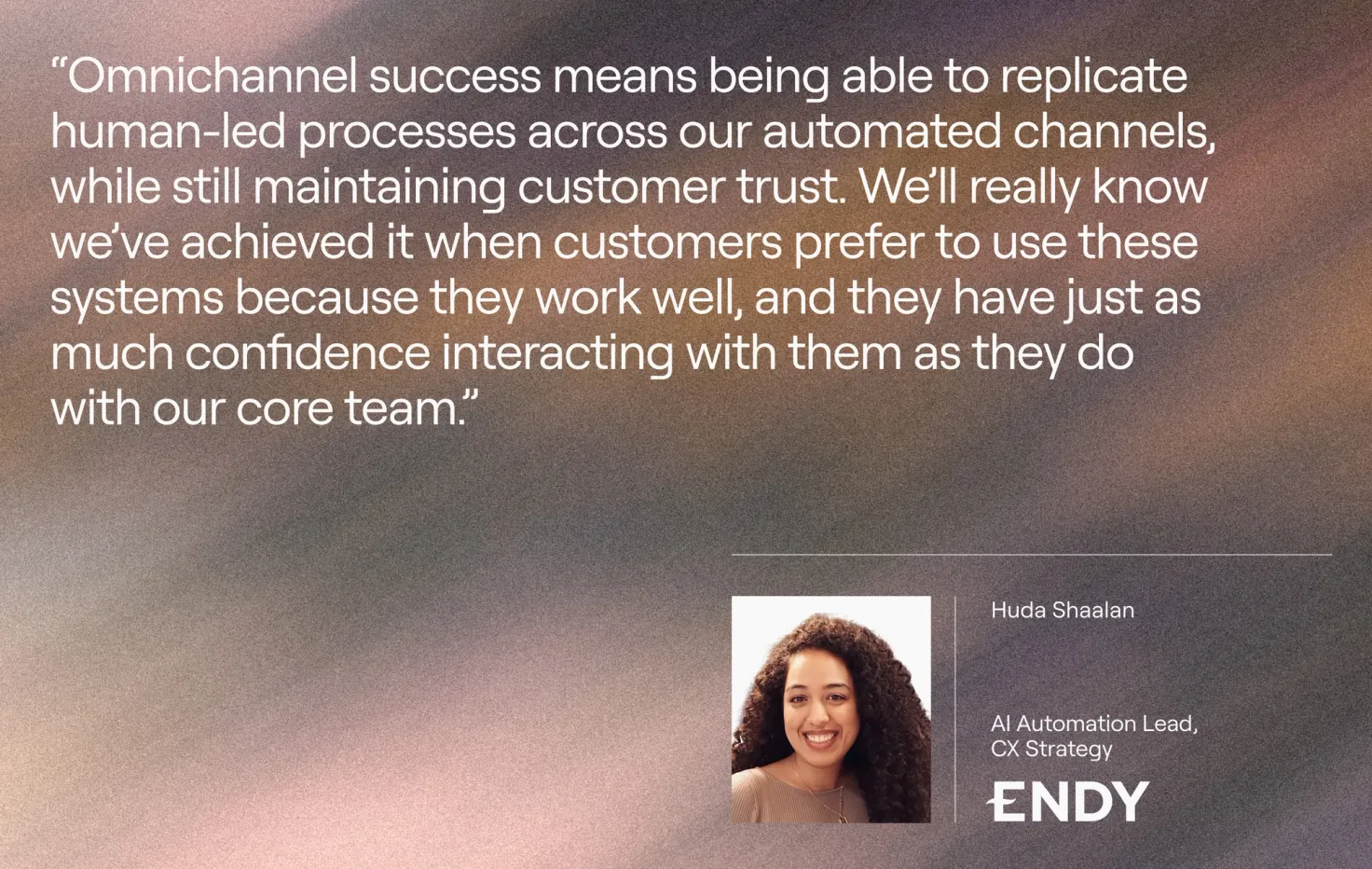
That definition reframes the conversation.
This isn’t about expanding AI customer service agents into more inboxes. It’s about encoding the same decision logic, validation steps, and structured workflows your best human agents use and applying them consistently across messaging, email, and eventually voice.
Preference—not containment—is the benchmark.
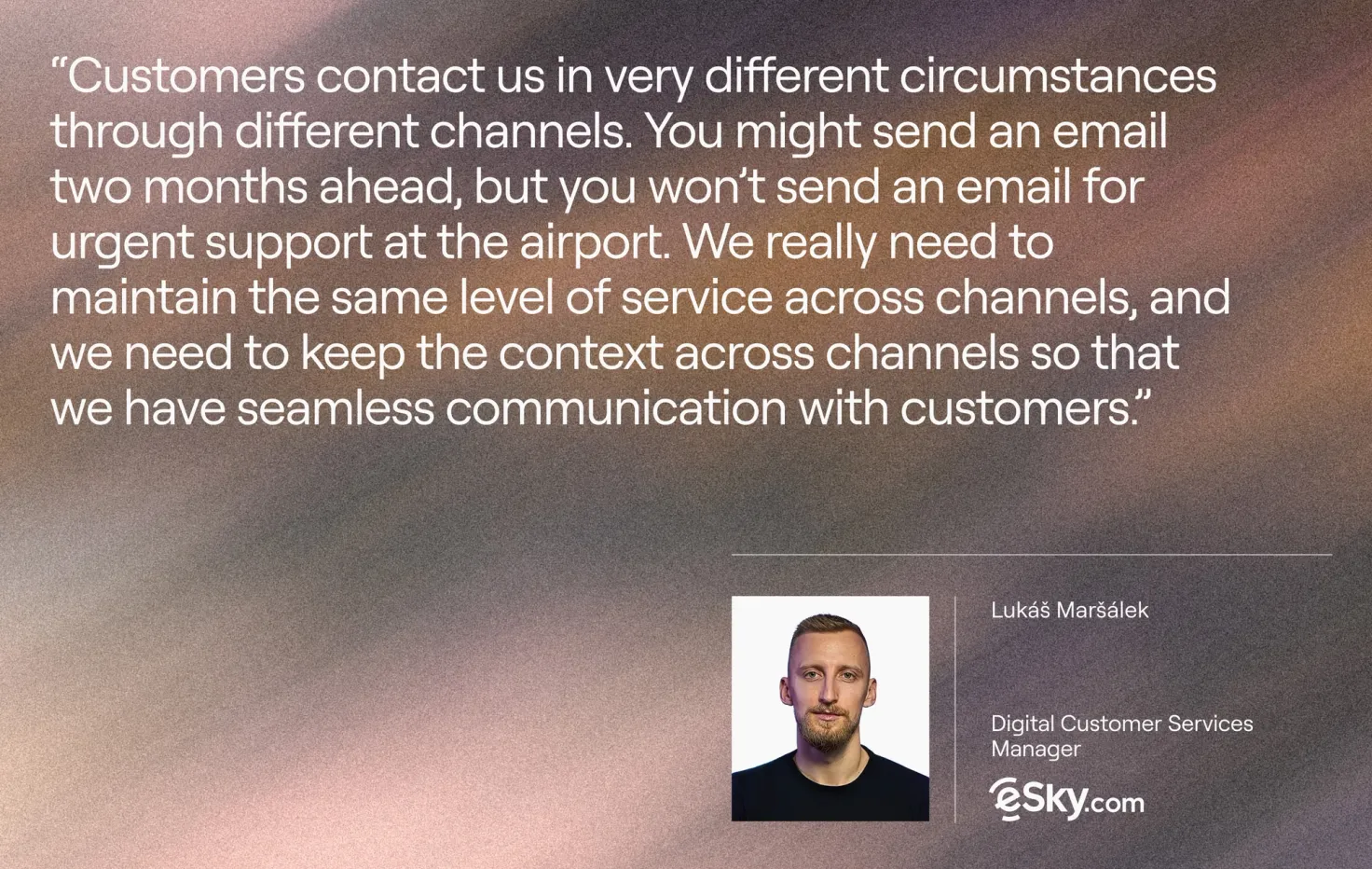
Continuity matters because customers don’t behave in neat channel silos. Different channels carry different expectations. Email supports planning. Messaging supports convenience. Voice supports urgency.
Omnichannel customer experience means adapting to those moments without resetting context or redefining resolution each time.
For example, one panelist described how order modification workflows had to function identically across messaging and email, validating identity, confirming fulfillment windows, and executing updates without human intervention.
The workflow didn’t change by channel. The orchestration did. That’s the difference between channel expansion and intelligence centralization.
How to choose the best omnichannel AI customer service platform
Here's what capabilities AI customer service platforms need to deliver the omnichannel experiences that your customers crave.
Learn moreWhy AI voice agents raise the standard for omnichannel customer experience
As more organizations explore AI voice agents for customer service, the architectural stakes rise.
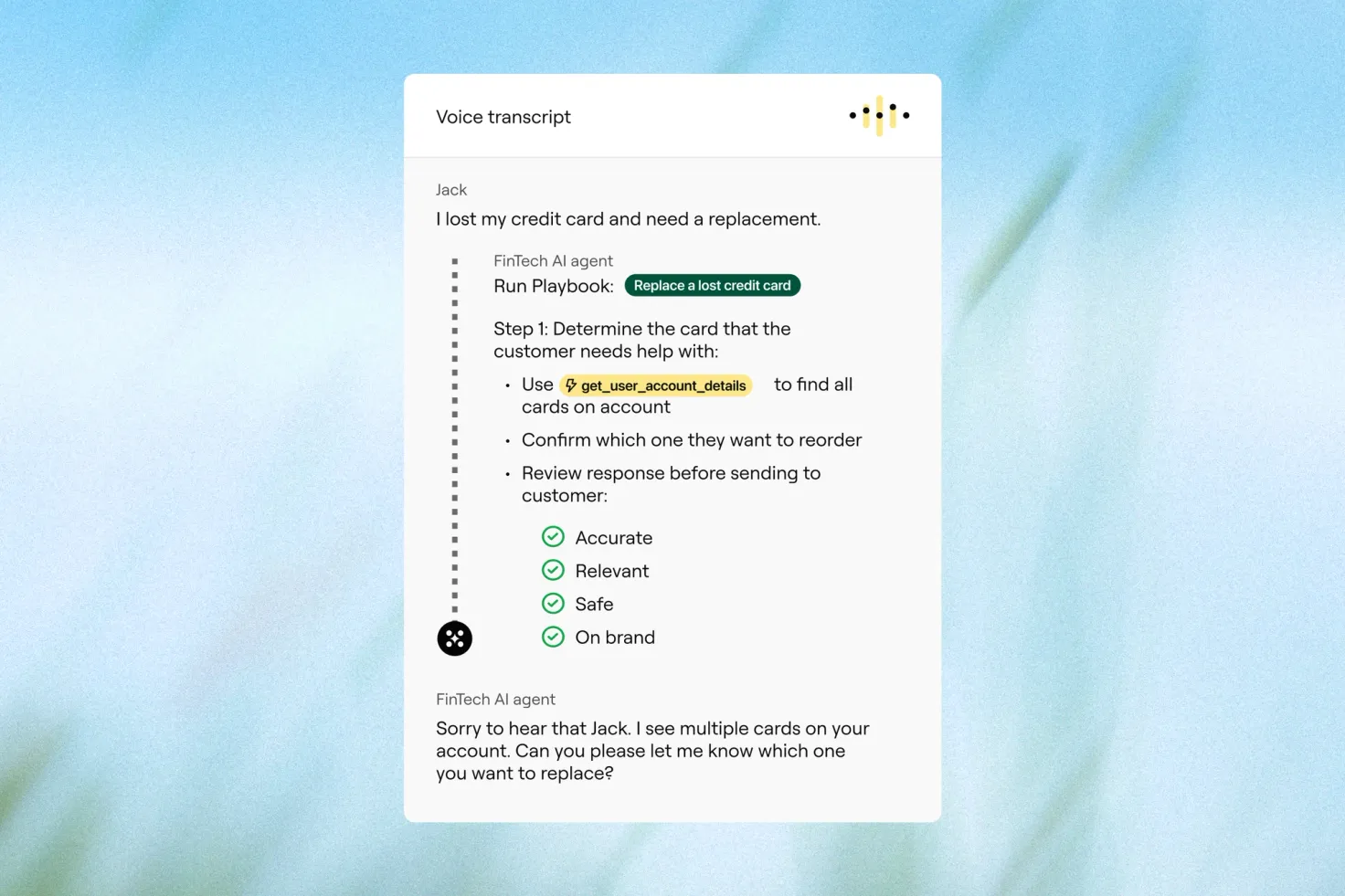
Voice is real-time. There’s no asynchronous buffer. No second session to reconcile inconsistencies. Authentication, data retrieval, policy validation, and workflow execution all happen in one continuous interaction.
If intelligence is fragmented across channels, voice exposes it immediately. That’s why the idea of one AI agent operating from a shared reasoning layer matters even more when voice enters the mix.
When AI voice agents run on the same intelligence layer as messaging and email:
- Context persists across interactions
- Resolution standards remain consistent
- Policies apply uniformly
- Performance reflects complete journeys
In the webinar, we also talked about why voice is especially demanding: it requires your AI agent to “talk fast and think slow.” Ada supports this with a patent-pending, dual reasoning architecture that delivers instant responses for simple questions and deeper reasoning for complex, multi-step problems without fragmenting the experience across channels.
Containment measures whether a conversation ended without escalation. Automated resolution measures whether the issue within that conversation was fully solved. In an omnichannel environment, that distinction matters. A contained conversation isn’t necessarily a resolved issue, especially if customers reopen or recontact later.
That’s why defining resolution clearly at the conversation level is critical as organizations expand AI across channels.
Voice simply raises the bar. If your AI customer service agent can resolve complex, multi-step workflows in real time—across authentication, updates, credits, confirmations—every other channel becomes easier to govern.
Unified intelligence makes that possible.

AI customer service is a management discipline
Another theme that carried through the entire conversation was operational ownership, specifically, the idea that AI is a management discipline.
The most successful teams don’t treat AI customer service agents as static deployments. They treat them as scalable team members. That means:
- Structured playbooks that encode real SOPs,
- QA and sentry testing before and after launch,
- Continuous coaching and refinement,
- Clear performance metrics, and
- Regular iteration cycles.
It also means measuring what actually matters. Containment may drive cost efficiency. But long-term value comes from resolution quality and trust. And personalization becomes the multiplier.

But not superficial personalization. When AI is deeply personalized and grounded in customer context, it moves beyond answering questions to building relationships. And when AI voice agents, messaging automation, and email workflows operate from the same contextual foundation, personalization compounds instead of fragmenting.
This is where CX teams shift from managing channels to managing intelligence. Governance isn’t about monitoring four separate systems, it’s about refining one AI customer service agent that operates everywhere.
Playbook updates apply across channels. Coaching improvements propagate instantly. Performance reflects the full journey, not isolated sessions.
This is also where teams need faster feedback loops. In the webinar, we discussed Ada’s MCP Server, a way to query your AI agent performance and conversation patterns in natural language, without toggling through dashboards. CX teams can ask questions like: “Why did CSAT drop on Tuesday?” or “How are WhatsApp conversations performing in the UK vs. the US?” and get answers tied to real conversation data and configuration.
That’s when AI customer service stops being reactive and starts becoming strategic.

The human impact of unified omnichannel AI
One of the strongest signals from the webinar wasn’t technological. It was organizational.
When repetitive workflows move to automation, teams don’t shrink, they actually evolve. Human agents shift toward:
- Complex case resolution
- High-empathy scenarios
- Quality assurance and AI coaching
- Workflow design and optimization
Volume spikes flatten. Routing improves. Handle times decrease. Agents receive better-prepared cases instead of repetitive policy questions.
In the webinar, we heard specific examples of career-path growth: teams creating or promoting roles like QA automation specialists and AI specialists, often by reallocating internal talent rather than hiring externally.
Unified intelligence strengthens the feedback loop between insight and improvement, and it reinforces something critical: omnichannel maturity isn’t about replacing teams. It’s about amplifying them.
The future of omnichannel AI customer service
Omnichannel customer experience is no longer defined by channel coverage. It’s defined by coherence.
If your AI customer service agent can:
- Maintain context across email, messaging, and AI voice agents
- Adapt to medium-specific expectations without redefining resolution
- Apply consistent policies everywhere
- Personalize interactions based on real customer data
- Update once and propagate everywhere
Then omnichannel becomes sustainable, not just scalable.
The organizations leading this shift aren’t simply expanding into new channels. They’re centralizing intelligence.
The future of AI customer service won’t be defined by how many channels you automate. It will be defined by how many systems you no longer have to manage.
And that’s what turns a collection of bots into a true omnichannel super agent.
One experience, every channel: How leading brands expand without breaking CX
Your AI agent should deliver the same great experience, no matter the channel. In Part 1 of this webinar series, learn how leading brands deliver consistent, connected service across voice, chat, email, social and more.
Watch on-demand