

When companies become AI-native, they usually enter through one of two doors.
The first is engineering. Developers adopt AI coding tools, begin managing AI systems that write code alongside them, and gradually rethink how software gets built. It's the path most companies talk about.
The second door is customer experience.
Customer service teams process thousands of conversations every day, identifying friction across products and journeys and responding to customer needs in real time. When AI agents become capable of resolving those conversations autonomously, the role of the CX team starts to change. Instead of managing tickets, they begin managing a system that learns, improves, and generates intelligence for the rest of the organization.
That's what happened at Dott.
The European micromobility company operates across more than 400 cities and manages approximately two million customer contacts every year. What began as an effort to improve customer service evolved into something much larger: a new CX operating model for how the company works with AI.
Today, Dott's CX team doesn't primarily manage queues. It manages an AI agent, continuously improves performance, and surfaces insights that influence decisions across the business.
In many ways, CX became Dott's first AI-native team, and now the rest of the company is following its lead.
How Dott’s AI-first CX provides instant resolutions on the go
The European micromobility operator went from a 32% to 77% automated resolution rate by treating AI not as a support tool, but as a product requirement.
Learn moreHow Dott's CX team got there first
In 2019, Dott's first response time target was resolving 80% of tickets within six hours. A scripted chatbot handled roughly 30% of volume. The rest went to human agents, half of them outsourced.
"Six hours in 2026 is absolutely unacceptable," says Nicolas Gorse, COO at Dott. "Now it's less than three seconds."
The difference between those two numbers isn't simply speed. It's a completely different operating model.
When Dott launched an AI agent in November 2024, automated resolution jumped from 32% to 62% within three months. By February 2026, it had reached 77%, driven by 25 API-powered automations connecting the AI agent directly to Dott's backend systems and enabling it to resolve issues without escalation.
Instead of spending time resolving individual issues, the team became responsible for the performance of the AI agent itself: maintaining knowledge, improving quality, identifying failure modes, and uncovering opportunities to increase resolution.
The work shifted from handling conversations to improving the system handling them.
This is what an ACX team looks like in practice. The team that once managed a ticket queue now manages an AI agent handling approximately two million customer contacts every year.
Autonomous customer service became a new operating capability
Before looking at what changed inside Dott, it's worth defining what autonomous customer service actually means.
Autonomous customer service is a model where AI agents can understand customer requests, make decisions, and take action on a customer's behalf. Unlike traditional chatbots that provide information, AI agents can resolve issues by completing tasks such as processing refunds, updating accounts, or triggering actions in backend systems.
Dott's end-ride workflow is a good example.
Micromobility depends on GPS. When riders try to end a trip, the app checks their location against authorized parking zones. Most of the time, the process works seamlessly. But GPS isn't perfect, and there are situations where rides can't be closed successfully.
Historically, that meant entering a customer service queue.
Today, when a rider contacts Dott because they can't end a trip, the AI agent can understand the issue, determine what's required, and trigger the API call needed to close the ride immediately. The interaction takes seconds.
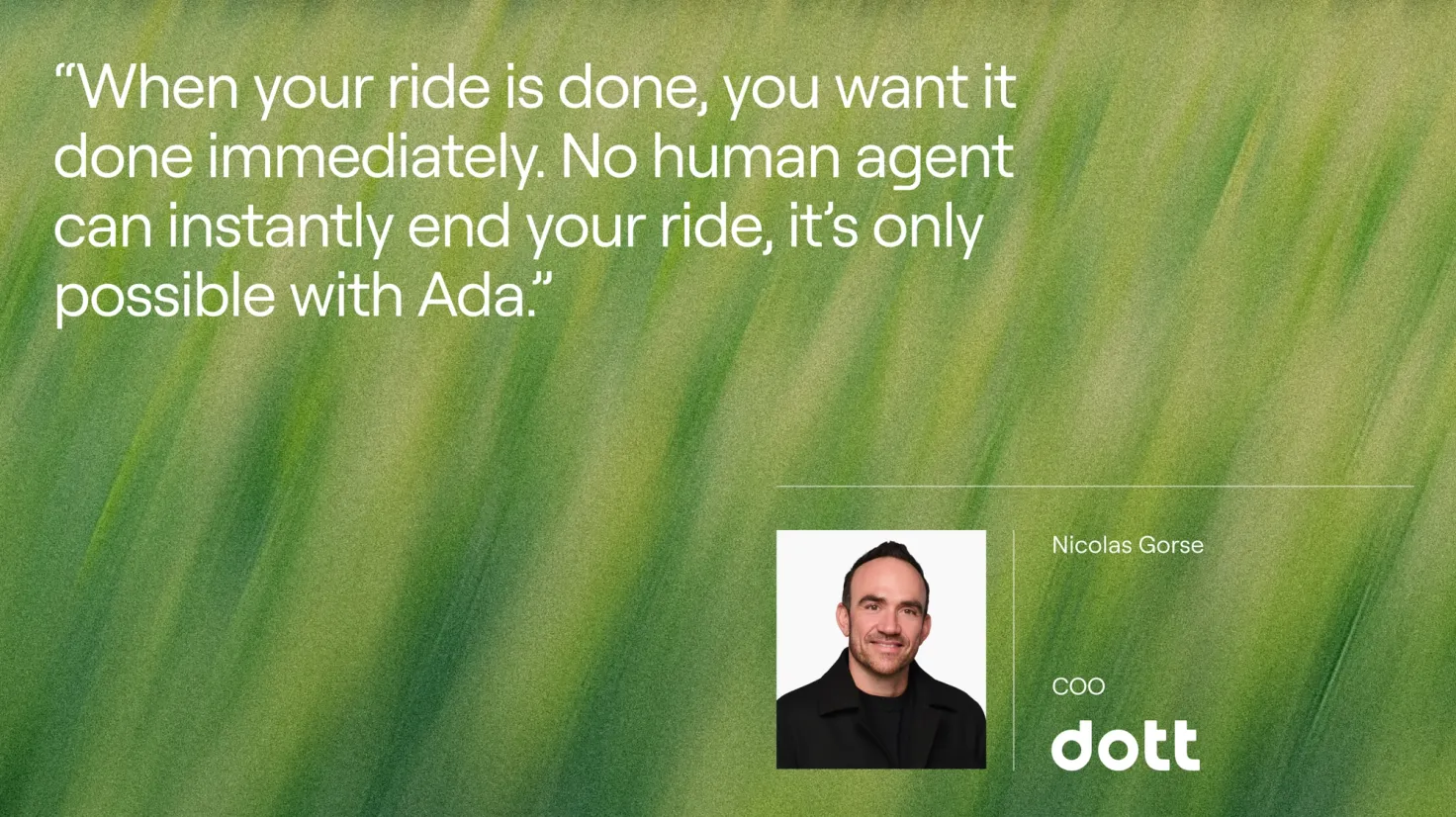
Across Dott's 25 API-powered automations—including refunds, vehicle checks, and trip management—the AI agent doesn't simply provide information. It resolves issues autonomously.
That's what makes autonomous customer service fundamentally different from earlier generations of automation.
What happens when CX becomes an AI-native team?
Many organizations deploy AI in customer service. Far fewer build the operating model required to continuously improve it. That's the distinction between introducing AI into customer service and building an agentic customer experience (ACX) team.
Every customer conversation becomes organizational intelligence
Automation is the most visible outcome of Dott's transformation, but it isn't the most important one.
Dott receives approximately two million customer contacts annually. For years, understanding what those conversations revealed required manual review.
The team could review roughly 50 conversations per day. They knew certain customer experiences weren't performing as well as they should—and they had theories about why—but they couldn't validate them at scale.
Nicolos describes this as struggling to "distinguish the noise from the true symptoms.”
That changed when the team gained the ability to analyze conversations at scale. Patterns emerged that would have been nearly impossible to identify manually. In one market, a spike in refund requests initially looked like a refund-process problem. Deeper analysis revealed a pricing issue: customers weren't using their allotted minutes before expiration. The solution wasn't redesigning the refund experience. It was changing the expiration date.
In another case, the AI agent appeared to struggle with a specific topic. The root cause turned out to be conflicting knowledge articles that were sending customers into loops.
Neither issue would have been obvious through manual review alone.
This is where autonomous customer service becomes something more than operational efficiency; every customer conversation becomes a source of organizational intelligence.
The team closest to those conversations gains visibility into product issues, policy friction, knowledge gaps, and customer behavior patterns before anyone else. When those insights are captured and acted on systematically, customer experience becomes a source of organizational intelligence.
How the job of Dott’s CX team changed
As AI agents took on more customer interactions, the role of the CX team expanded. At Dott, the team became responsible for:
- Managing the knowledge architecture that powers the AI agent
- Identifying opportunities to improve automated resolution
- Monitoring quality and coaching agent performance
- Analyzing customer conversations for trends and root causes
- Turning customer feedback into operational improvements across the business
The work no longer centered on handling individual conversations. It centered on improving the system handling them.
Their influence changed, too
As the AI agent's capabilities expanded, so did the team's influence. The work no longer stopped at resolving customer issues. It extended into performance optimization, root-cause analysis, and improving experiences across the business. At Dott, that means managing knowledge architecture, quality improvement loops, and performance optimization across millions of customer interactions.
It also fundamentally changed how it worked with Engineering.
In many organizations, customer service teams bring engineering broad descriptions of problems: customers are struggling with refunds, a journey feels confusing, or a workflow appears broken. Engineering then has to investigate, validate, scope, and prioritize.
At Dott, the conversation looks different. The CX team arrives with a specific, evidence-backed diagnosis: which market is affected, which workflow is involved, what edge case is occurring, and how frequently customers encounter it.
That precision changes everything:
- Issues move from identification to resolution faster.
- Engineering spends less time investigating symptoms and more time solving root causes.
- Some problems never require engineering involvement at all because the team can address them through knowledge improvements or operational changes.
What starts as customer experience intelligence becomes operational intelligence for the rest of the business.
This is the shift many organizations underestimate. An ACX team isn't measured by ticket volume. It's measured by the performance of the AI agent, the quality of customer outcomes, and the speed at which it can identify and resolve systemic issues.
The companies making the most progress with AI are building the capability to manage and improve AI agents continuously.
The company story hiding inside the customer service story
When the web arrived, companies split into two groups: some treated it as a capability to outsource. Others treated it as a capability to own.
The companies in the second group fundamentally changed how they operated.
AI is creating a similar divide, and for many organizations, the first place they'll build that capability isn't engineering. It's customer service.
Dott's transformation wasn't really about reducing tickets or increasing automation rates. It was about building a new organizational capability. The team closest to the customer became the first team inside the company to learn how to manage AI agents, improve them continuously, and turn millions of conversations into actionable intelligence.
That's why the Dott story matters beyond customer service.
It shows what happens when CX becomes the first AI-native team in the organization, and why customer experience may become the most important entry point into AI transformation.
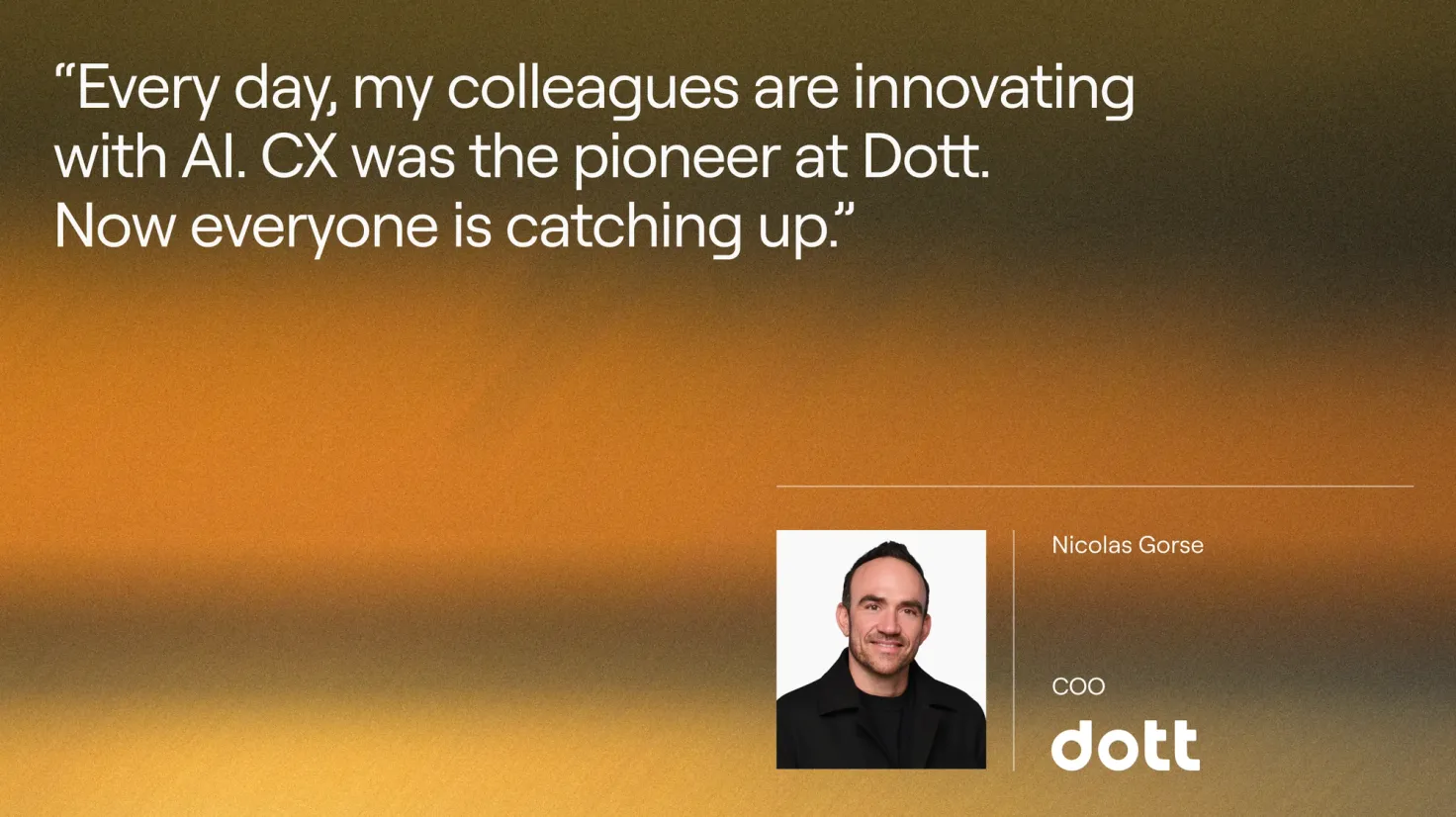
As Nicolas Gorse puts it: "CX was the pioneer at Dott. Now everyone is catching up."