

You’ve seen the dashboard: containment, deflection, average handle time. But when it comes to voice, the old metrics don’t tell the full story.
AI voice agents for customer service are changing what’s possible in the contact center. They’re resolving complex issues, unlocking new revenue, and improving customer satisfaction across every call. But if you’re still measuring them like an IVR, you’re missing the bigger picture.
Because today’s AI voice agents are more than menu replacements. They actually reshape how support teams operate.
But to move past the pilot phase, prove business value, and earn cross-functional buy-in, you need a better measurement strategy. One that reflects what AI voice agents can actually do.
That means knowing which metrics matter, when to use them, and how to interpret what they’re really telling you.

What makes voice AI different, and why it changes what you measure
Let’s start here: voice isn’t just another channel. It’s the one customers turn to when other channels fall short. It's urgent. High-stakes. Personal.
And that changes everything about how you measure success.
Where containment might tell you something in messaging, it tells you very little in voice. Where handle time might flag efficiency, it doesn’t explain impact. Voice demands a deeper look at what resolution really means, and what your AI agent is capable of unlocking.
What voice AI unlocks
Before jumping into KPIs, take a step back. What are we actually measuring for?
AI voice agents aren’t just automating calls, they’re reshaping outcomes. They can resolve, triage, personalize, upsell, and escalate with context. That unlocks a fundamentally different experience for your customers, and a new set of outcomes for your business.
This shift in what’s possible is exactly why your approach to measurement needs to evolve. Let’s look at what voice AI changes, so we can be clear on what success looks like.
How AI voice agents improve customer satisfaction
If you’re looking for a simple answer to a complex question, this is it: AI voice agents improve customer satisfaction by delivering fast, consistent, and competent help, without the frustrating hoops of legacy systems.
Specifically, they:
- Eliminate hold times and menu trees
- Resolve issues immediately or escalate with full context
- Maintain brand tone across every call
- Free human agents to focus on more valuable work

In short: faster service, fewer roadblocks, more resolution, and better outcomes for everyone. They also drive business outcomes like:
- Increased automated resolution
- Reduced average handle time
- Improved first-call resolution
- Higher conversion in key segments
- Lower cost per contact
And they do it while reducing load on your human agents. But to prove this—and to scale it—you need the right framework for evaluating performance.
How to evaluate AI voice agent performance
Let’s get practical. You’re implementing voice AI. The tech is working. Now you need to show that it’s delivering value.
First thing to know: an effective evaluation framework should evolve over time, just like your AI voice agent does.
In early days, it’s about validating performance and minimizing risk. Later, it’s about optimizing for efficiency, revenue, and experience. Let’s break it down. Here’s how to measure performance at different stages of maturity, starting with the quick wins that get leadership nodding.

In early pilots: Prove potential, fast
When launching an AI voice agent for the first time, you’re not trying to boil the ocean. You’re looking to demonstrate clear wins that are easy to understand, quick to report, and directionally valuable.
In your first 30–90 days, you want to validate outcomes without overwhelming your team or stakeholders. That means focusing on metrics that show clear, directional value.
1. Containment (and why it falls short)
Containment measures how often an AI agent completes a call without escalating to a human. It’s one of the most overused metrics in voice AI, and often it’s the first number execs ask for.
But it’s not the most useful metric for voice AI. Voice automation is more complex. And sometimes, escalation is the right outcome.
Containment doesn’t equal success. In fact, it can obscure it.
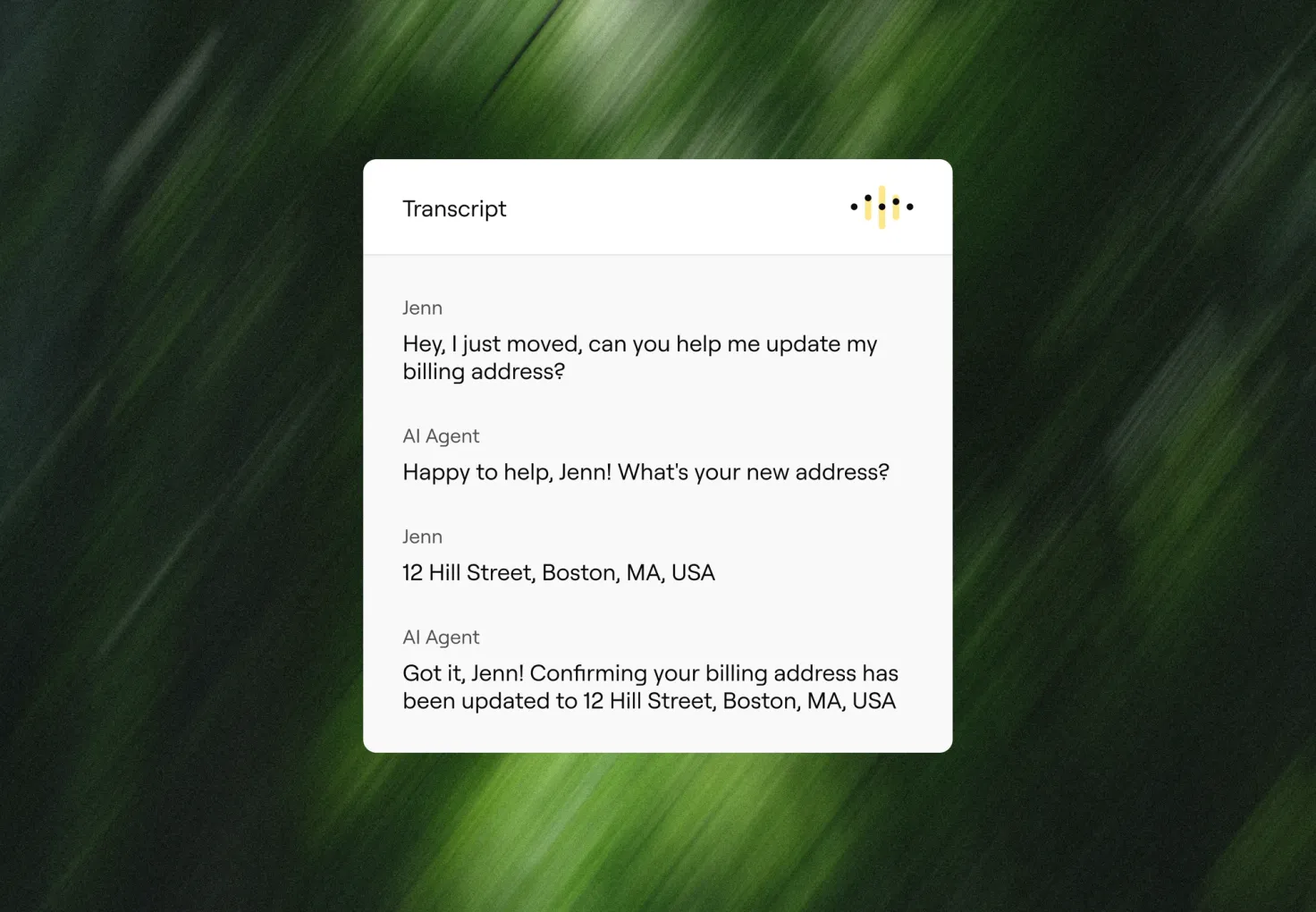
Let’s say a customer calls to update their shipping address. The AI completes the task, then flags a revenue opportunity based on CRM data. It introduces a tailored upsell and routes the call to a sales agent to close. Was the call contained? No. Was it a win? Absolutely.
Containment is a lagging, surface-level signal. The better metric is resolution, and even that has nuance.
2. Automated resolution
Automated resolution is a clearer measure of success: it tracks whether your AI voice agent actually resolved the customer’s intent, end-to-end, without needing a human.
But in voice, it’s not always binary.
Some of the most impactful outcomes happen in the grey zone, where the AI agent partially resolves an issue, authenticates the caller, collects key info, and passes that context forward.
Resolution should be seen as a spectrum. Start by tracking it. Then look deeper.
3. Average handle time (AHT)
This one’s simple: how long did it take to resolve the call?
Tracking AHT shows how efficiently your AI agent is handling tasks, and how much agent time you're giving back to the business.
Shorter AHT not only reduces costs, it creates a smoother customer experience.
AI voice agents nail this, eliminating delays, automating tasks, and preventing redundant handoffs. They don’t transfer blindly. They don’t repeat questions. And they don’t force customers through dead-end menus.
4. Escalation patterns (not just rates)
Not every escalation is a failure. In many cases, it’s a sign the system is working exactly as intended.
Rather than asking how often your AI agent escalates, ask how well it escalates. Most pilots see three common escalation paths:
- Full resolution: The AI completes the task and closes the ticket.
- Partial resolution: The AI performs part of the workflow, then hands off with context.
- Priority transfer: The AI recognizes a VIP or high-value scenario and routes immediately—but still adds value with personalization and setup.
Measure the quality of escalations, not just the frequency. It’s the difference between blind transfers and intelligent triage.
When escalations are smooth, customers don’t feel like they’re starting over. And that makes a huge difference in satisfaction and loyalty.
5. Customer satisfaction and signal quality
Traditional CSAT and NPS still matter, but they’re not the whole story.
Voice conversations are dynamic. Instead of relying only on surveys, you can mine conversation data. Voice AI opens the door to richer insights:
- Did the agent understand the customer’s goal?
- Was the issue resolved without confusion or repeat questions?
- Was the tone consistent with your brand?
- What products or services are actually causing service issues? At what frequency?
- Are we seeing spikes in certain topics, products, or requests in real time?
- Are we giving customers opportunities to share open-ended feedback, not just press a number?
Rather than analyzing tone directly (which is notoriously noisy), analyze intent, flow, and resolution. The real signal lives in what was said, and how it was handled.
Over time: Track transformation, not just activity
Once the pilot is behind you and your AI voice agent is live across more use cases, it’s time to zoom out. Now, the metrics shift from validating the tech to demonstrating how it transforms your operation.
As your AI voice agent matures, the question becomes: what’s changing in your business? These long-term metrics help you measure strategic value.
1. Cost per contact
Every resolution your AI agent handles means less time, money, and headcount spent on low-complexity calls.
More than that, every interaction handled by AI reduces strain on your agents. That means fewer hires, more bandwidth, and better coverage during peak periods.
Tracking CPC helps quantify your return on automation, especially at scale. Track:
- Reduction in agent load
- Lower staffing costs
- Fewer repeat calls
These savings are especially valuable during seasonal spikes, crises, or product changes, when call volumes climb but agent capacity can’t.
2. Revenue influence
AI voice agents don’t just reduce costs—they can unlock growth. With the right workflows, AI agents can:
- Identify upsell eligibility,
- Deliver targeted offers, and
- Route qualified leads with context.
Your AI voice agent doesn’t need to close deals, but it can light the path to conversion, especially in industries like subscription services,ecommerce, and banking.
Track how many conversations touch revenue, and how often those touches convert.
3. Customer lifetime value (LTV)
The compounding effect of better service? Customers stay longer.
When customers call and actually get helped—quickly, naturally, and on-brand—they stay longer, spend more, and trust your brand more. AI voice agents improve retention, and higher retention means higher LTV.
4. Agent satisfaction, productivity, and team transformation
As AI handles more routine interactions, your team shifts to more strategic work. With AI voice agents handling repetitive calls, your agents can:
- Focus on complex, high-value interactions,
- Take on roles like AI Coach or Conversation Designer, and
- Reduce burnout and attrition.
These aren’t hypotheticals. They’re already showing up at enterprise-scale Ada customers. It’s the foundation of an agentic customer experience model.
5. Operational agility
Legacy voice systems are slow. Change takes weeks, if not months. AI voice agents flip that.
Want to update a call flow? Add a message about a promo? Adapt to an outage? With the right setup, you can do that in minutes—not weeks. And when customer needs change fast, agility matters more than ever.

The intelligence powering better conversations
So what makes this kind of performance possible? It’s not just speech recognition. The most effective AI voice agents are able to understand intent, apply context, and determine the best course of action instantly.
They balance fast responses for simple tasks with deeper reasoning when complexity increases. They know when to hand off, how to personalize, and how to adapt in real time. And they do it all without breaking the customer experience.
This level of intelligence is what makes AI voice agents feel less like tools—and more like teammates.
Better metrics unlock better outcomes
Containment got us here. But it won’t take you forward. If you’re measuring voice AI with legacy KPIs, you’re going to get legacy results.
But when you start measuring for what actually matters—resolution, sentiment, agility, revenue—you unlock something more: momentum. Voice becomes a channel your team wants to invest in. Your customers notice the difference. And your business gets more efficient, more scalable, and more customer-centric in the process.
That’s what AI voice agents were built for. And that’s what your metrics should reflect.
Modern AI voice agents: A de-risked path for enterprises
This guide gives you a practical roadmap to move beyond IVR and benefit from the power of AI voice agents for customer service.
Get the guide