

Enterprise AI in customer experience is entering a different phase of maturity.
The first wave was about coverage: expand where customers show up and reduce obvious friction. That phase delivered value quickly because it focused on surface-level efficiency.
The second wave is proving more demanding.
As AI agents take on authentication, policy enforcement, data retrieval, and multi-step workflows, the complexity shifts. What once felt like channel expansion begins to resemble operational redesign. Agentic AI in customer experience is no longer confined to answering questions; it’s making decisions, executing actions, and shaping customer outcomes across messaging, email, and voice.
When AI in customer experience operates at the core of operations, success is no longer defined by where it is deployed. It’s defined by how it’s managed.
Many organizations sense this shift but struggle to articulate it. The symptoms surface first: coordination overhead increases, updates become harder to synchronize, and performance metrics grow more difficult to interpret. What looked like automation progress starts to feel structurally fragile.
In many cases, the reason is simple: AI customer service stalls without structure.
It’s the point where incremental automation stops being enough. A different approach becomes necessary, one where intelligence can reason, act, and personalize interactions across the full customer journey. This is the shift toward agentic AI in customer experience.
To understand why, we need to examine the tension that sits beneath most enterprise AI customer experience programs today.
Is your enterprise ready for AI customer service?
Before choosing the right AI customer service solution for enterprise scale, it’s important to understand where the organization is at now. This assessment helps you answer that question with clarity and chart the right course forward.
Take the assessmentThe structural tension inside enterprise AI
The tension is rooted in how many enterprises structure AI within customer experience operations.
Most organizations didn’t set out to build a comprehensive operating model for AI from the beginning. Instead, AI was introduced pragmatically to solve immediate pressures.
Messaging automation absorbed repetitive inquiries. Email workflows reduced backlog. Voice AI modernized contact center operations. Each initiative improved a specific part of the customer experience.
For a time, that incremental approach works. But expanding the AI channel by channel is not the same as building a program.
As AI agents take on authentication, policy enforcement, data retrieval, and transactional workflows, the underlying architecture begins to matter. An AI agent retrieving static information can tolerate isolated logic. An AI agent authenticating customers, enforcing policy, retrieving structured data, executing transactions, and confirming outcomes cannot.
When intelligence evolves independently across channels, predictable patterns emerge:
- Business rules diverge subtly across modalities.
- Updates must be replicated across systems rather than propagated from one source.
- Definitions of resolution vary depending on how the customer engages.
- Governance controls are applied unevenly.
- Performance reporting reflects channel sessions rather than end-to-end journeys.
At this stage, organizations often assume they’ve reached the limits of AI capability. 55% of businesses are measuring AI and human interactions together, making it structurally impossible to see where AI is underperforming.
In reality, they’re encountering the limits of scaling AI without an operating model. Without that structure, AI customer service initiatives often plateau even as the underlying technology continues to improve.
The strain becomes visible when AI operates at scale across regions, use cases, and systems. What worked in pilot conditions begins to break under real operational load.

Reframing AI in customer experience as an operational capability
Architecture alone does not explain the friction. The way AI is positioned inside the organization compounds it.
AI in customer experience is often introduced as a product enhancement. It is evaluated like software and implemented like a tool. Once AI customer service agents begin resolving complex inquiries and executing actions across systems, that framing no longer holds.
At that point, AI is participating in core operations. In effect, AI customer service agents become some of the most scalable customer-facing employees in the organization.
Human agents operate within structured systems that define accountability, quality standards, escalation paths, and ongoing coaching. When AI customer service agents assume comparable responsibility, the same discipline must apply.
Without clear ownership and operating cadence, the symptoms intensify:
- No single leader is accountable for AI performance across channels.
- Improvements depend on engineering cycles rather than structured review loops.
- Governance and policy enforcement vary by workflow.
- Knowledge updates fail to propagate consistently.
- Teams spend more time reconciling systems than refining outcomes.
Under these conditions, scaling becomes fragile. Expansion stalls. Performance gains flatten. 80% of businesses don't have a fully adopted governance framework for AI in customer experience.
Organizations that move beyond this plateau recognize that AI requires an operating framework, not just deployment momentum. They establish accountability, align resolution standards, and formalize improvement cycles that treat AI performance as an ongoing operational responsibility.
That shift marks the transition from incremental automation to institutional capability.
The emergence of agentic customer experience (ACX)
What begins as architectural strain and organizational friction eventually forces a broader question: if AI agents are now embedded inside customer operations, how should they be governed?
Agentic customer experience (ACX), the discipline of managing AI customer service agents as a core operational capability, is the response to that shift. The ACX Operating Model provides the structure that makes this discipline scalable.

It recognizes that today’s AI agents do more than answer questions. They authenticate users, enforce policy, retrieve and write data, execute workflows, and influence trust. Because they operate with real customer context, agentic AI for customer experience can personalize experiences dynamically rather than relying on static automation. At that level of responsibility, expansion without structure creates risk.
ACX establishes three structural requirements for scaling AI responsibly:
- A unified intelligence foundation: AI agents operate from one coherent reasoning layer across messaging, email, and voice, with consistent policies and safeguards.
- A structured operating cadence: AI performance is reviewed, measured, and improved against defined resolution and business outcomes, not just automation rates.
- Explicit organizational ownership: Accountability for AI performance is clearly defined, with roles responsible for governance, knowledge integrity, and continuous improvement.
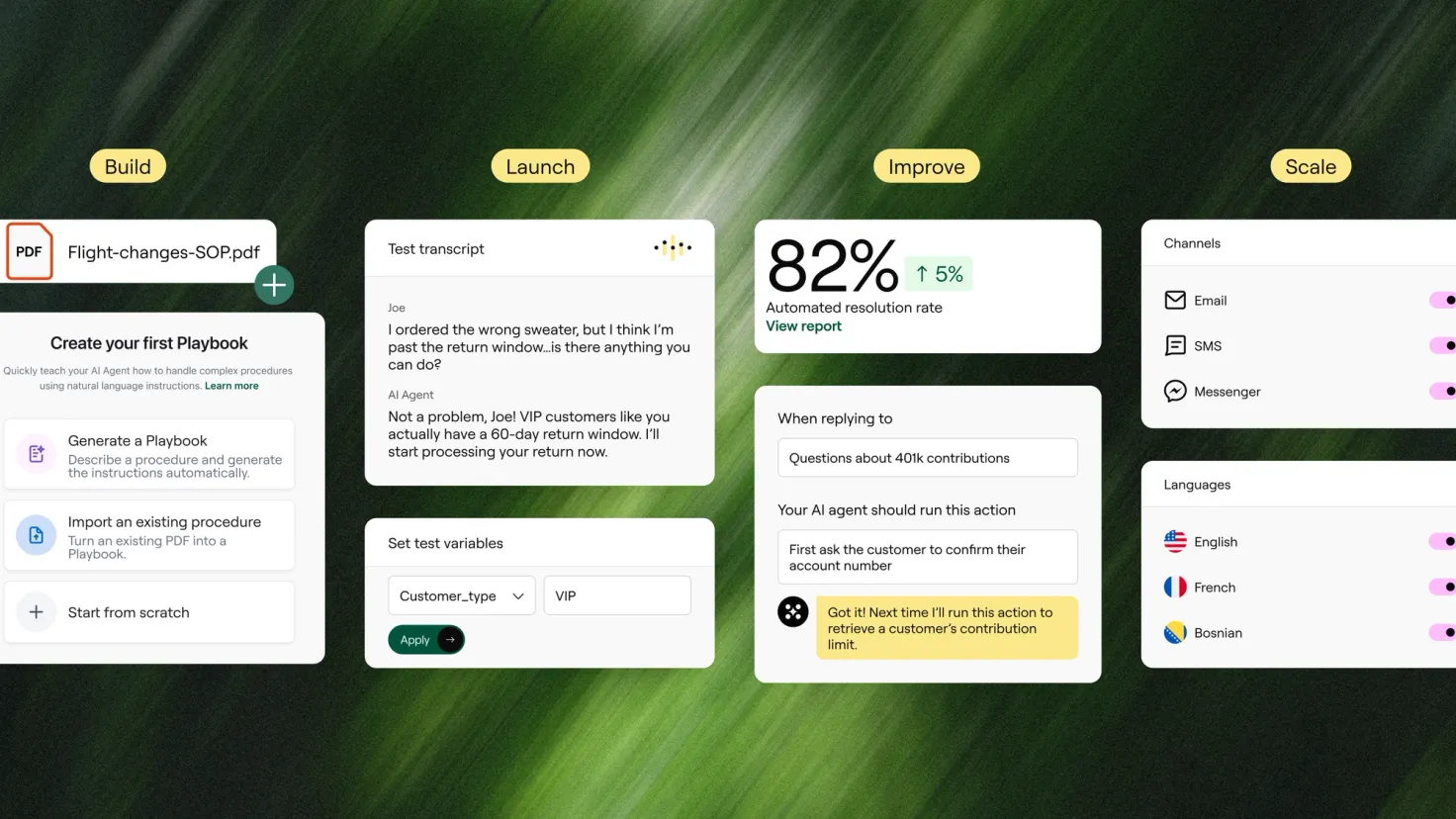
Together, these elements move AI from experimentation to institutional capability. What changes when that structure is in place is where the real impact begins.
What changes when AI is operated intentionally
Once AI is embedded within a disciplined operating framework, changes become visible across systems, teams, and metrics. Three structural shifts emerge.
1. Intelligence becomes coherent
Instead of maintaining separate logic across messaging, email, and voice, AI agents operate from a shared reasoning foundation. That means:
- Policy updates apply consistently across channels
- Context persists across interactions
- Resolution is defined once and enforced everywhere
- Safeguards do not vary by surface
The operational burden of synchronizing systems begins to shrink. Coordination gives way to consistency. As intelligence becomes unified, agentic AI can respond with context, act across systems, and resolve issues faster, which directly improves the overall customer experience.
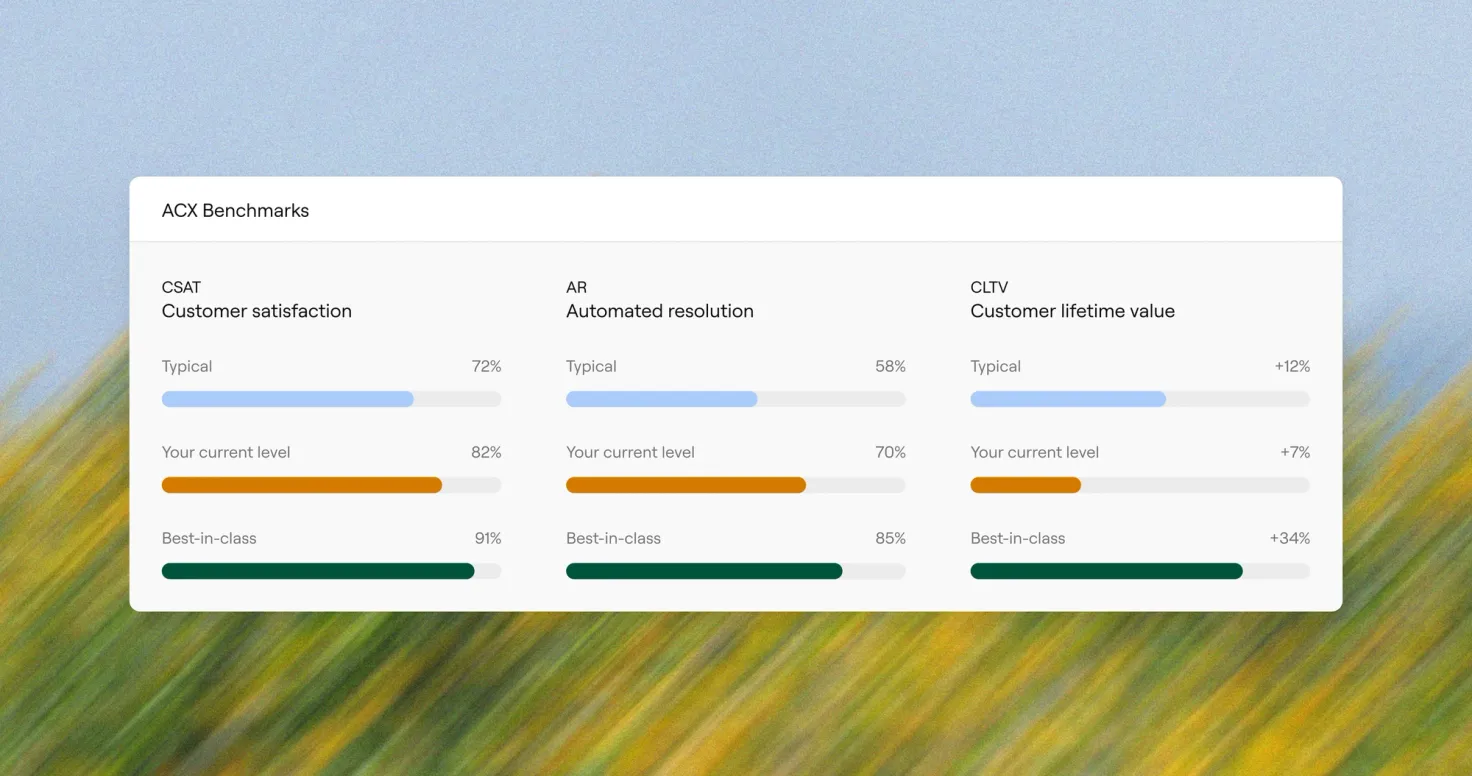
At that point, enterprises begin evaluating AI impact differently. Success is no longer measured by containment alone, but by resolution quality, customer satisfaction, cost-to-serve reduction, and the ability to complete end-to-end workflows across systems.
2. Improvement becomes disciplined
Resolution rate currently ranks 7th among outcomes businesses track from AI deployment, behind wait times, cost-per-interaction, and ticket deflection.
AI performance is no longer measured through isolated automation spikes or containment percentages. Organizations begin to anchor improvement around:
- Resolution quality
- Customer satisfaction
- Cost-to-serve
- Journey-level performance rather than session-level metrics
Review cycles become deliberate. Iteration becomes structured. Gains accumulate rather than resetting with each new expansion.
3. Ownership becomes explicit
With defined accountability in place, AI stops existing between teams.
- A clear leader owns performance across channels
- Knowledge integrity is actively governed
- Engineering resources shift from reactive fixes to strategic enhancements
Confidence grows because guardrails are defined. Over time, these shifts compound.
Integrated systems allow AI agents to retrieve data, execute transactions, and maintain context across channels, which directly improves resolution speed and consistency.
Updates no longer require cross-channel reconciliation. Governance becomes embedded rather than layered on. Performance reflects full customer journeys rather than individual sessions. Expansion into higher-stakes use cases—identity verification, policy enforcement, real-time voice transactions—becomes methodical rather than risky.
And that is where durable differentiation begins.
How to choose AI technology for enterprise customer service
This guide breaks down the seven essential categories every agentic CX RFP should include and what to look for in each.
Get the guideThe real inflection point: How intelligence is governed
AI in customer experience has moved beyond experimentation. The technology is capable, the models are improving, and the pressure to modernize operations while reducing cost is only increasing.
59% of consumers prefer always-on AI over waiting for a human, but only when it can actually resolve their issue.
The constraint is no longer intelligence, but how that intelligence is governed. Without structure, even the most capable AI struggles to scale consistently.
As AI customer service agents take on identity verification, policy enforcement, transactional updates, and real-time voice interactions, they become embedded in the core of customer operations. At that point, the question shifts from how many interactions can be automated to how well intelligence is managed across the enterprise.
Organizations that continue layering AI channel by channel will make progress, but they will also accumulate coordination overhead. Governance scrutiny will intensify. Performance will improve, but unevenly.
Organizations that formalize an operating model around AI will experience something different:
- Improvements will propagate
- Metrics will reflect full customer journeys
- Ownership will be clear
- Expansion into higher-stakes workflows will feel deliberate rather than risky
- Over time, gains will compound
This is the distinction that will define the next phase of customer experience transformation.
Agentic customer experience provides the structure for that phase. It establishes the discipline required to scale intelligence as a core operational asset.
The enterprises that recognize this shift early will establish a disciplined system for managing intelligence as a core operational asset. Others will continue expanding AI in customer experience without addressing the structure behind it.
Agentic CX in 2026: What consumers expect and most enterprises miss
There’s a common assumption that consumers are skeptical of AI in customer service. The data says otherwise. Our 2026 report surveyed 2,000 consumers to understand how people actually experience AI in customer service today.
Read report