Green Feather Online
- 37 point increasein automated resolution rate in five months
- 4 brandsmanaged by one platform
- 90% CSATfor top performing complex workflow
“We're not afraid of peaks anymore": Green Feather's agentic CX transformation in online casinos
Green Feather Online has been running online casinos since before AI entered the mainstream. Today, they operate four casino brands across multiple markets and languages, handling the full complexity of regulated gaming at scale: VIP player management, compliance-sensitive escalations, and goodwill grant inquiries.
Before Ada, Green Feather's support model struggled to keep pace with the business's explosive growth. The support team was fully capable, but with roughly 125,000 tickets per month, six to seven languages, and no automation, the options were limited. As the business grew faster than they could hire, it became clear that scaling through headcount alone wasn't a strategy. It was a treadmill.
This was 2023. Green Feather knew a safe bet when they saw one. "We realized that if we want to continue to scale, it's not going to be by adding more human agents," says Arik Weiss, CEO of Green Feather Online, who has been with the company for 15 years. "We have peaks and troughs that are very hard to handle with a human team, but would be prime for AI."
The payoff of betting on a long-term partner
Green Feather evaluated several vendors. A feature list wasn't what they were after; platform demos only get you so far, and anyone can put together a polished one. What they were really buying was confidence in the team. What set Ada apart, Arik says, was the pre-sales process.
"Ada led with questions rather than the product. They first really tried to understand where we needed help and if they could actually help us, rather than just pushing the platform and leaving us to figure things out later."


The Ada team was transparent about what the platform could do and what was coming. That transparency, combined with a genuine interest in a long-term partnership over a closed deal, was what got Green Feather to commit.
"The important thing was that we had a partner who understood what we were looking for and was able to present solutions, and help us build those solutions as we progressed together," Arik says.
Their bet paid off in spades. Two years in, Green Feather's biggest growth constraint has shifted. Where once scaling the business meant scaling the support team, their Ada-powered AI agents absorbed that pressure. As Arik puts it, “we're not afraid of peaks anymore.”
The transformation from CX to ACX
AI customer service has changed how Green Feather grows as a business. This level of maturity wasn’t an accident. From day one, Green Feather made a decision that most companies don't: rebuild the customer experience around AI.
When Arik and the team committed to Ada in 2024, they didn't slot it in as a feature or a cost-cutting measure. They treated it as the foundation of a new kind of support function, one that could unlock the full benefits of Agentic Customer Experience (ACX).
The clearest signal of that commitment was Anton Vavercak, Solution Engineer. Already a few years into his tenure, his role evolved until he was fully focused on Ada-powered ACX—not as a side project alongside other responsibilities, but as his entire mandate.
Arik's framing cuts right to it. "Think of the AI agent as a very capable but untrained human agent. Just like you would with any new hire, you make sure they have proper onboarding, access to knowledge, consistent coaching, and performance evaluation. That's how we treat Ada," he says.
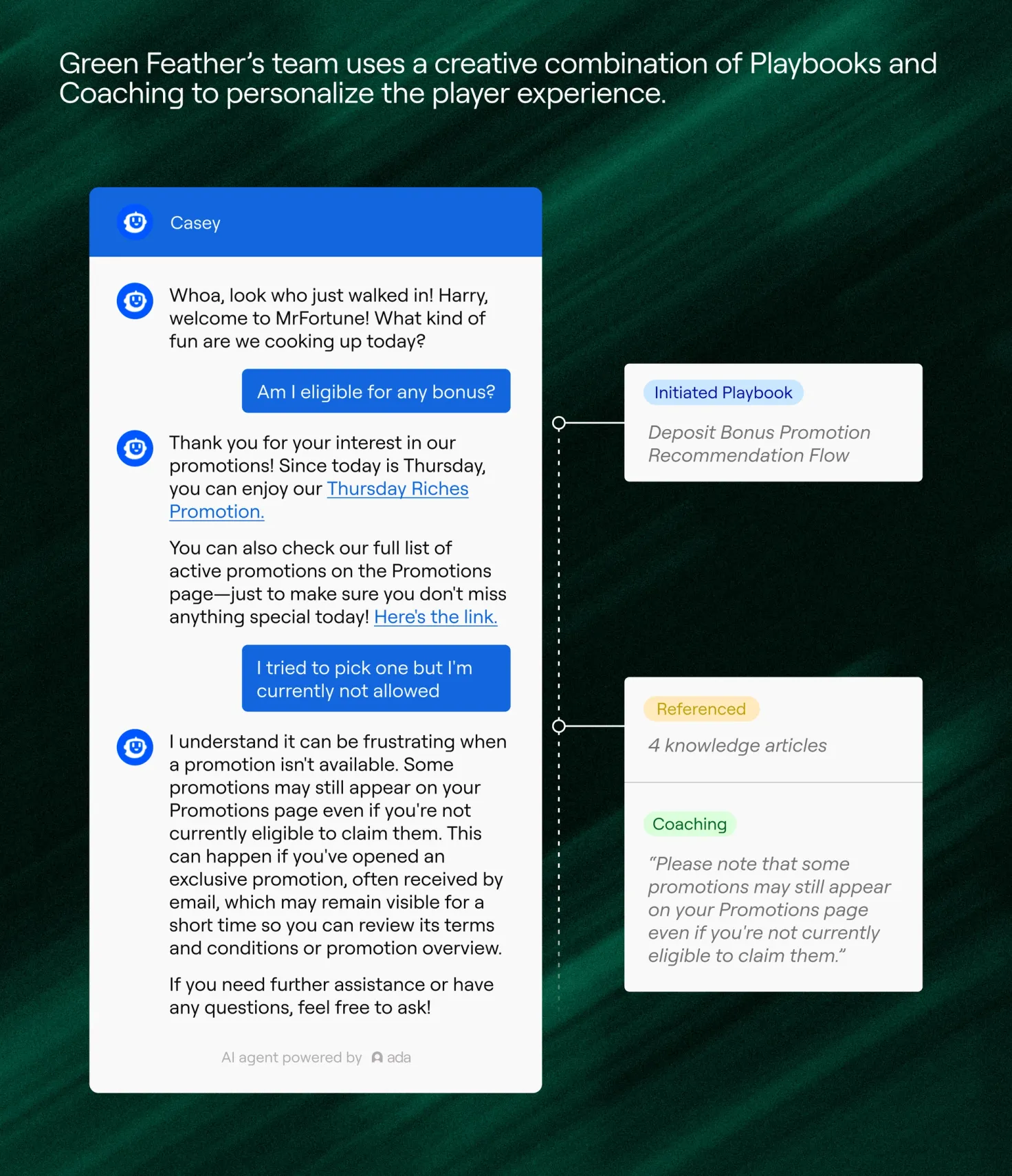
Anton points to the Deposit-Bonus Recommendation Playbook as an example of how coaching and logic work together. "Ada identifies the player's exact day based on their timezone and serves the correct daily promo," he explains. "Within the same Playbook, Ada also handles welcome package offers for new players on their first three deposits, and has a tailored promo for high-stake players who typically deposit around €100. Ada identifies which promotion best fits the player's profile and expectations, and sends them the link."
Anton works across QA, technical teams, back office, and most closely with the high net value player team, whose desk sits right next to his. That proximity is deliberate; understanding what the VIP team needs and where Ada can absorb volume without disrupting the premium experience is a constant, collaborative process. It's not platform management. It's organizational coordination.
Headcount hasn't changed significantly since Ada came on board, but roles have. The AI agent owns everything recurring and repetitive. Human agents handle the cases that require judgment and provide white-glove service for VIP and high net value players.
+37 point increase in five months
When Green Feather started with Ada, their automated resolution rate was roughly 3%. Within five months, it had crossed 40%, owing to the cumulative effect of consistent, daily work, and it has been steadily climbing since.
Anton identifies three main levers: knowledge base optimization, coaching, and Playbooks. The knowledge base was the foundation, not just adding content, but optimizing it for AI interpretation and retrieval. Ada's built-in analysis tools were critical here, surfacing intent breakdowns by topic, automated resolution rates by question type, and exactly where conversations were stalling.
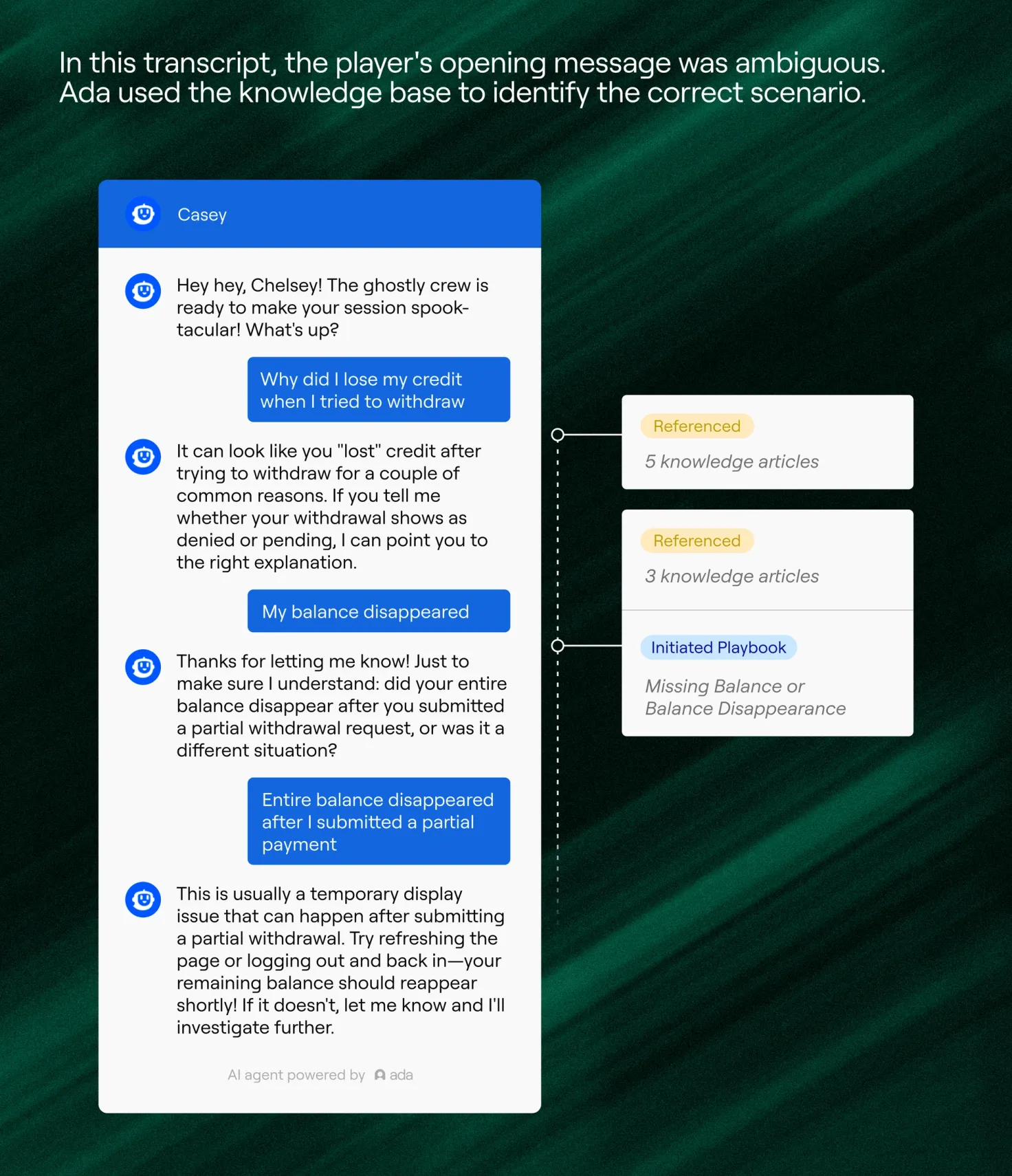
Anton highlights the Missing Balance or Balance Disappearance Playbook as a standout example. "Balance discrepancies are sensitive. There are only a few possible explanations, and Ada works through them based on the player's responses," he explains. "When it identifies the right scenario, it resolves without escalation. If nothing matches or the player asks for a human, it hands off immediately. It took a couple of rounds of coaching to get right, but it now saves the team significant effort."
That depth of analysis revealed something Arik hadn't fully anticipated: many of the biggest opportunities weren't about improving CX, but rather about understanding why certain questions were being asked at all.
"Ada's analysis helped us understand that if we were getting a lot of chats about a particular topic, the solution wasn't always answering better, but preventing them altogether by fixing the product or UX issue that was causing them."

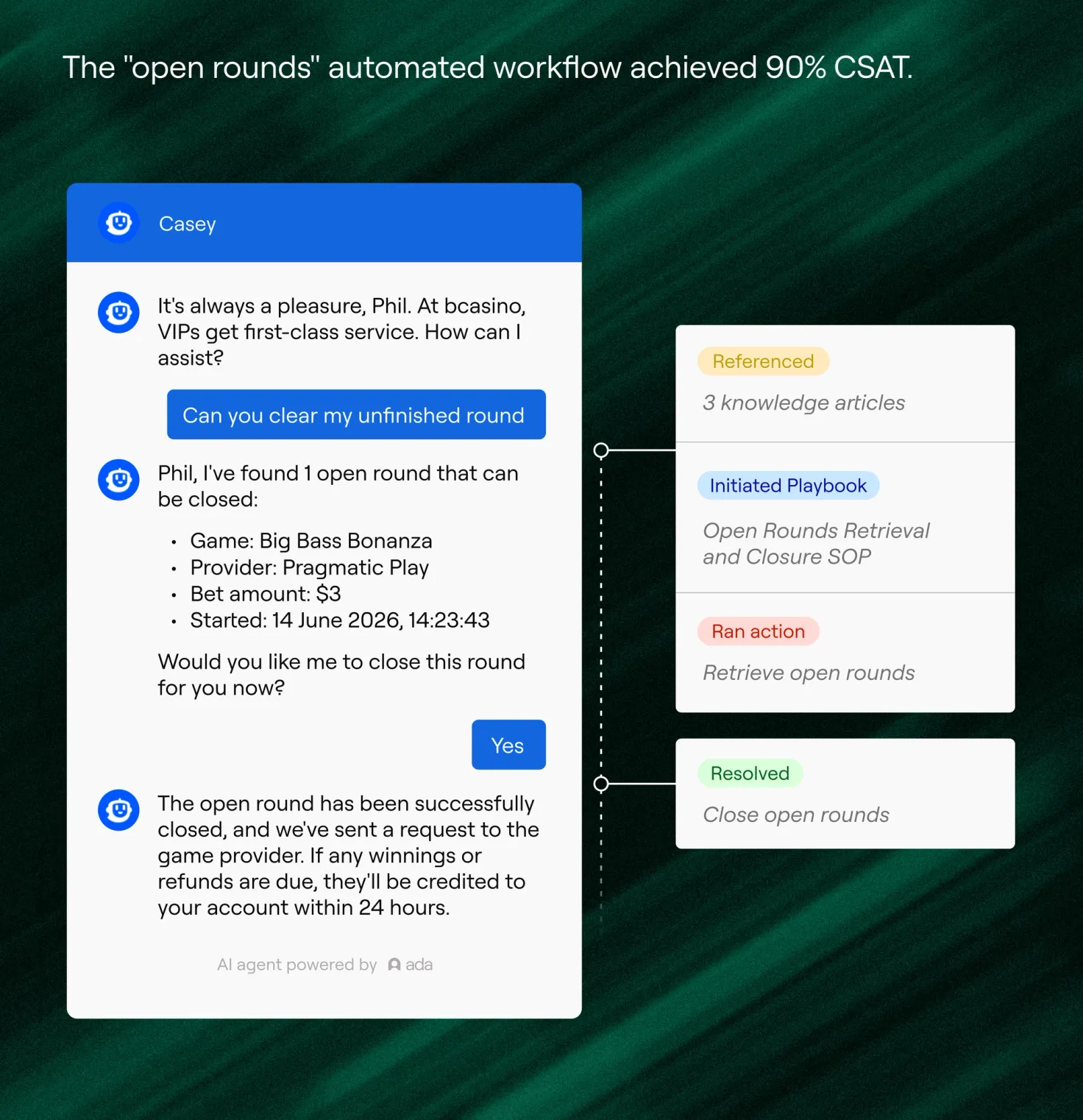
One of the clearest examples is open round inquiries: players stuck mid-round due to a technical issue, reaching out for a resolution. Ada's analytics flagged the volume. Green Feather took a two-pronged approach:
- They built an API integration so Ada could resolve open round issues in seconds, replacing a process that previously required a support ticket and a wait of minutes to hours.
- They investigated the root cause on the product side to reduce how often those issues occurred at all.
When open round inquiries come in, Ada now handles them with a CSAT of around 90%.
The Playbook integrations run directly on Green Feather's own platform, not through a third-party tool or ticketing software. They create specific API endpoints that give Ada the information it needs (user activity, standing, reward history), and all decision-making logic lives in the Playbooks. Anton's role is to define the logic and requirements; the dev team's job is to build the endpoint. Because Ada holds the intelligence, the development workload stays light.
Complex resolutions in a highly regulated industry
In gaming, CX workflows aren't just complex, they're highly regulated, with low tolerance for error. Every market brings different rules, different languages, and different standards for what can and can't be said to a player. Managing that across multiple brands is a problem most companies in the industry haven't solved. Green Feather has.
Multiple brands, one operation
Green Feather doesn't run one casino. They operate four brands across multiple markets. Managing multilingual, multi-market, compliance-sensitive support through a single operation is where Ada's architecture becomes a strategic asset.
They run a single operation across all their markets, with Ada handling first contact everywhere using the same AI and escalation stack. Anton manages compliance at the knowledge base level: knowledge base articles are scoped to specific player groups or entry URLs, so only the relevant content surfaces depending on where a player is coming from.
For more complex regional requirements, Playbooks handle the differences independently using Ada's generative capabilities without needing separate CX operations for each market or brand.
"Ada lets us look at everything as one big operational brain," Arik says. "And when it comes to the specifics, Ada knows how to reply or where to direct the player."
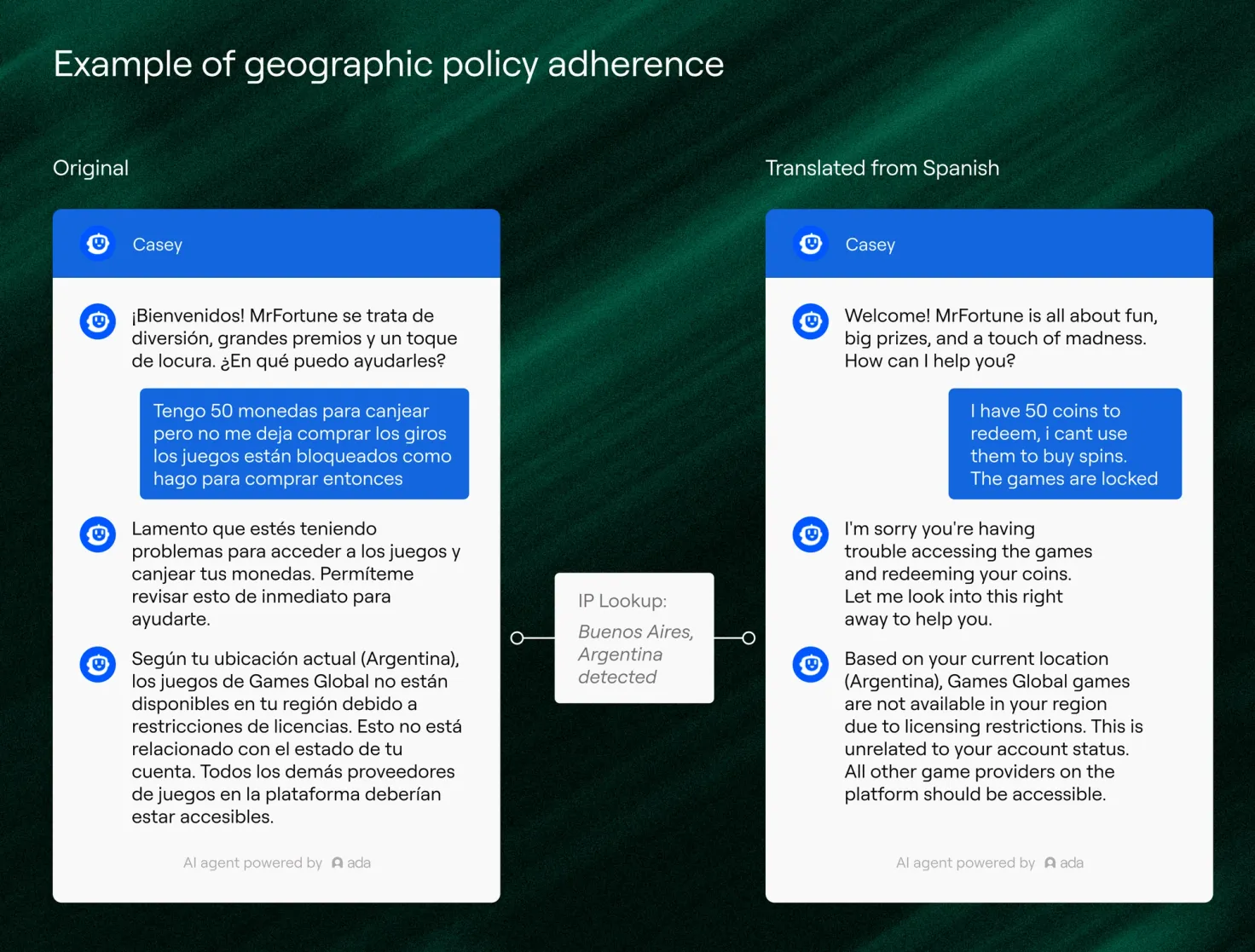
That same precision extends to Green Feather's most complex workflows for issues that, handled manually, required agents to cross-reference multiple data points before responding. These are high-stakes interactions, financially and emotionally, where getting it wrong has real consequences.
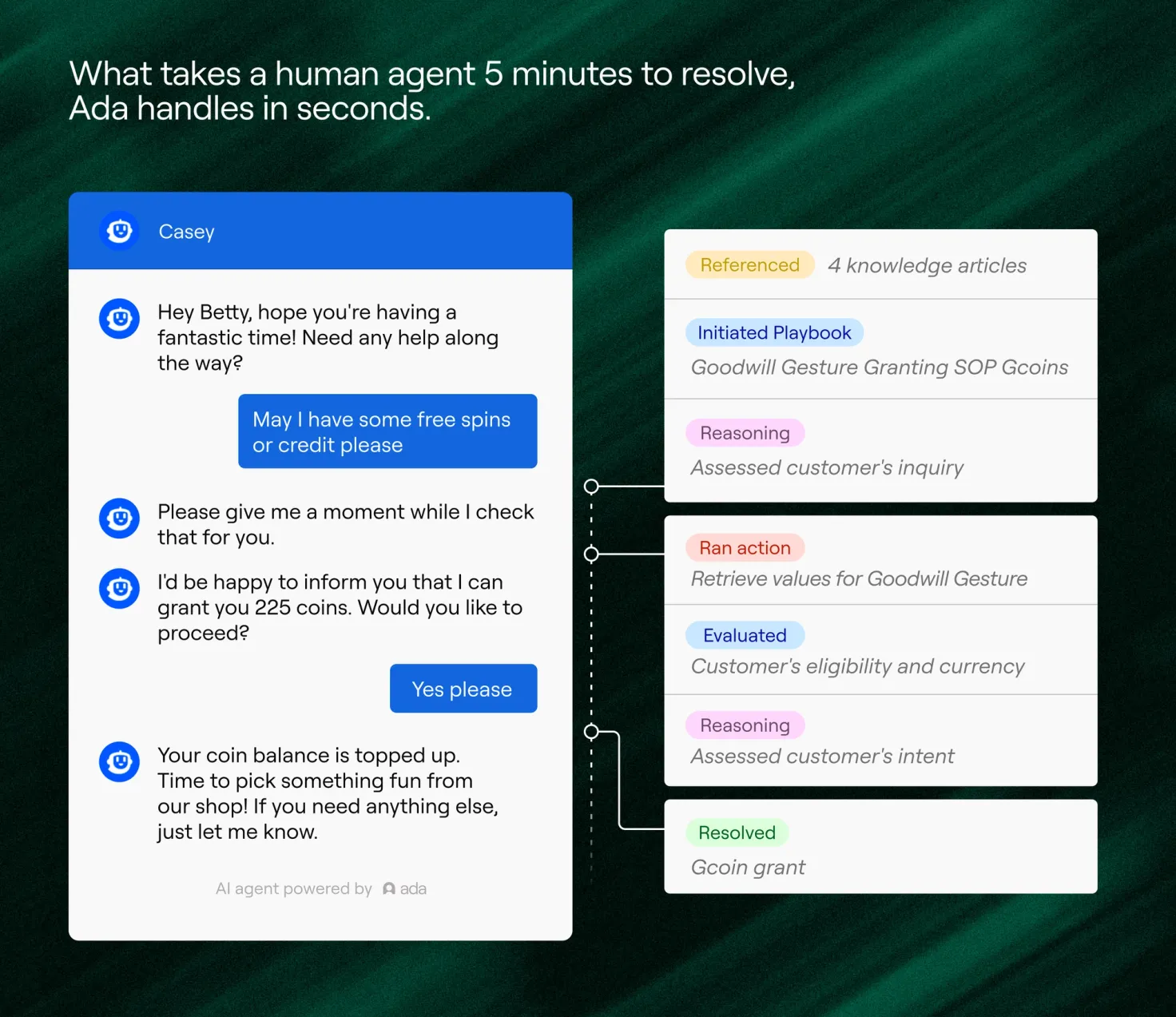
Take Goodwill Gesture inquiries. Goodwill gestures are complimentary credits or bonuses that players can request when they feel a resolution warrants it: a refund for a failed transaction, compensation for a technical issue, or a goodwill offering to retain a valued player.
A live agent working through an eligibility assessment could take up to five minutes. For a support team handling volume at scale, that adds up. Anton rebuilt the entire decision-making flow inside Ada using API integrations that connect directly to Green Feather's own platform. Ada now makes a handful of API calls within a single Playbook interaction, pulling the information it needs, running through the relevant logic, and resolving the player's request in seconds.
An investment in the future
For Green Feather, Ada isn't the whole AI story, it's one layer of it. Alongside Ada, they run machine learning models for prediction and content presentation at scale. Ada handles customer interactions; ML handles what gets shown to players and when. Arik describes them as working together as a stack. That's the context for what makes Green Feather's ACX ambitions credible: they're not experimenting with AI, they're building with it across the business.
Their focus moving forward is on optimization: tightening knowledge structure, closing weak spots, and moving the remaining high-volume question types to API-driven Playbooks. The vision beyond that is straightforward: Ada absorbs the growth. Scaling the business no longer means scaling the support team proportionally. Hiring has already shifted; Green Feather now recruits for problem-solving and empathy, not throughput. They don't need someone who can handle a hundred chats a day, they need someone who can handle the complex case.
Arik's advice to other gaming operators is direct: treat AI adoption as an operational decision first. The technology is the easy part.
"What it actually requires is someone fully dedicated to owning the ACX program, iterating daily, testing, failing, improving. Not managing it as a side project or a backlog item for the tech team."