

When Endy’s redemption code appeared on 200,000 Tim Hortons® Roll Up To Win™ cups across Canada, the company knew a surge in customer contacts was coming. Questions about redemptions, shipping, delivery timelines, and order issues would hit all at once, across multiple channels and at unpredictable volume.
Endy’s AI agent resolved 85% of those campaign-related contacts autonomously.
For most ecommerce brands, that kind of volume spike exposes the limits of their AI customer service program—workflows break down, escalations increase, and support teams end up manually filling operational gaps.
But not Endy. They spent the previous year building something more scalable: an agentic customer experience (ACX) program designed to handle complex customer workflows consistently across brands, channels, and high-volume customer moments.
Endy's playbook for multi-brand AI CX at scale
Endy's AI agent automatically resolves customer interactions across messaging and email for three brands, driving lower costs, stronger CSAT, and impact that reaches well beyond customer service. This is the story of how they got there.
Read Endy's storyFrom AI customer service to agentic customer experience
By the time Huda Shaalan joined Endy as Team Lead, CX AI & Automation, the company already had an AI agent live on messaging for the Endy brand.
The next challenge was scaling it.
Endy wanted to expand across Casper and Hush, launch into additional channels like email, and automate increasingly complex customer workflows without rebuilding operational logic every time the business grew.
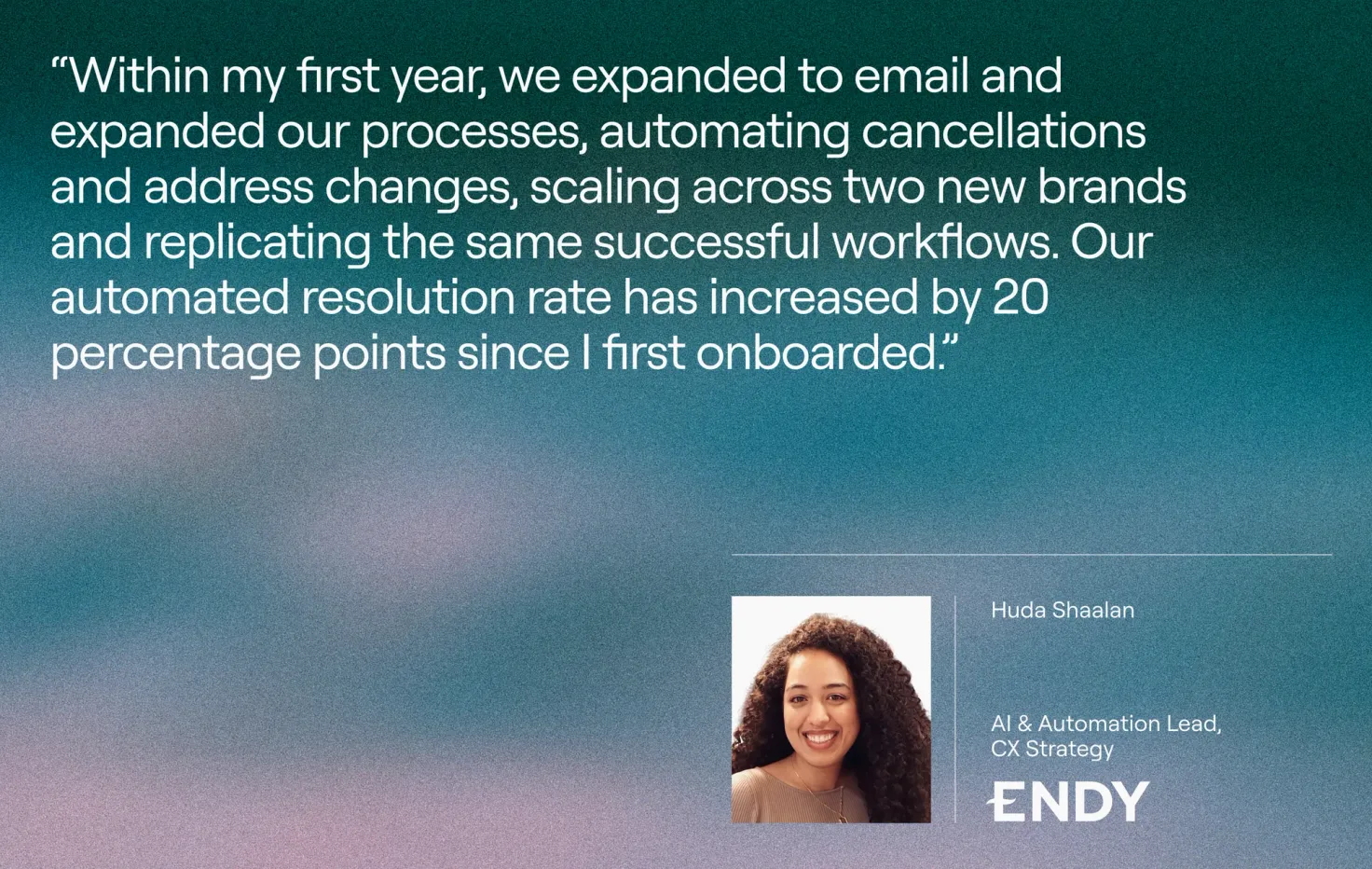
“Within my first year, we expanded to email and expanded our processes, automating cancellations and address changes, scaling across two new brands and replicating the same successful workflows,” Huda said.
As the program expanded, the team realized scaling AI customer service required more than adding new automations. Workflows needed to operate consistently across brands, channels, and increasingly unpredictable customer interactions.
That shift marked the difference between traditional AI customer service and an agentic customer experience approach.
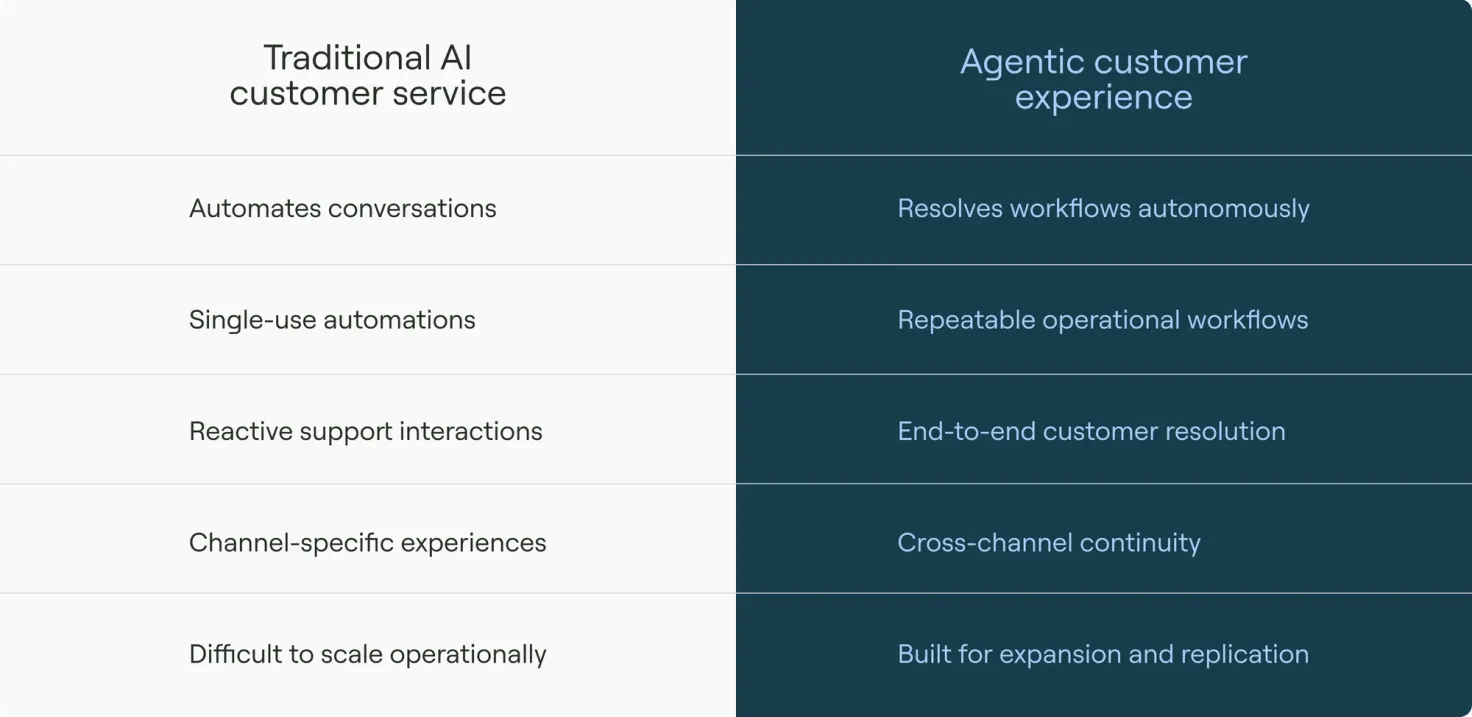
For Endy, Playbooks became the operational layer that made that shift possible.
With Playbooks, the team could resolve increasingly complex customer requests consistently across brands, channels, and customer scenarios without rebuilding operational logic every time the business expanded.
That foundation helped Endy scale its AI agent across three brands, handle 10,000 support tickets without escalating to human agents during Black Friday and Cyber Monday, and expand into new markets with significantly less operational overhead.
How Playbooks helped Endy scale customer experience
Playbooks became especially valuable when customer conversations stopped following predictable paths.
A customer might begin with an address-change request, then ask whether their purchase is covered under warranty. A few messages later, they realize they forgot to add matching pillows to the order and want help choosing the right option. Then they ask whether the shipment can still arrive before the weekend.
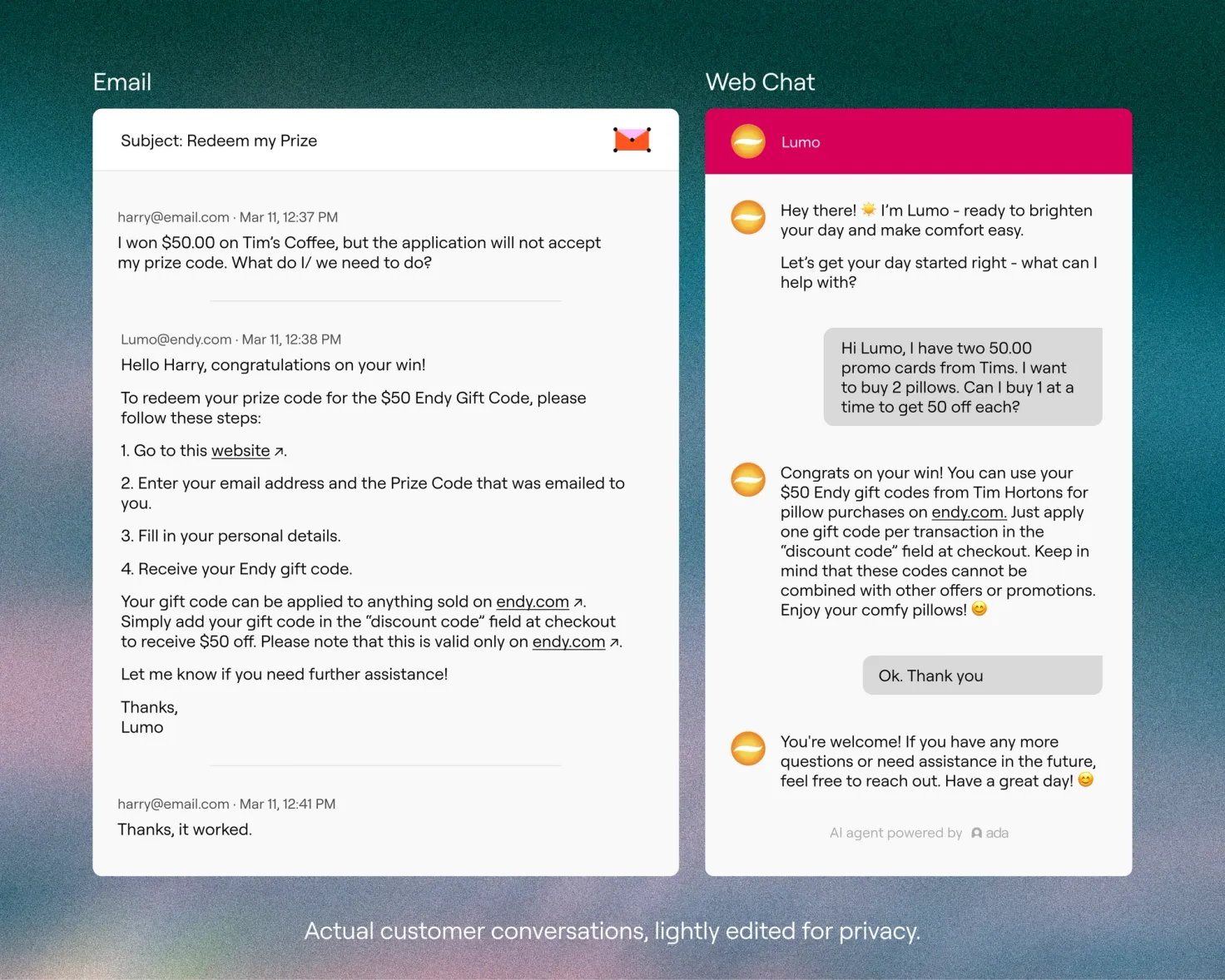
Instead of forcing customers to restart the conversation or escalate unnecessarily to a human agent, Endy’s AI agent could maintain context across the interaction, answer follow-up questions, and return to the appropriate step in the process without losing momentum.
Address changes became one of the clearest examples of how the system worked operationally. The AI agent could verify customer identity, confirm eligibility within the modification window, collect updated information, and execute the change directly through Shopify without requiring a human handoff.
Just as importantly, those workflows became repeatable across brands.
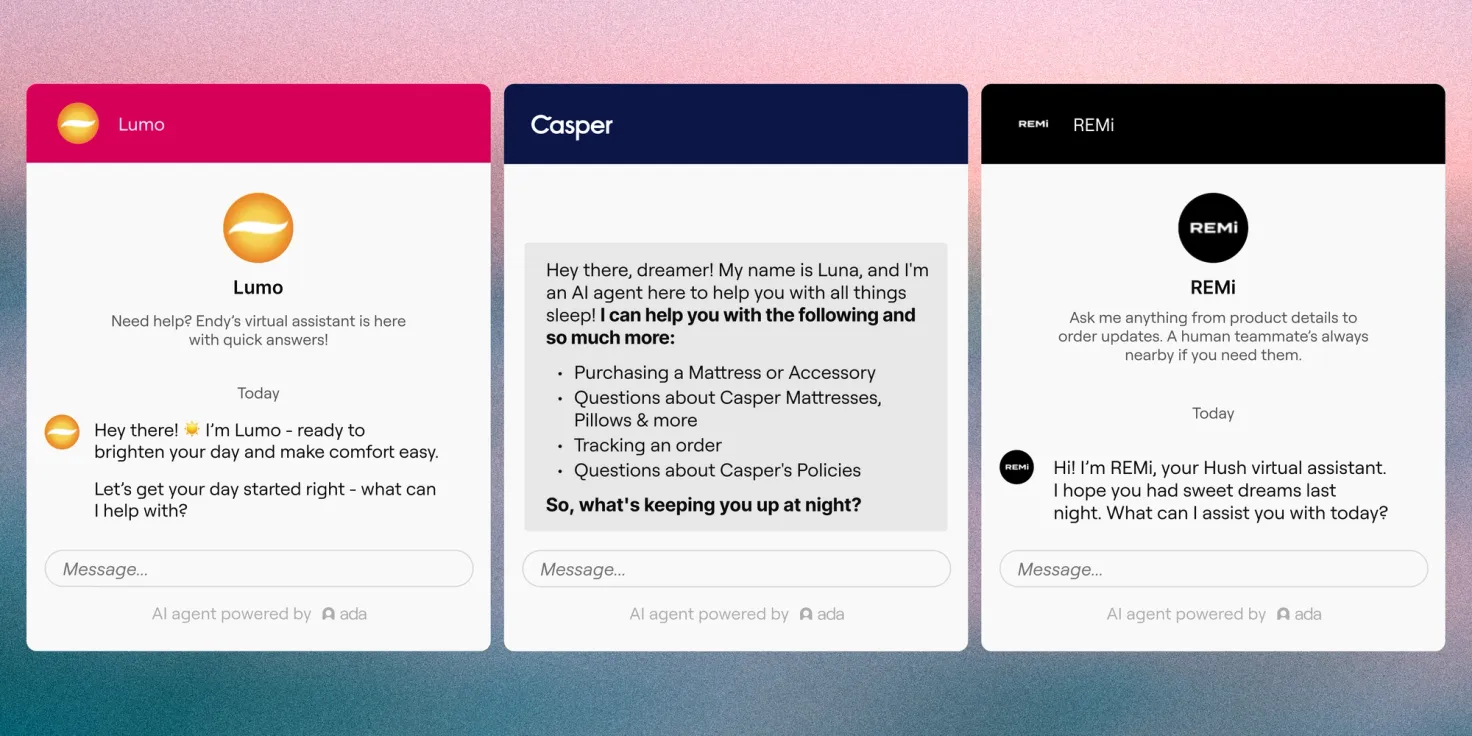
Once a process proved successful on the Endy brand, the team could extend the same Playbook architecture across Casper and Hush with minimal adaptation. Tone, greetings, and brand voice changed between brands, but the operational foundation stayed consistent.
Proving the system could scale
As Endy expanded its ACX program, the team focused on proving workflows could scale reliably before extending them further.
Huda used automated resolution rate as a signal that a Playbook was ready to expand into a new environment. Messaging channels needed to consistently achieve at least a 50% automated resolution rate before moving into additional brands, while email required at least 40%.
Those thresholds helped the team scale deliberately rather than expanding faster than the workflows could support.
That operational consistency became especially important during high-volume customer moments.
By the time Endy’s Tim Hortons® Roll Up To Win™ campaign launched nationwide, the team had already spent months refining and replicating Playbooks across brands and channels.
The campaign became one of the clearest examples of how repeatable workflows allowed Endy to scale customer experience under pressure without dramatically increasing operational overhead.
What scaling AI customer service actually requires
Endy’s success didn’t come from deploying more automation.
The company built a repeatable operational foundation for scaling ecommerce customer experience across brands, channels, campaigns, and increasingly complex customer interactions.
Playbooks gave the team a way to execute workflows consistently, adapt to real customer behavior, and expand confidently without rebuilding systems from scratch every time the business grew.
That’s the shift from traditional AI customer service toward agentic customer experience: moving beyond isolated automations and building systems that can scale operationally alongside the business.
By the time Endy expanded across three brands, launched into new markets, and handled nationwide campaign surges, the company wasn’t rebuilding workflows for every new challenge. It was extending a foundation that had already proven it could scale.
For ecommerce leaders evaluating what AI customer service can realistically achieve beyond basic automation, Endy’s experience offers a practical blueprint for what scaling successfully actually requires.
Unlock more complex AI resolutions
Browse real examples of AI agents using plain-language instructions to automate multi-step processes with speed and precision.
Explore Playbooks