Build vs buy: Should we build an AI customer service agent in-house or use a platform?
Just because you can, does that mean you should? We break it down.
As generative AI technology becomes more widespread and accessible, it makes sense that enterprises are curious about the possibility of building an AI agent for customer service in-house. After all, who knows your business and your customers better than your own team?
The reality is not that straightforward.
Before diving into the development of an in-house AI solution, it is crucial to weigh several key factors against the benefits of working with established AI Customer Experience (ACX) platform partners. By understanding these factors, you’ll be better equipped to make an informed decision that aligns with your organization's needs and resources.
1. What is the total cost of ownership (TCO) for building an AI customer service agent?
How much does it actually cost to build and maintain an AI customer service agent? And how does that stack up against paying an annual fee to a third party vendor? Let’s tally it up.
The human talent and resources you’ll need to successfully launch and manage an AI customer service agent.
- Building in-house: Dedicated team of 6+ FTE with specialized skills.
- Partnering with platform provider: One AI Manager to work with the partner platform and manage the AI agent.
What it takes to build an AI agent from a technical perspective.
- Building in-house: You’ll need...
- Product Manager to lead the project,
- Product Designer to design the AI agent interface,
- Front-end Developer to craft what the customer experiences,
- Back-end Developer to create the logic and systems that make it all work, and
- Integrations Engineer to build out integrations with business systems, such as your CRM, CSM, CCaaS, telephony, and/or email service providers (alternatively, you can use integration platform software , in which case you’ll have to add in that cost.)
- Partnering with platform provider: You'll need to...
- Select the right ACX platform partner for your needs and assign a team member to become the AI Manager,
- Onboard the AI agent (this process will look different depending on which ACX platform you choose),
- Connect the ACX platform to business systems using out-of-the-box integrations, and
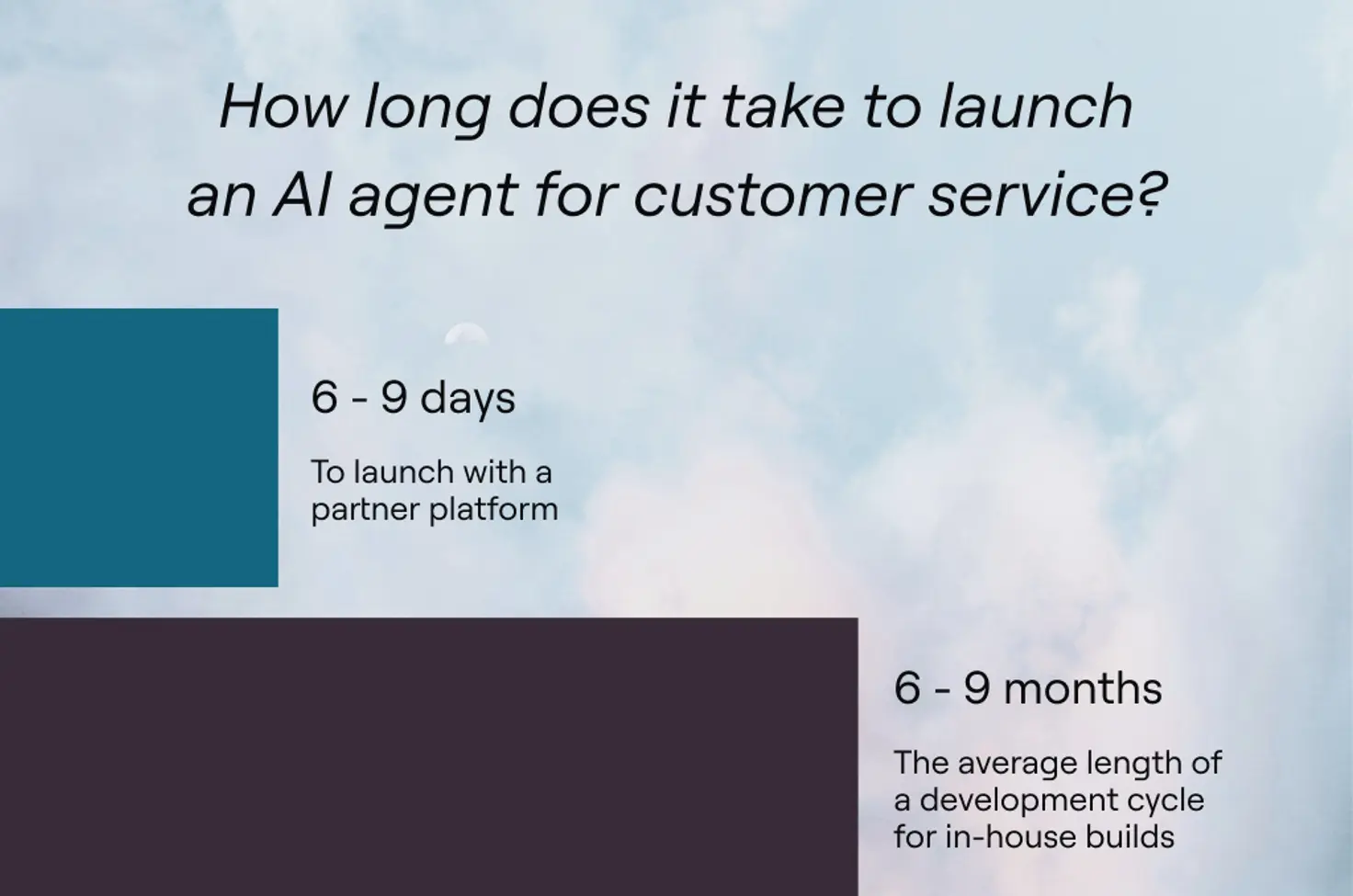
- Be ready to deploy your AI agent in 6 to 9 days.
There’s a common misconception that “publicly available” means “free”. The reality is, you still have to pay to use the AI models that will be powering your AI agent, including: large language models (LLMs), speech-to-text, text-to-speech, translation, and more.
- Building in-house: Typically for AI models, you have to pay per token. Depending on the model, a token can mean different things, for example: number of words in a sentence (usually one token is around 2 or 3 words) or minutes in an audio file (usually token is one minute).
Each model will have its own pricing scheme, but your cost per conversation will essentially depend on how verbose your customers are. This makes it difficult to forecast how much the AI models will actually cost month over month. - Partnering with platform provider: ACX platform providers have partnerships with AI companies, and will have worked out these costs into their pricing models. Crucially, these pricing models are tuned to dimensions of your enterprise that you already forecast, so you can predict costs confidently and work them out into your own budgeting.
While AI models power the conversations you have with customers, they don’t store them. You’ll need data warehousing to access the conversation history for things like analytics, insights, and auditing.
- Building in-house: Prices vary significantly based on requirements.
- Partnering with platform provider: ACX platform providers store all data related to the AI agent, and the platform fee includes this cost.
Related: What’s required for enterprise security/compliance (PII handling, audit logs, governance) for AI support? We answer this and more in understanding the privacy, data, and security risks of AI agents.
Building and launching the AI agent is not a one-and-done commitment. In order to remain competitive, the AI agent should be constantly improving, much like you’d expect your human agents to improve at their jobs the longer their tenure is.
- Building in-house: You'll need...
- AI Manager to manage and coach the AI agent,
- Engineer for maintenance, troubleshooting, and additional integrations,
- ML Specialist to improve the AI agent’s capabilities as the underlying tech evolves,
- Data Scientist to build out the automated resolution reporting dashboard and audit the accuracy of the AI agent’s resolutions, and
- Security Manager to ensure that the AI agent meets privacy and security standards of operation.
- Partnering with platform provider: You'll need...
- AI Manager to manage and coach the AI agent.
- The ACX platform partner will handle everything else, meaning you’ll benefit from a higher frequency of updates that are well-researched and have higher ROI, such as:
- Updating the underlying tech,
- Developing new AI agent skills and capabilities,
- Adding new management features,
- Building out easy-to-use insights and analytics dashboards, and
- Handle any maintenance, troubleshooting, and additional integrations.
Customers want to connect with you on every channel available—and they want to be remembered when they do. Omnichannel service is necessary to maintain a competitive advantage.
- Building in-house: Developing for different modalities such as voice and email involves distinct challenges, which can complicate and prolong the development process for in-house teams. For example:
- In order to build your own AI customer service agent for voice, you'd also need to build an orchestration layer to handle things like speech transcription, speech synthesis, and integration with telephony.
- Handling the nuance of voice conversations requires extra optimization, such as allowing your customers to interrupt, knowing when callers have finished speaking, or accurately capturing data such as order numbers, reference numbers, and more.
- Partnering with platform provider: You can partner with an ACX platform provider that has rich omnichannel capabilities. Deploying the AI agent on new service channels becomes a matter of “when”, not “if” or “how”.
Related: What’s the best omnichannel AI customer service platform for chat, email, voice, and messaging? Find out in the guide to finding the right AI agent for omnichannel customer service.
The secret cost of staying up to date
The rapid pace of AI innovation makes it increasingly difficult for enterprises to keep up without continual reinvestment. What’s cutting-edge today can be obsolete in just a few months, forcing you to constantly evaluate and implement new technologies or risk falling behind.
As we move closer to artificial general intelligence (AGI), AI systems will not only evolve in complexity but also demand more nuanced applications.
Businesses that have built their own AI customer service agents will quickly discover the hidden costs of staying up to date.
This happened before with scripted conversational AI. Enterprises that built their own in-house solutions are now having to start from scratch, reinvesting in development, integrating new tools, and scaling for omnichannel service—all of which are essential to ensure customer satisfaction and prevent outdated tech from undermining the customer experience.
And those who did reinvest and built their own AI agents are still experiencing surprise costs. Evolving LLM models open up new opportunities but require new skill sets and architectures to take advantage of, many of which haven't been invented yet.
This doesn't stop at big transformations like that. For example, if you want to introduce new integrations to automate different parts of your customer experience, your development and engineering teams will need to manually set up those integrations, test them, and deploy them.
So as you’re tallying up the costs, don’t forget to factor in the longevity of the solution, and what kind of resources you’ll require to stay up to date.

2. What ROI can enterprises expect from AI customer service automation?
Now that we’ve broken down the costs, let’s talk about the results. Assuming both options are working comparably and delivering a similar automated resolution rate, which one is giving you a better bang for your buck?
How long does it take to get to production for build vs buy (time-to-value)?
With an investment as high-value as building an AI agent for customer service, there are a number of time-consuming milestones between getting approval and deployment.
At the very least, you’ll need to identify the key stakeholders, gather the requirements for the solution, hire the team or create a task force in your existing departments, develop the solution, test and iterate to improve it, train the teams on using it, and finally roll it out.
Think about how much time each of those steps take, and what kind of effort is involved in the details of those steps as well.
How much time to recruit the talent if you don't have it in house? How many people are involved in the process? Once the team starts working, how much time will they need to ramp on internal processes?
Think about it this way, if you spend 6 months building a solution in-house, that’s 6 months where you're not automatically resolving support inquiries and losing out on savings while you build.
By the time the AI agent is live, you could have already broken even on the initial cost and started seeing positive returns with an ACX platform.
Opportunity cost
Beyond the financial investment, companies must also consider the opportunity cost of building an AI agent for customer service. While it's true that every company should consider innovating with AI, the focus should be on areas that directly align with core business objectives and growth.
For example, a a FinTech like Tilt would gain more by developing AI applications that enhance portfolio performance, or a SaaS like Monday.com could better serve its mission by focusing on AI that makes workflows more efficient.
It's also important to evaluate what critical projects or teams will be impacted by reallocating resources to AI development. Will your recruitment team now have to shift focus towards finding specialized AI talent, or will you outsource to agencies, incurring high costs just to keep your internal teams focused on core functions?
Diverting resources to build an AI customer service agent can be a distraction from key business priorities.
“One of the things that we've seen is people don't understand generative AI as well as they think they do."



3. What are the biggest risks of building an AI agent without an evaluation framework?
Hallucinations, regressions, reliability, maintenance burden... Building an AI agent is one thing, building the evaluation framework to make sure it's actually working is something else.
Testing
It’s easy enough to build a demo that looks good, but once you scale to a larger conversation volume or more diverse customer inquiries, things get complicated.
Before you deploy the AI agent to your customers, you need a testing environment to run conversation simulations, especially for sensitive inquiries that need to adhere to compliance policies. Otherwise, you risk exposing your customers to a potentially faulty AI agent and you have to deal with the consequences of any problems that might cause.
To avoid this, you need to have thoughtful, structured evaluation frameworks for your system in place.
- Building in-house: In addition to the AI agent itself, you’ll have to build your own in-house testing systems.
- Partnering with platform provider: Benefit from the ACX platform’s testing tools.
"From a compliance perspective and a comfortability perspective, the ability to put in SOPs and have a structure in place to monitor compliance-related conversations was really important. Before we launched anything, we had to make sure that we had all that in place, and tested it in various situations, looked through the responses, and made sure that the evidence is documented internally. This helped us get comfortable about opening this up to our customers."


Insights and analytics
It should go without saying that deploying an AI agent is useless if the AI agent doesn’t work. Or worse, works poorly.
To make sure that the AI agent is delivering exceptional customer experiences, you have to monitor its performance, audit conversations, and analyze insights to keep improving AI customer service.
- Building in-house:
- Your team will need dedicated tooling to track the data that’s most relevant to your customer service KPIs in related to the AI agent program, including: automated resolution rate, CSAT, NPS, and more...
- You’ll also need to manually audit the conversations marked as “contained” to see whether they were actually resolved or the customer simply gave up on the conversation.
- Partnering with platform provider: You can use purpose-built dashboards to:
- Get an accurate automated resolution rate, with the ability to drill into why the AI agent is classifying a conversation as resolved or unresolved,
- Understand the actions your AI agent took so you can coach it to continuously improve performance,
- Measure your AI agent’s success across channels,
- Track the impact on key business metrics, and
- Bring your data into business intelligence tools to gain a deeper understanding of the customer experience.
4. What does ongoing ops look like (monitoring, QA, continuous evaluation, incident response)?
A large component of the success of the AI agent is how well your team is managing and coaching it. Your AI Managers need tooling to identify gaps and take the necessary steps to resolve more types of inquiries. Let’s take a look at some considerations for continuous improvement.
As the underlying technology evolves, the AI agent should be able to learn new skills that make the customer experience even better. How will you be adding these new skills?
- Building in-house: You’ll need a dedicated team to take on the development of new skills.
- Partnering with platform provider: Benefit from a continuous rollout of new skills.
How does your team identify what part of the customer experience needs improvement?
- Building in-house:
- The feedback loop will look different depending on how you set up the analytics dashboards and who is in charge of reviewing the data.
- The team would analyze the uncontained conversations and cross-reference them with CSAT and customer data to uncover gaps and opportunities.
- The cadence of the feedback loop needs to be determined based on level of effort and time needed from the team members involved.
- Partnering with platform provider: The AI agent surfaces insights and improvement opportunities, pulling conversation and customer data from all channels it’s deployed on as well as relevant connected business systems. The AI Manager can spend their time addressing the opportunities instead of looking for them.
Who receives the feedback to improve the AI agent? And how soon until it is implemented?
- Building in-house:
- The AI Manager identifies a list of improvement opportunities based on the loop above, then they schedule these improvements with the Engineering team in charge of improving the AI agent.
- The team then triages this request and adds it to the relevant sprint. Depending on their triage criteria, it could take anywhere between 2 weeks and 2 months.
- Partnering with platform provider:
- With the right coaching tools, the AI Manager can communicate the feedback directly to the AI agent using natural language. The AI agent implements any coaching feedback instantaneously. This means you make changes to the AI customer service experience as fast as your business evolves.
- The ACX platform may also have the ability to quantify the impact of each opportunity on key metrics like CSAT or automated resolution rate, so the AI Manager can easily build a business case to invest in solving the most pressing problems your customers face.
5. If we build in-house, what’s the one thing we won’t realize we're missing until it’s too late?
The big answer is: expertise.
Max Ball, Principal Analyst at Forrester, says it best: “If I just get Google or I get OpenAI or something else, I can build a self-service application, but there's just so many things that can go wrong. There's guardrails that need to be put in place. You need to watch out for hallucinations. You need to understand response times.
It's very important that you use a platform that takes generative AI and puts it into a context of AI for customer service. You need the right set of tools to do that. You need people who've been thinking about the guardrails, who've been thinking about the problems and living that stuff for a significant chunk of time. You need somebody who lives and breathes this stuff, who understands it.”
AI for customer service
If you were building a large-scale LLM-powered AI agent that your customers will interact with, you’ll need expertise in AI, customer service, and AI for customer service.
It’s essential to work with partners who have been immersed in this world for years. Not only do they understand your pains and how to solve them, they also have working relationships with software and technology companies that give their AI agents an edge.
ACX program expertise
In addition to technology expertise, ACX platform providers have worked with enterprises across various industries to launch and grow ACX programs. They have tried and tested methodologies and best practices that you can benefit from to truly transform customer service, beyond simply automating FAQ.
For example: onboarding and education processes to upskill human agents, leading to higher implementation success rates and better value for the business.

6. When does building an AI customer service agent actually make sense
While it may seem that there’s a strong bias towards working with an ACX platform partner, there are scenarios in which it actually makes more sense to build an in-house AI agent.
You need a highly specialized AI agent
If you need an AI agent to take actions that are truly unique to your enterprise, you’re likely to get more value by building it yourself. While a partner platform can definitely build out specialized use cases, you would be bound by their timelines.
You need complete control over the AI agent development roadmap
In the same vein, the biggest benefit of building an in-house AI agent is that you can customize it entirely to fit your enterprise’s exact needs. Perhaps your entire customer base prefers a specific communication channel, so you don’t care about omnichannel capabilities and instead want to further optimize that one channel. Or perhaps you have multiple highly specialized customer intents that make up the majority of your conversation volume.
Whatever the case may be, building your own AI agent gives you the ability to prioritize the skills that make the biggest impact, and if the impact is big enough, it’ll offset the in-house total cost of ownership.
Meet your new AI customer service agent
With Ada, you get an ACX platform delivers efficient, high-quality support at scale, continuously improving the speed and quality of results across all channels and languages, 24/7.
Book a demo