How to choose AI technology for enterprise customer service: 7 key categories every RFP must cover
Choosing the right AI technology for enterprise customer service means evaluating vendors across seven categories: strategic fit, AI agent capabilities, platform extensibility, operational ownership, reporting and measurement, architecture and scalability, and security and compliance. This guide breaks down each category and what to look for in your RFP process.
Key definitions
AI agent for customer service: An AI-powered system that handles customer inquiries across channels on its own. It uses reasoning and integrations to resolve issues without a human, going beyond scripted flows to complete multi-step tasks and make decisions.
Agentic Customer Experience (ACX): The category Ada coined for customer service run by AI agents that resolve issues, take action, and continuously improve across every channel and language, with the customer’s own team managing the program.
In this guide
- The seven categories every AI customer service RFP should include
- Common mistakes when choosing AI agents for enterprise customer service
- A ready-to-use template for your AI agent RFP
You sign an AI customer service contract on the strength of an RFP. About a year in, you find out which of the answers were guesses.
The categories that were easy to score usually hold up. What the AI agent can do, what it connects to, what the security team required: you can test those, take references on them, and put them in a contract.
The expensive surprises come from the four nobody can settle with a test. Who owns the AI agent day to day, and whether that’s a team you already have. What your reporting counts as a resolution. Who you call the week volume triples. Whether the company behind the platform still fits requirements that have moved since you signed.
An RFP can’t settle those four on its own. It can ask better questions about them, and it can put the answers in writing.
The wrong platform creates dependency, limits scale, exposes compliance risk, and stalls the program. Many enterprises find out too late that their AI agent can’t move past FAQs, needs constant engineering support, or can’t show measurable impact.
Through enterprise deployments, we’ve seen what separates platforms built to run a program at scale from tools bolted onto one. This guide breaks the decision into seven categories every enterprise RFP should cover, and what to look for in each. It also covers four common mistakes, and it ends with a companion RFP template of 100+ evaluation questions.
The seven categories every AI customer service RFP should include
Choosing an AI platform for customer service is a long-term operating decision. The technology evaluation is one part of it.
These seven categories cover the factors that determine the long-term value of your AI customer service program: vendor alignment, scalability, governance, security, and enterprise readiness.
Categories two, three, and seven get settled by a test or a security review. Categories one, four, five, and six you have to pin down yourself, and they’re where the value shows up later.
- Vendor profile and strategic fit: assess whether the vendor is structured to support your transformation at scale
- AI agent capabilities: evaluate reasoning, personalization, and omnichannel orchestration
- Platform, extensibility, and integrations: determine how the platform connects to your systems and adapts over time
- Operational ownership and continuous improvement: confirm your team can manage and optimize the AI agent independently
- Reporting, measurement, and business impact: ensure visibility into performance, growth, and ROI
- Architecture and scalability: validate the technical foundation for resilience under pressure
- Security, compliance, and AI governance: verify enterprise compliance standards and responsible AI practices

1. Vendor profile and strategic fit
As AI agents mature, they become embedded in your CX operations, data ecosystem, and governance framework. You need to understand who you’re partnering with, how they deploy, and whether they’re structured to support sustained success.
Before comparing features, start by assessing whether the vendor is built to support your company’s transformation at scale.
Long-term vendor stability directly affects program maturity. Enterprise AI agents evolve over time. Your vendor’s ability to support optimization, governance, and scale will determine whether your program matures or stalls after launch.
Begin with the vendor’s core operating model. Ask whether the solution is delivered as a scalable SaaS platform or relies on professional services for deployment and ongoing management. Examine the company’s financial stability, ownership structure, and product roadmap for long-term viability.
Evaluate their experience serving enterprises in your industry and request proof of measurable outcomes, such as improvements in automated resolution, CSAT, or cost-to-serve. Review their implementation methodology and post-launch support model. Finally, assess whether they foster an active customer community that enables shared learning, benchmarking, and continuous improvement.
2. AI agent capabilities
AI agents represent your brand at scale. The quality of their reasoning, personalization, and orchestration determines whether your customers trust your brand.
Capability depth separates an AI agent that reasons from a scripted flow with a modern model on top. This category helps you choose a multi-channel AI agent that can reason, learn, and apply knowledge at scale, rather than a decision-tree bot wrapped in a modern AI model.
Assess the AI agent’s ability to stay on-brand across every channel and language while following your policies and guidelines. That consistency has to hold as you expand across geographies and channels.
Examine how the AI agent reasons through an inquiry. Check whether it can interpret multi-step or multi-intent requests and choose the next action on its own, whether that means retrieving information, running a workflow, or triggering a backend process. An enterprise AI agent chooses the next action, which is a different job from retrieving an answer.
Finally, evaluate whether all customer service channels are managed within a single platform. A unified system gives you shared logic, centralized governance, and consistent optimization across Messaging, Voice, and every other channel you run, without rebuilding your CX strategy around a fragmented tech stack.
3. Platform, extensibility, and integrations
Enterprise AI agents must move from conversation to action. Without strong integrations, even advanced reasoning stays surface-level.
Before committing, determine how the platform connects to your systems and how easily it adapts over time.
Integration depth determines operational value. Whether your AI agent becomes operational infrastructure or remains a limited support layer depends on how deeply it connects to your existing systems.
Review the foundational LLM strategy, including model flexibility and resilience. Assess how knowledge sources are integrated and synchronized. Examine native integrations with agent platforms and ticketing systems, including transcript handoff and routing.
Evaluate the ability to securely trigger backend actions through read and write APIs. Finally, understand the technical effort required for integration and ongoing maintenance, and whether your teams can extend functionality independently.
4. Operational ownership and continuous improvement
The most durable AI programs let non-technical customer service operators manage AI agent performance, refine behavior, and scale impact without waiting in an engineering queue.
Before selecting a vendor, check whether your team will have full control over the AI customer experience, such as training the AI agent, updating policies, simulating conversations, finding insights, and expanding use cases, or whether you’ll stay reliant on the vendor for changes.
Operational independence accelerates program maturity. Programs that rely heavily on external engineers or ongoing vendor intervention struggle to mature. Operational ownership means your team can move at the speed of your business.
Evaluate the vendor’s commitment to enablement. Look for no-code functionality that lets non-technical teams configure, optimize, and extend the AI agent independently.
Review the availability of structured onboarding, regular training sessions, certification programs, and self-guided learning resources. Finally, determine whether your internal CX team can diagnose performance issues, test changes safely, and deploy improvements without heavy vendor involvement.
5. Reporting, measurement, and business impact
To scale AI customer service successfully, you need clear visibility into performance, growth, and ROI, along with the ability to analyze the underlying data closely.
Visibility drives executive confidence and continuous improvement. Without clear insight, you won’t know how your AI agent is performing or where improvements are needed, and progress will stall. A lack of visibility into ROI weakens executive confidence and limits long-term impact.
Assess whether the platform captures the metrics that matter, from automated resolution and CSAT to operational impact. Look for pre-built dashboards for quick visibility, along with the flexibility to create custom reports aligned to your KPIs.
Evaluate how easily data integrates with your BI tools and whether the system proactively surfaces insights and improvement opportunities, helping your team move from reporting to action.
6. Architecture and scalability
Enterprise environments demand resilience under pressure. AI agents must perform reliably during peak volumes and global expansion. This is where you validate the technical foundation.
Architecture limitations surface quickly at scale. Technical constraints directly affect customer experience during high-volume periods and global expansion.
Look for confidence that the platform can scale smoothly as demand grows. Review uptime history and service commitments, and ask how the system handles traffic spikes and global expansion.
Understand the vendor’s approach to resilience, including redundancy and disaster recovery, so your AI customer service program can expand without compromising performance.
7. Security, compliance, and AI governance
AI agents process sensitive customer data at scale. Be sure the platform meets enterprise compliance standards and demonstrates responsible AI practices.
Security gaps create regulatory and reputational risk. Governance failures can create exposure that outweighs any AI gains.
Verify certifications such as SOC 2 Type II and the regulatory compliance standards relevant to you. Review data residency options, encryption practices, and data retention policies.
Assess role-based access controls, audit logging capabilities, and overall governance transparency. Ensure the vendor demonstrates structured AI safety practices, ongoing testing, and clear accountability for safeguarding customer data.
Common mistakes when choosing AI agents for enterprise customer service
1. Choosing features over an operating model
Most platforms you evaluate will have overlapping features, but an enterprise AI program needs more than tools. It needs a clear methodology for deployment, ownership, performance management, and continuous improvement. That’s the difference between launching an AI agent and building Agentic Customer Experience (ACX) as an internal capability.
2. Choosing managed services instead of a scalable platform
Some vendors rely heavily on forward-deployed engineers who write and then manage custom code and prompts for each customer. At first this can feel high-touch and supportive, but the model doesn’t scale. It creates dependency and slows innovation.
A platform-first model is different. It’s configured, not customized. The same person who writes an SOP can deploy it live, and improvements ship across customers at the same time.
The best platforms also give you a methodology for using the controls well. A scalable platform paired with a proven operating model means your team isn’t left to figure it out alone. Clear steps, templates, benchmarks, and best practices provide the structure to move from launch to maturity with confidence.
Your team owns the program and has a repeatable path to improving it over time.
3. Buying software instead of building a long-term partnership
Results come from expertise as much as from tooling.
The most successful enterprise programs treat their AI vendor as a long-term partner: one that offers structured onboarding, clear operational frameworks, useful benchmarking data, and access to an active community of peers.
Without that partnership layer, teams are left with powerful tools and limited direction.
4. Choosing a pricing model with ambiguity at its core
Some vendors charge based on automated resolution. While this may seem straightforward, it can require ongoing auditing to confirm that conversations labeled “resolved” were resolved.
If automated resolution (AR) definitions are loose, you risk paying for containment rather than resolution, or even double-paying when customers re-engage through another channel. Containment and resolution aren’t the same measure. Containment counts conversations that didn’t need a human. Resolution counts customers who got what they came for.
When AR drives pricing, product priorities may also shift toward increasing billable resolutions instead of improving overall agent performance. Before you sign a contract priced on automated resolution, get the definition in writing.
A ready-to-use template for your AI agent RFP
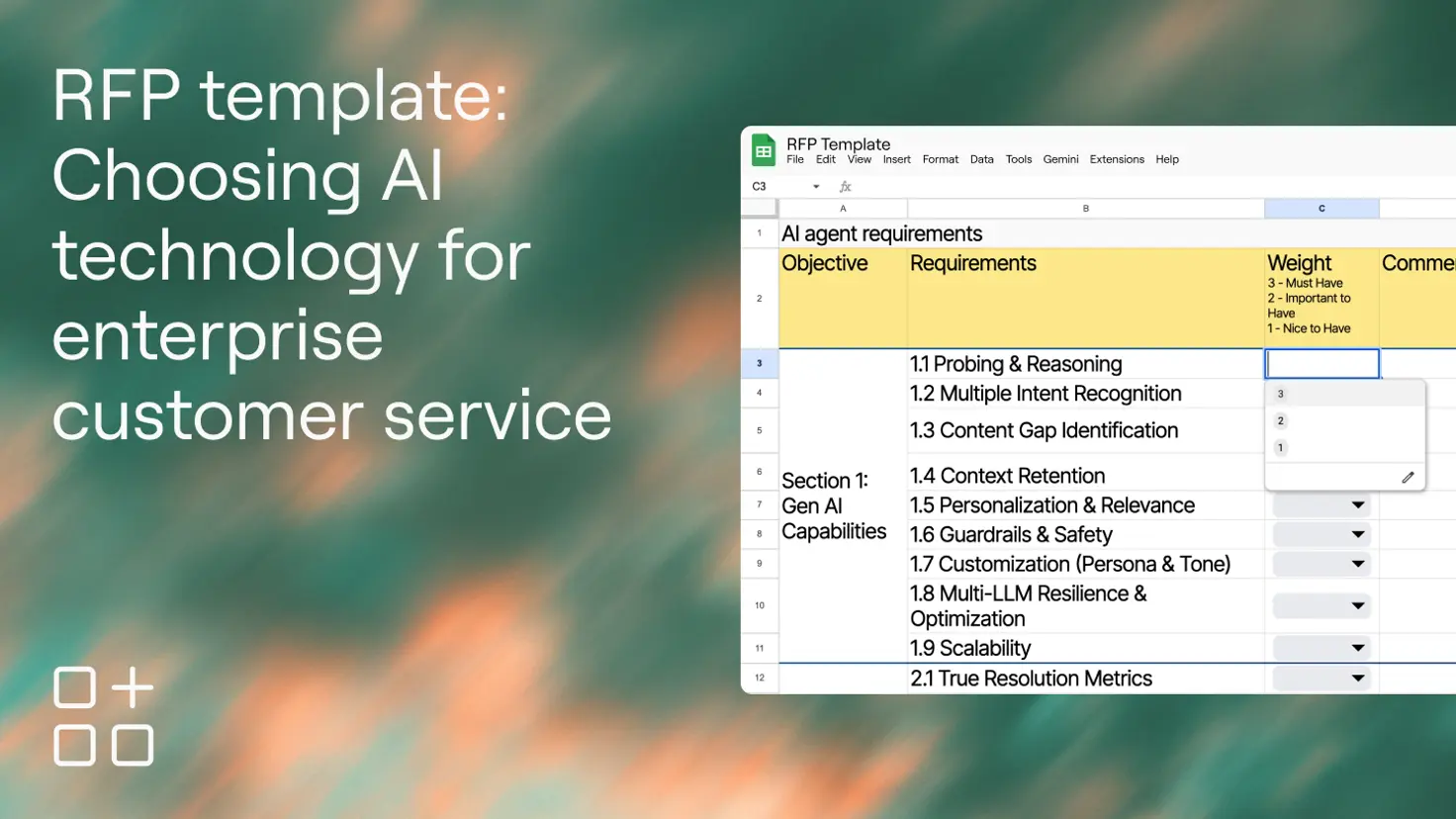
To give you a head start, we’ve turned the seven categories in this guide into a structured RFP template designed for enterprise-grade evaluations.
The Excel (.xls) template contains 100+ evaluation questions across all seven categories, in a scoring-ready format, ready to send to vendors.
If you’re evaluating AI agents for customer service, it will save you time and help you avoid costly blind spots. Download the companion template to get your copy.
Key takeaways
- Evaluate vendors across seven categories: strategic fit, AI capabilities, platform extensibility, operational ownership, reporting, architecture, and security and compliance.
- Prioritize operational ownership. Choose platforms that let non-technical teams manage and optimize AI agents independently.
- Assess integration depth. AI agents must connect to backend systems to move from conversation to action.
- Avoid feature-only comparisons. Look for vendors with a clear operating model and methodology, not just tools.
- Verify scalability and resilience. Architecture limitations surface quickly during peak volumes and global expansion.
- Demand pricing transparency. Understand exactly what you’re paying for and how resolution is defined.
- Treat vendor selection as a partnership decision. Long-term success depends on ongoing support, enablement, and shared learning.
Frequently asked questions
What is an AI customer service RFP?
An AI customer service RFP (request for proposal) is a formal document enterprises use to evaluate and compare AI agent vendors. It sets out requirements across categories like capabilities, integrations, security, and pricing so vendors can show they meet enterprise standards.
How many categories should an AI customer service RFP cover?
A thorough AI customer service RFP covers seven categories: vendor profile and strategic fit, AI agent capabilities, platform extensibility and integrations, operational ownership, reporting and measurement, architecture and scalability, and security and compliance.
What are common mistakes when selecting an AI customer service platform?
Four common mistakes are choosing features over an operating model, selecting managed services that create vendor dependency instead of a scalable platform, buying software without building a long-term partnership, and accepting pricing models with ambiguous resolution definitions that need constant auditing.
How is an AI agent different from a scripted bot?
A scripted bot follows decision trees and retrieves pre-written answers. An AI agent reasons through a multi-step request and decides the next action: retrieving knowledge, running a workflow, or triggering a backend system to resolve the issue end to end.
How do I measure ROI on an AI customer service platform?
Key metrics include automated resolution rate, cost-to-serve, CSAT, handle time, and escalation rate. Look for platforms with built-in dashboards and BI tool integrations that give you visibility into these metrics and surface improvement opportunities.