How to choose AI technology for enterprise customer service: 7 key categories every RFP must cover
This guide breaks down the seven essential categories every agentic CX RFP should include and what to look for in each.
Enterprise decisions about AI agents for customer service are no longer experimental, they’re strategic. For CX leaders, this isn’t about launching a chatbot. It’s about reducing cost-to-serve, protecting brand trust at scale, improving CSAT, and building a durable AI capability inside the organization.
The wrong platform can create vendor dependency, limit scalability, expose compliance risk, and stall your transformation. Many enterprises discover too late that their AI agent can’t move beyond simple FAQs, requires constant engineering support, or can’t deliver measurable business impact.
The stakes are high, the market is crowded, and every solution promises to do the same thing. How do you choose?
In a category evolving this quickly, it’s easy to miss the details that matter most. Through real-world enterprise deployments, we’ve seen what separates growth-ready platforms from bolt-on solutions. To help you evaluate AI agents for customer service with clarity, we’ve distilled those insights into a practical framework.
This guide breaks down the seven essential categories every enterprise RFP should include and what to look for in each.
The 7 categories every AI customer service RFP should include
Choosing an AI platform for customer service isn’t just a technology evaluation. It’s a long-term operating decision.
These seven categories represent the core factors that determine the long-term value of your AI customer service program—from vendor alignment and scalability to governance, security, and enterprise readiness.

1. Vendor profile and strategic fit
As AI agents mature, they become increasingly embedded in your CX operations, data ecosystem, and governance framework. It’s critical to understand who you’re partnering with, how they deploy, and whether they’re structured to support sustained success.
Before comparing features, start by assessing whether the vendor is built to support your company’s transformation at scale.
Enterprise AI agents evolve over time. Your vendor’s ability to support optimization, governance, and scale will determine whether your program matures or stalls after launch.
You should begin by understanding the vendor’s core operating model. Is the solution delivered as a scalable SaaS platform, or does it rely heavily on professional services for deployment and ongoing management? Examine the company’s financial stability, ownership structure, and product roadmap to ensure long-term viability.
Evaluate their experience serving enterprises in your industry and request proof of measurable outcomes, such as improvements in automated resolution, CSAT, or cost-to-serve. Review their implementation methodology and post-launch support model. Finally, assess whether they foster an active customer community that enables shared learning, benchmarking, and continuous improvement.
2. AI agent capabilities
AI agents represent your brand at scale. The quality of their reasoning, personalization, and orchestration determines whether your customers trust your brand.
You don’t want to fall for the trap of a chatbot in an LLM mask. This category ensures you choose an omnichannel AI agent capable of reasoning, learning, and applying those learnings at scale.
Assess the AI agent’s ability to remain consistently on-brand across every channel and language, adhering to your policies and guidelines. Consistency cannot break down as you expand across geographies or modalities.
Examine how the AI agent reasons through an inquiry. Can it interpret multi-step or multi-intent requests and autonomously determine the best next action—whether that means retrieving knowledge, executing a workflow, or triggering a backend action? True enterprise AI agents should make decisions, not just retrieve answers.
Finally, evaluate whether all customer service channels are managed within a single platform. A unified system ensures shared logic, centralized governance, and consistent optimization across chat, messaging, and voice without rebuilding or fragmenting your CX strategy because of a fragmented tech stack.
3. Platform, extensibility & integrations
Enterprise AI agents must move from conversation to action. Without strong integrations, even advanced reasoning remains surface-level.
Before committing, determine how the platform connects to your systems and how easily it adapts over time.
Integration depth determines whether your AI agent becomes operational infrastructure or remains a limited support layer.
Review the foundational LLM strategy, including model flexibility and resilience. Assess how knowledge sources are integrated and synchronized. Examine native integrations with agent platforms and ticketing systems, including transcript handoff and routing.
Evaluate the ability to securely trigger backend actions through read and write APIs. Finally, understand the technical effort required for integration and ongoing maintenance, and whether enterprise teams can extend functionality independently.
4. Operational ownership & continuous improvement
The most durable AI programs empower non-technical customer service operators to manage AI agent performance, refine behavior, and scale impact without waiting in an engineering queue.
Before selecting a vendor, assess whether your organization will truly control the AI customer experience—coaching the AI agent, managing policy changes, testing or simulating conversations, surfacing insights, extending agentic use cases, etc—or remain dependent on outside support.
Programs that rely heavily on external engineers or ongoing vendor intervention struggle to mature. True operational ownership means your team can move at the speed of your business.
Evaluate the vendor’s commitment to enablement and empowerment. Does the platform offer intuitive, no-code functionality that allows non-technical teams to configure, optimize, and extend the AI agent independently?
Review the availability of structured onboarding, regular training sessions, certification programs, and self-guided learning resources. Finally, determine whether your internal CX team can diagnose performance issues, test changes safely, and deploy improvements without heavy vendor involvement.
5. Reporting, measurement & business impact
To scale AI customer service, you need clear visibility into performance, growth, and ROI—with the ability to drill into the data with precision.
Without clear insight, you won’t know how your AI agent is truly performing or where improvements are needed, and progress will stall. Plus, lack of visibility into the ROI of the AI customer service program weakens executive confidence and limits long-term impact.
Assess whether the platform captures the metrics that matter—from automated resolution and CSAT to operational impact. Look for pre-built dashboards for quick visibility, along with the flexibility to create custom reports aligned to your KPIs.
Evaluate how easily data integrates with your BI tools and whether the system proactively surfaces insights and improvement opportunities, helping your team move from reporting to action.
6. Architecture & scalability
Enterprise environments demand resilience under pressure. AI agents must perform reliably during peak volumes and global expansion. This is where you validate the technical foundation.
Architecture limitations surface quickly at scale and directly impact customer experience.
Look for confidence that the platform can scale smoothly as demand grows. Review uptime history and service commitments, and ask how the system handles traffic spikes and global expansion.
Understand the vendor’s approach to resilience—including redundancy and disaster recovery—to ensure your AI customer service program can expand without compromising performance.
7. Security, compliance & AI governance
AI agents process sensitive customer data at scale. It’s best to be sure the platform meets enterprise compliance standards and demonstrates responsible AI practices.
Security gaps or governance failures can create regulatory exposure and reputational risk that outweigh any AI gains.
Verify certifications such as SOC 2 Type II and relevant regulatory compliance standards. Review data residency options, encryption practices, and data retention policies.
Assess role-based access controls, audit logging capabilities, and overall governance transparency. Ensure the vendor demonstrates structured AI safety practices, ongoing testing, and clear accountability for safeguarding customer data.
Common mistakes when choosing AI agents for enterprise customer service
1. Choosing features over an operating model
Most platforms you evaluate with have overlapping features, but an enterprise AI program needs more than tools. It needs a clear methodology for deployment, ownership, performance management, and continuous improvement. That’s the difference between launching an AI agent and building Agentic Customer Experience (ACX) as an internal capability.
2. Choosing managed services instead of a scalable platform
Some vendors rely heavily on forward deployed engineers who write and then manage custom code and prompts for each customer. At first, this can feel high-touch and supportive, but this model doesn’t scale. It creates dependency and slows innovation.
A platform-first model is different. It’s configured, not customized. The same person who writes an SOP can deploy it live and improvements ship across customers simultaneously.
But the best platforms don't just hand you the controls, they give you a methodology to use them well. A scalable platform paired with a proven operating model means your team isn't left to figure it out alone. Clear steps, templates, benchmarks, and best practices provide the structure to move from launch to maturity with confidence.
The result isn’t vendor reliance, it’s customer empowerment and a repeatable path to leveling up your agentic CX program over time.
3. Buying software instead of building a long-term partnership
Tools alone don’t drive maturity, expertise does.
The most successful enterprise programs treat their AI vendor as a strategic partner—one that provides structured onboarding, operational frameworks, benchmarking insight, and access to a broader community of practitioners.
Without that partnership layer, teams are left with powerful tools but limited direction.
4. Choosing a pricing model with ambiguity at its core
Some vendors charge based on automated resolution. While this may seem straightforward, it can require ongoing auditing to confirm that conversations labeled “resolved” were truly resolved.
If AR definitions are loose, you risk paying for containment rather than real resolution, or even double-paying when customers re-engage through another channel. When AR drives pricing, product priorities may also shift toward increasing billable resolutions instead of improving overall agent performance.
A practical framework for your AI agent RFP
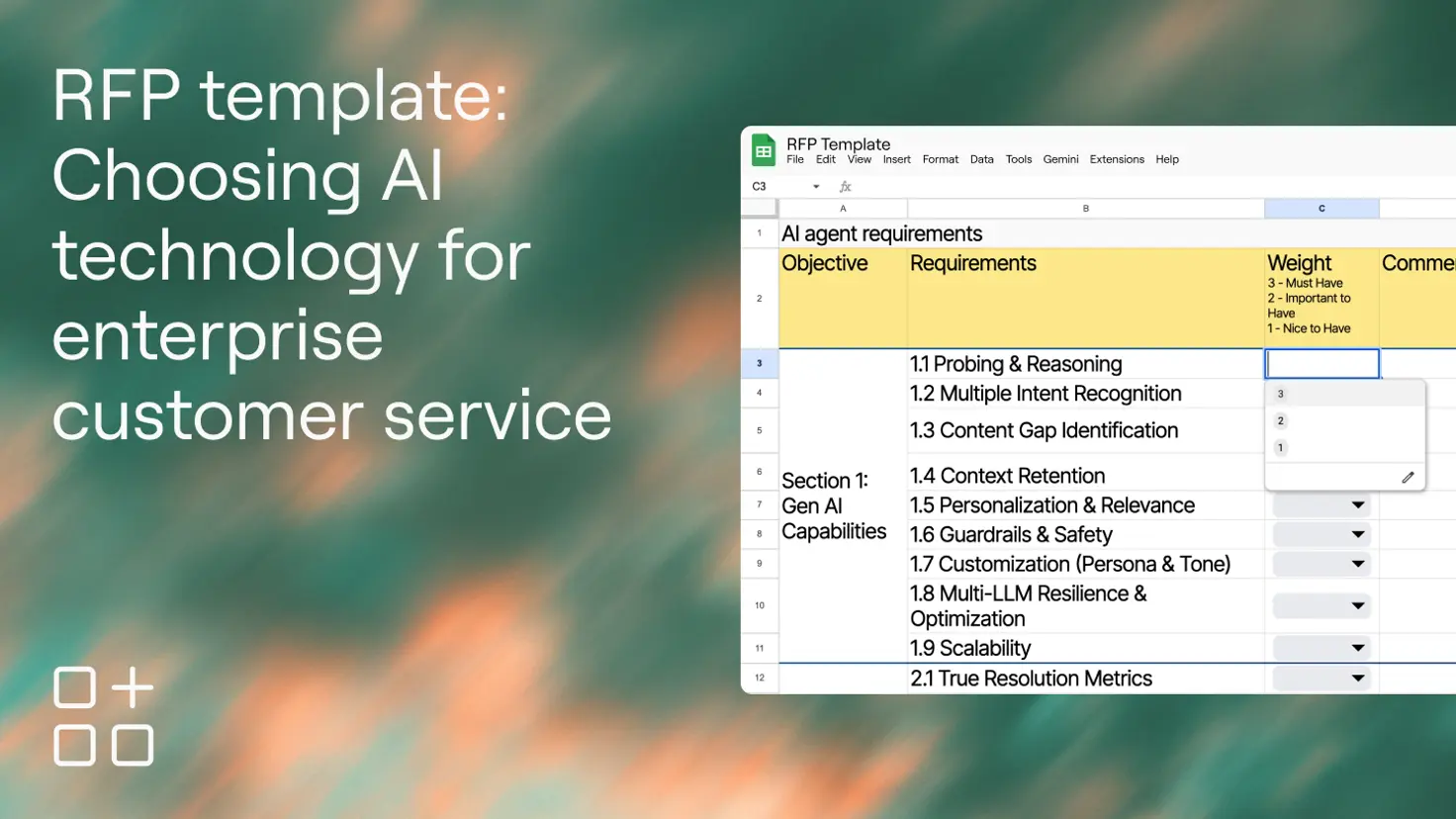
To give you a headstart, we’ve turned the seven categories in this guide into a structured, ready-to-use RFP template designed specifically for enterprise-grade evaluations.
The Excel (.xls) template contains 100+ detailed evaluation questions across all seven categories, in a scoring-ready format, for direct submission to vendors.
If you’re evaluating AI agents for customer service, this will save you time and help you avoid costly blind spots. Click the "Download companion" templates to get your copy.