
NinjaTrader
- 70% automated resolutionacross brands, channels and markets in 2026
- ~1M conversations a yearacross four AI agent deployments
- 20 Playbooksbuilt and tested in three days
- 2 brands, 2 regionsNinjaTrader and Tradovate, North America and Europe
The Leverage Multiplier: How NinjaTrader’s lean AI team resolves 70% of nearly 1M trader conversations
Company snapshot
Industry: Fintech
Region: North America and Europe
Channels supported: Chat, email and voice
Ada customer since: 2022
NinjaTrader's AI agent, Nina, automatically resolves 70% of nearly 1 million trader conversations a year across chat, email and voice. NinjaTrader's AI team got there by connecting Nina to the company's own APIs, building 20 Playbooks in three days with Ada's MCP server and Claude, and reviewing every change in a daily improvement loop with a human at every step.
Learning to trade is a long road. New traders have to get onboarded, place a first trade and learn from the trades that don't go their way. They have questions at every step, and they want real answers fast.
NinjaTrader, the futures trading platform behind the NinjaTrader and Tradovate brands, set out to give every trader a real answer. Led by Dennis Evans, Sr. Director of AI Products & Platform, a lean AI team runs NinjaTrader's AI agent across two brands, two regions and three channels. The system they built earned NinjaTrader The 2026 ACX Award for The Leverage Multiplier.
Why NinjaTrader measures automated resolution instead of containment
When NinjaTrader started its AI journey, Dennis Evans was leading client operations. He quickly saw that a trader who gets pointed somewhere else is a trader at risk.
"When traders get deflected, they churn instantly," Dennis says. "There's plenty of other places they can go to trade."
That's why NinjaTrader's AI team holds Nina to automated resolution instead of containment. Containment counts any conversation that never reaches a human agent. Automated resolution counts only the conversations where Nina solves the trader's problem.
"If someone asks, ‘What is the status of my application?’ I don't want them to get the answer, ‘Go here and look at the status of your application.’ It should be able to tell them what their application status truly is."


Before NinjaTrader connected its AI agent to the company's own systems, the agent could only answer from knowledge articles. When a trader asked about their application, the best it could do was send them to the page where they could check it.
"Answering a how-to question or just regurgitating knowledge wasn't resolving questions," Dennis says. "It was telling people where to go, but it wasn't getting them a true resolution."
Empowering Nina with APIs
To answer questions the way human agents do, Nina needed the same information human agents see. Engineering time was scarce, so Dennis asked for one thing: help explaining why a trader's application hadn't been auto-approved yet, the team's most common question.
Eventually, an engineer shared NinjaTrader's API specs with him. "I didn't even know what APIs were at the time," Dennis says.
NinjaTrader's AI team found one endpoint that showed exactly where a trader stood in onboarding, connected it to an Action and put it in a Playbook (an automated workflow). From then on, when a trader asked why their application hadn't been approved yet, Nina could look up that trader's application and tell them exactly where it stood, without sending them anywhere else. The difference showed up right away. "Now people were willing to stay with our bot. Now people were willing to talk to it, and they were getting the answers they needed."
Dennis Evans calls NinjaTrader's method designing backwards: start with the questions Nina can't resolve yet, look at how human agents answer them and which systems they check, then give Nina the same access through Actions and Playbooks.
"As soon as we saw that we could take an Action, put it in a Playbook and get the right answer for this person, we instantly saw things changing."
How NinjaTrader built 20 Playbooks in three days with Ada's MCP server
Building each Playbook by hand took time. Then Ada’s MCP server changed the game. NinjaTrader's AI team connected it to Claude, gave it Ada's documentation, NinjaTrader's API specs and a list of unresolved questions with how humans answer them, and asked it to build Playbooks.
Claude produced 20 Playbooks in about six hours. The team spent the rest of the three days testing them across 165 scenarios. Along the way, Claude and the Ada MCP helped find missing and underused endpoints, which removed most of Nina's dependency on engineering.
"Then Ada MCP came along, and that's what really changed it for us. I was able to connect Ada MCP to Claude and let it do the work for us."
How NinjaTrader's daily improvement loop works
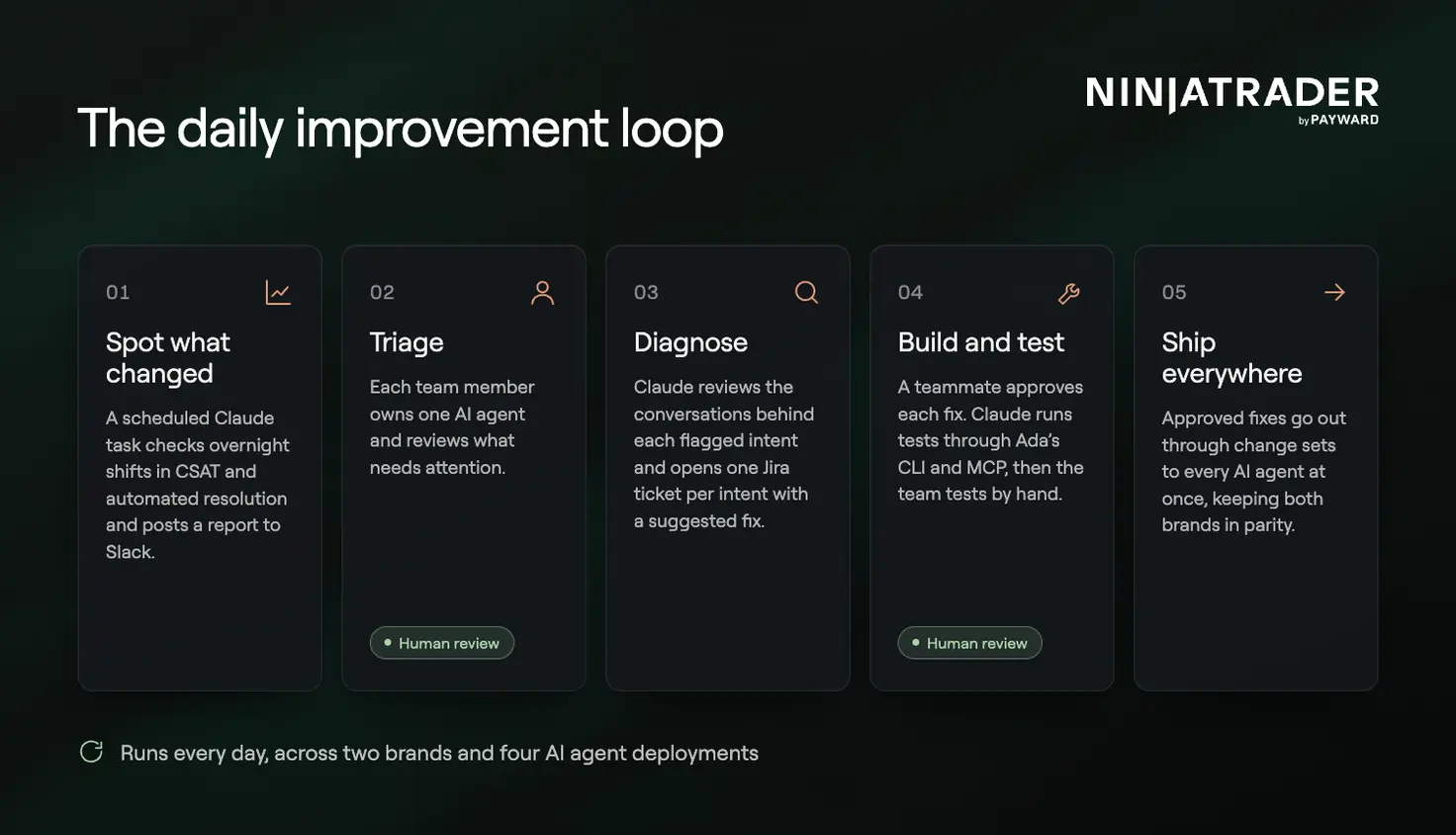
To review that many Playbooks at scale, NinjaTrader's AI team built a daily improvement loop that pairs automation with human review at every step:
- Spot what changed. A scheduled Claude task checks overnight shifts in CSAT and automated resolution, with a close look at the three most-used Playbooks, and posts a report to Slack.
- Triage. Each team member owns one AI agent and reviews what needs attention.
- Diagnose. Claude reviews the conversations behind each flagged intent or Playbook and opens one Jira ticket per intent, with conversation links, what went wrong and a suggested fix.
- Build and test. A teammate approves the fixes, which are built in a sandbox connected to NinjaTrader's staging trading environment. Claude runs tests through Ada's CLI and MCP, then the team tests by hand.
- Ship everywhere. Approved fixes go out through change sets to every AI agent at once, keeping both brands in parity.
"A problem that we find on one through a conversation is probably existing on another bot," Dennis says. "It's just that conversation didn't happen on that other bot."
The bar is the experience itself. "It's not just ‘Did it get a response?’ or ‘Did it resolve it?’" Dennis says. "We ask, ‘Was it a good experience?’"
"We've automated a lot of what we're doing, but we have a human gate at every step where we need one."
The loop gets sharper every day. When Claude flags something that isn't a real problem, the team records it in shared skills in GitHub, so the next review knows better. Every change made in Ada is also posted to Slack, where Claude turns it into a daily change-tracking dashboard in Confluence.
The loop also catches issues no one has reported. Claude once traced a run of fallback responses to an endpoint returning more data than Nina needed, and recommended saving the response as a variable and handling it with the Code tool.
"It's really given us the leverage to grow as fast as we can and keep up with the pace of our client growth," Dennis says.
Dennis Evans's advice for AI teams building at scale
Dennis Evans has three pieces of advice for teams building at scale:
- Codify your rules. Early on, everyone's AI tools built a little differently. The team now keeps one set of skills in GitHub, updated daily, so every Playbook gets built the same way.
- Build outside the UI. "That's where you're going to get your speed," Dennis says. He now works almost entirely in Ada's CLI, which lets him run several agents at once.
- Test everything. Use AI agents, Simulations and hands-on testing, in the sandbox first and again in production.
How NinjaTrader is turning Nina into a trading companion
Nina already takes action for traders. Someone working in the trading platform can ask Nina to set a daily loss limit, a risk setting usually managed in a separate dashboard, and Nina sets it for them. Proactive messages go a step further: Nina lets traders without a daily loss limit know that traders tend to last longer with one, and offers to set it up.
As Nina took on more of the work, NinjaTrader moved Dennis's team out of customer service and into the company's innovation lab, with Ada as the connective layer across its AI tools. When NinjaTrader launched its own MCP server so traders could connect AI tools to their accounts, Dennis wanted it to run through Ada too.
"Let's run it through Ada, because then we can build a better MCP," Dennis says. "We know what it can't do. We know what people are asking for."
Next, Dennis wants Nina to connect to that server directly, so every trader gets the same experience inside NinjaTrader without another AI subscription. Nina already answers calls after hours, and the team plans to bring Nina into the mobile app and new products. Longer term, Nina will coach traders on how their trading day went and where their strengths and weaknesses are.
The goal is an AI agent that feels like the AI tools traders already use every day.
"I don't want people to think they're just talking to another customer service chatbot," Dennis says. "They expect that Claude experience or that ChatGPT experience, and that's where we're really trying to get."