
GoFundMe
- +20% increasein CSAT
- +28% increasein automated resolutions
- 3 product SKUsmanaged by one platform
GoFundMe scaled safe, empathetic support with AI customer service.
As a global leader in online fundraising, GoFundMe is no stranger to urgent customer conversations. Whether it’s a donor inquiring about a crisis relief campaign or an organizer seeking urgent help during a sensitive time, the stakes are always high, and so is the need for trust.
But scaling this kind of high-empathy support isn’t easy. GoFundMe needed a way to handle growing volumes of complex queries without sacrificing the safety, tone, or personal touch its community expects.
Enter Ada.
What started as a strategic shift to AI soon became something more: a transformation of GoFundMe’s customer experience model and a redefinition of what’s possible when generative AI is deployed with care, rigor, and a safety-first mindset.
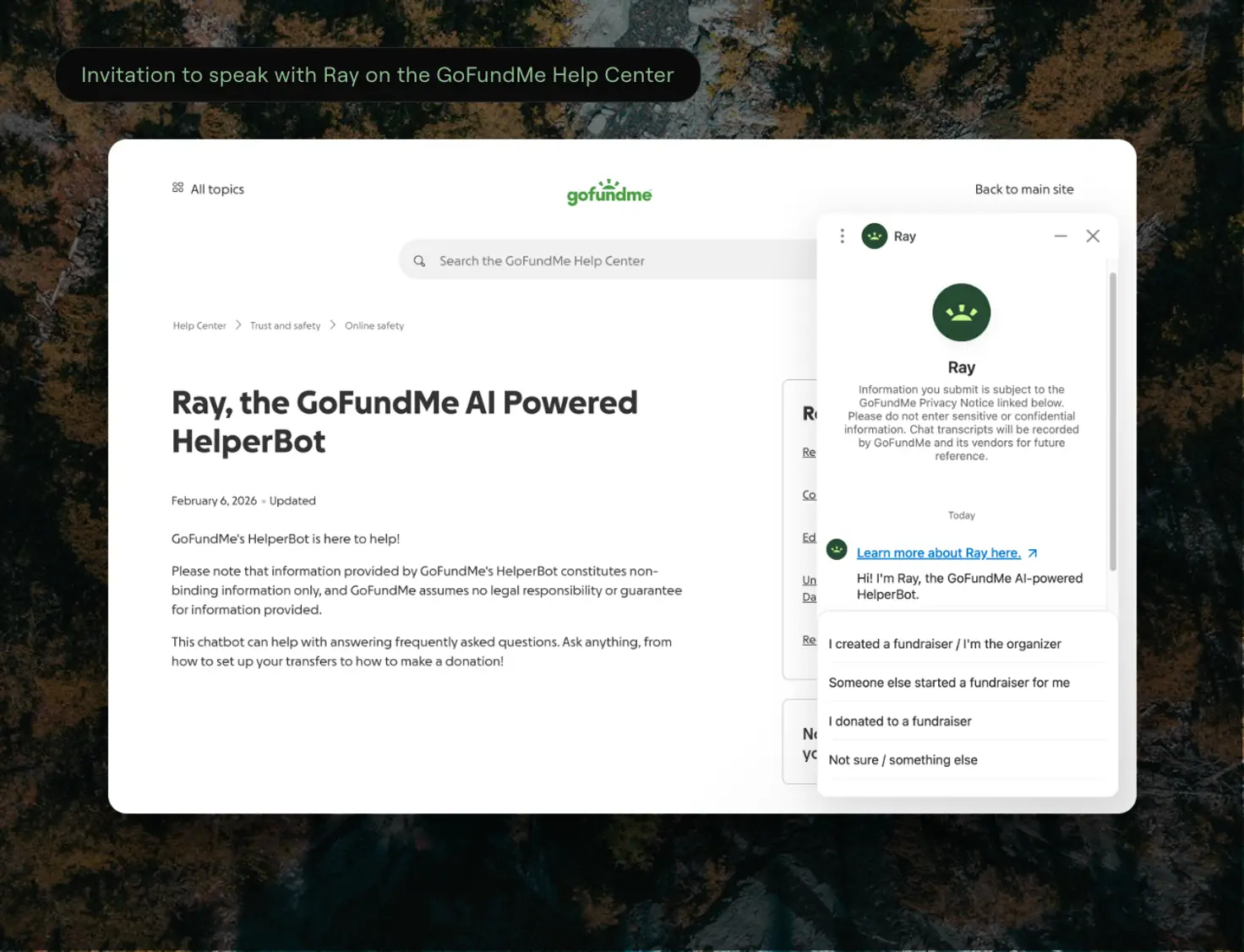
A thoughtful path to deploying an AI agent for customer service
Kelly Leary, Strategy Analyst at GoFundMe, has been a long-time user of Ada’s scripted chatbot, and had experience with the benefits and ROI of automation. She knew the leap to generative AI would be impactful, and that AI agents held promise.
“I was eager to move forward,” Kelly said. “But at the time people were still getting used to the idea of AI, and it still seemed like a scary thing, so it was important to do it right.”
“Because I was working on our Ada chatbot day-to-day, I saw the benefits of the generative AI agent right from the start.”


So Kelly took a methodical, cross-functional approach. Over the course of a year, GoFundMe ran three structured testing phases involving key internal teams, including Care Support, Trust and Safety, Security, and Strategy.
With the help of their Ada ACX Consultant, the GoFundMe team batch tested conversations to evaluate high-level metrics like containment and automated resolution. Kelly then rated each conversation on a 1-to-5 scale for risk, tone, accuracy, and navigation. She used those scores and the high-level metrics as a guiding assessment of the AI agent’s readiness.
Early testing focused on safety, including hallucinations and relevance. They even threw in edge cases—like asking for a chicken noodle soup recipe—to see how the AI agent would respond. Once confident in its guardrails, the team shifted to testing common complex customer questions.
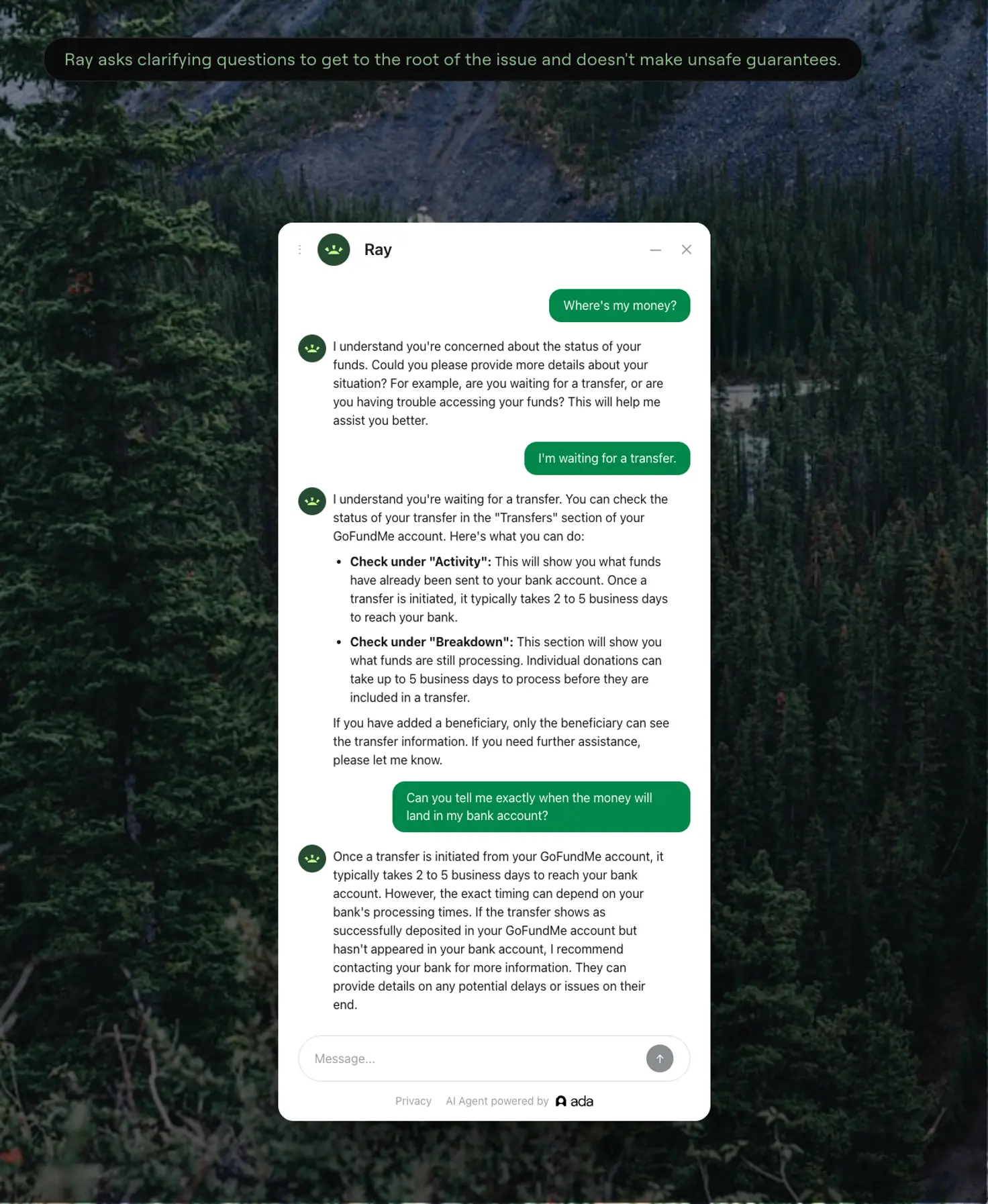
“Customers will ask ‘where is my money,’ but the scripted bot couldn’t dig deeper and could only give a generic troubleshooting answer,” Kelly explained. “The AI agent could actually engage in a back-and-forth to uncover the real issue causing the delay.”
The extended testing timeline allowed Kelly to track progress over time and build internal buy-in.
“The longer that we were testing, the more AI became normal in everybody's day-to-day and the more buy-in we were getting internally.”
By the third round of testing, results were clear. The AI agent could handle nuanced back-and-forths. It didn’t make unsafe guarantees. And it earned trust, both from internal stakeholders and customers.
The turning point came when Kelly demoed the AI agent to GoFundMe’s executive team. Their reaction? “This is a no-brainer.”
Earning trust through safety-first design
From day one, the team designed their AI agent with clear guardrails. Every test, rating, and decision was filtered through a single question: Would we feel confident putting this in front of our customers?
That mindset showed up in both technical and operational choices.
To protect against account takeover, the Trust and Safety team built two-factor authentication directly into the AI agent. Before any sensitive handoff or account-related support, it confirms a customer’s identity, ensuring the right information reaches the right person.
Just as important: what the AI agent can’t do.
Today, the AI agent isn’t connected to customer data via an API. That means it can’t surface personal information, even if prompted. The team chose to move at a pace that prioritized safety over speed.
Control also matters most in moments that carry public or emotional risk.
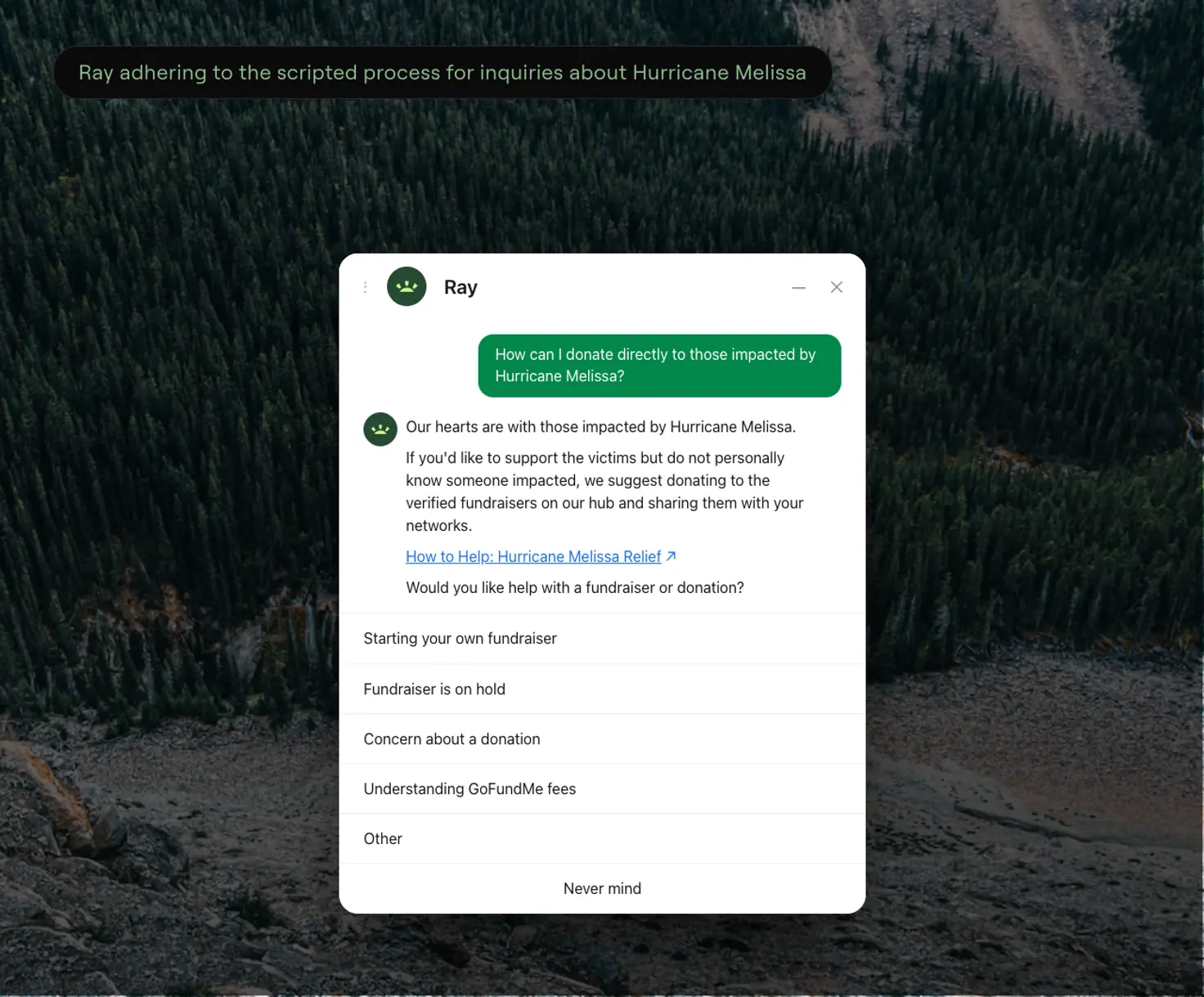
Using Ada’s platform capabilities, the team can coach the AI agent to use scripted messaging when responding to specific topics. This guidance ensures customers receive accurate, empathetic messaging, while preventing conversations from being taken out of context or misinterpreted publicly.
Outcomes that speak for themselves
Since launching their AI agent powered by Ada, GoFundMe has seen measurable improvements across the board:
- +20% increase in CSAT
- +28% increase in automated resolutions
These numbers tell a clear story, but the real win goes deeper.
The agent gives GoFundMe's care team the time to be able to focus on high-impact, high-emotion cases that benefit from human attention. That shift isn’t just good for customers. It’s good for agents, too.
“They're big fans,” Kelly said. “They've been able to slow down and take a breath and really dive into the cases where customers need them most, without feeling like they have hundreds of tickets in the queue that they need to rush through to get to.”
Internally, AI is no longer seen as “scary” or risky. It’s now viewed as a mature, strategic part of GoFundMe’s CX, one that’s earned its place by improving outcomes, not cutting corners.
Meet Ray, the AI agent designed to respond with empathy
GoFundMe’s customer experience team faces a unique reality: every interaction is personal, emotional, and often urgent. Customers are asking about real money, real timelines, and real lives—sometimes in the middle of a crisis. That makes empathy non-negotiable.
Affectionately named Ray, the AI agent has become an extension of GoFundMe’s care philosophy, providing smart, empathetic, and always patient support. Designed to handle emotionally sensitive topics with grace, Ray is configured to acknowledge grief, stress, and urgency before providing relevant support.
Take this example: when a customer mentions they’re raising funds for a parent’s funeral, Ray doesn’t jump straight to troubleshooting. First, it offers a simple, compassionate acknowledgment—“I’m really sorry to hear that”—before moving into support. It’s a small moment, but one that builds trust instantly and creates a more thoughtful support experience.
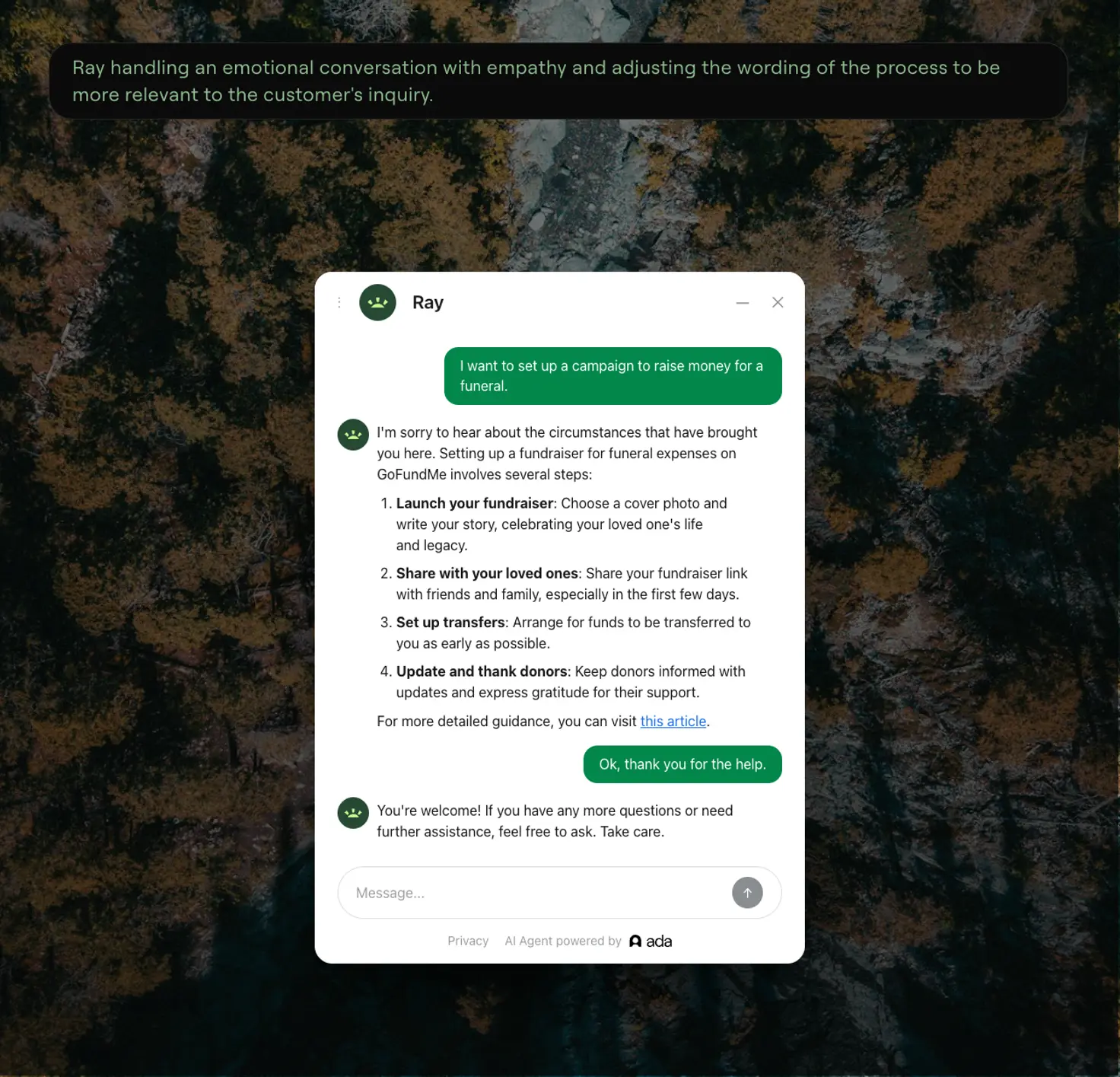
Ray may be powered by Ada, but it’s very much a product of GoFundMe’s voice, values, and vision for what AI customer experience should feel like.
“Ray is smart, empathetic, and very patient. It’s been really cool to see those values show up in our bot, especially because they reflect who we are as a company.”

Behind the scenes: the human impact
From care agent to AI lead
For Kelly, GoFundMe’s AI transformation wasn’t just a professional project, it was a personal one.
She started in the company’s care department, writing help center articles and answering customer questions. At the time, GoFundMe didn’t even have a chatbot. But as the company grew, so did the need for scalable support and Kelly stepped up to lead it. She’s now responsible for Ray’s daily performance, long-term vision, and continued improvement.
“If you had asked me when I was in college, are you going to be an AI Manager, I don't think I would have said yes. But now I can't really picture anything else,” Kelly said.
“I love that I can help customers from behind the scenes. It’s actually one of the most helpful places I can be because I can impact the entire customer experience at scale.”

An agentic model, built on collaboration and partnership
But Kelly’s not doing it alone. Her success is grounded in deep, ongoing collaboration with both Ada and her internal care team.
GoFundMe’s care agents don’t just escalate edge cases. They act as a distributed QA layer, regularly flagging unusual conversations or surfacing feedback from the front lines. And they do it without friction because trust goes both ways.
“They know I won’t take it personally if something’s not working. We’ve built this open communication where they feel totally comfortable flagging what needs to be improved,” Kelly said.
Much of that collaboration runs through Ada's intent intelligence feature, which replaced a manual tagging system from the scripted bot era. Instead of broad topics, granular intents drive the decision making: when certain intents spike in volume or show dips in containment or CSAT, Kelly and the care team use that signal to investigate, coach, or adjust workflows together.
And when that internal collaboration connects with Ada’s external support, the impact compounds. Kelly works closely with Valentina, her dedicated ACX Consultant, to prototype new use cases, build sandbox demos, and prepare for future API rollouts.
“I always feel like I’m Valentina’s only client,” Kelly said. “She makes it feel like a one-to-one partnership.”
What’s next
For Kelly and the team at GoFundMe, the journey is far from over.
Next on the roadmap: Expanding the use of Playbooks to create more structured, reliable flows for additional scenarios.
But with a proven track record of results, and a clear, safe, and agentic approach, GoFundMe’s team is poised to keep scaling meaningful, empathetic support. One thoughtful step at a time.