
Deezer
- +11 pts automated resolutionin six months
- 85% of support contactsflow through the AI agent
- ~50% of support workcompleted by AI
- 5x more conversationsanalyzed daily
Deezer gets one conversation to win a subscriber over. Here's how their AI agent makes it count
Company snapshot
Industry: Music streaming
Region: Global (HQ Paris, France)
Channels supported: Web chat, email, webform
Volume: ~20,000 chats/month with Melodie
Ada customer since: July 2024
For Deezer, first impressions are everything. Most subscribers who contact support will only ever do it once, so there's no long-term relationship in which to win back trust after a bad experience. And the conversation usually starts at a frustrating moment: the music has stopped, or a payment has failed, and the customer wants it fixed in minutes, not hours. Multiply that by millions of subscribers writing in many languages, add the volume spikes that come with any digital product, and that's the reality Deezer's support team designs for.
Deezer is the French music streaming service behind that experience, serving 9 million subscribers around the world with key markets in France, Brazil, and Germany. Unlike most players in the category, Deezer grew as a partner-first business, powering music for leading telcos like Orange in France and TIM in Brazil. Patrick Dunford , VP of Customer Care, has spent over a decade building the support operation. Neil Banks , Head of Community, owns the platform side, integrating Ada into Deezer's support stack. And Aline Giazzon manages the AI agent itself, a role that tells its own story below.
The second look
Ada first crossed Patrick's radar in 2018, when the team was evaluating the first generation of support automation. They went another way, and spent the next several years doing what the technology of that era demanded: Aline's team hand-built and maintained a library of intents, predicting every way a customer might phrase every question, in every language, across every market. The team kept it running, but the tooling capped what the experience could become.
"Endless work," is how Neil describes it. "Users would ask us a different question to what we'd programmed in, and that's different for each language. Across all our markets, it becomes an infinite problem."
By 2024, generative AI had changed what was possible, and the team went back to the market. Across the vendor landscape, Patrick ran into a challenge many support leaders will recognize: companies that were making AI claims that were hard to pin down in practice.
"I had a lot of conversations with vendors where I had to say: you're using all the buzzwords, but I've got no idea if you can do what I want. Ada was one of the very few using generative AI in a way that really impressed us."


Six years after that first look, Ada was back on Deezer's evaluation list, and the team put it to the test. As they fed it their knowledge, the AI agent began producing correct answers to questions nobody had scripted, and they didn't take the results on faith. "There were answers it gave that surprised us," Neil says. "They were correct, but we didn't understand how it had reached that conclusion until we traced back how it had linked together the different knowledge points."
For Aline, who had spent years hand-building intents, the difference was simpler: "We didn't need to train the AI agent anymore." Seeing Ada run on Deezer's own knowledge settled the decision. "Just by linking our knowledge base to Ada, we would start in a better place than where we were. We knew we couldn't waste any more time, and made the switch."
Impact from day one
Patrick built his business case cautiously, the way any VP planning a platform migration would. The AI agent, which Deezer affectionately named Melodie, made his projections look conservative almost immediately.
"Ada exceeded my prediction for success almost on day one. The automated resolution rate we achieved on day one was something like 30%, and it's only gone up from there. We did not need to spend a long time leveling up."

The speed had a foundation. Patrick has watched other companies stall on AI because their knowledge wasn't ready; Deezer had spent years getting theirs right, with a help center that serves hundreds of thousands of visitors a month and resolves issues before a conversation ever starts. Connecting it to Ada created a loop that keeps compounding: every improvement the team makes to the knowledge base sharpens the AI agent, and the AI agent surfaces the gaps to fix next.
Today, Melodie is involved in about 85% of Deezer's support contacts and handles roughly half of the team's work. Automated resolution has climbed 11 percentage points in six months. When an unexpected spike hits, the AI agent absorbs the surge of quick, transactional questions so the team can focus on the customers who have more complex inquiries.
Automation on their own terms
Deezer decides exactly how far automation goes. For certain requests, the team draws a line: Melodie handles everything up to that point, then brings in a person to make the final call.
Take cancellations: Melodie could handle them, but a subscriber weighing whether to leave gets a human conversation, every time.
"We made the deliberate decision to keep humans in the loop in some cases where we could choose not to. AI could be doing even more than that if we wanted."

The same discipline shows up in how the team reads its numbers. Deezer holds itself to tracking real resolution, not a flattering blend, and Ada's Reporting supports that standard by separating resolved conversations from contained ones. When automated resolution spikes, the team investigates before celebrating; if a coaching change is quietly resolving conversations it shouldn't, they want to know.
And they read AI agent CSAT with the same clear eyes, knowing satisfied customers often skip the survey while frustrated ones rarely hold back. The score has climbed steadily over the past six months, and Aline supplements it by reviewing the conversations themselves, where the real experience shows. Behavior backs that up: roughly 90% of subscribers who open a conversation engage with Melodie, 19 points above the industry average, in markets where skepticism toward AI runs high.
Not a side project
Choosing a platform was only half of Deezer's commitment. The other half was deciding that managing the AI agent would not be a side project. Aline came up through the front lines, starting at Deezer answering emails and web chats as an agent, then running the intent-based chatbot alongside her customer care manager role. Years of answering customers herself taught her what they needed, how they asked for it, and how Deezer's policies applied. In April 2025, Deezer made managing the AI agent her full-time job.
"With everything changing, we needed someone dedicated to this," she says. "It could not be a side project anymore." Her days now revolve around reviewing conversations, closing knowledge gaps, and building the Playbooks that steer Melodie through Deezer's most sensitive moments.
Refunds are the flagship; it’s one of Deezer's most requested topics, and the one where an AI agent can do the most damage, since promising money a company won't return destroys trust in a single message. Aline built the refund Playbook to protect that trust: it walks each customer through their specific scenario, sets realistic expectations about how Deezer's policy applies, and always offers the path to a human agent, who makes the final call on every refund. Built on Ada's latest Playbooks release, it keeps improving as she reviews conversations, adding conditions for situations the first version didn't cover. Escalation on refunds stays high by design, but customers arrive at the handoff understanding their situation instead of fighting it. Aline watches the sentiment in those conversations, and it has visibly improved.
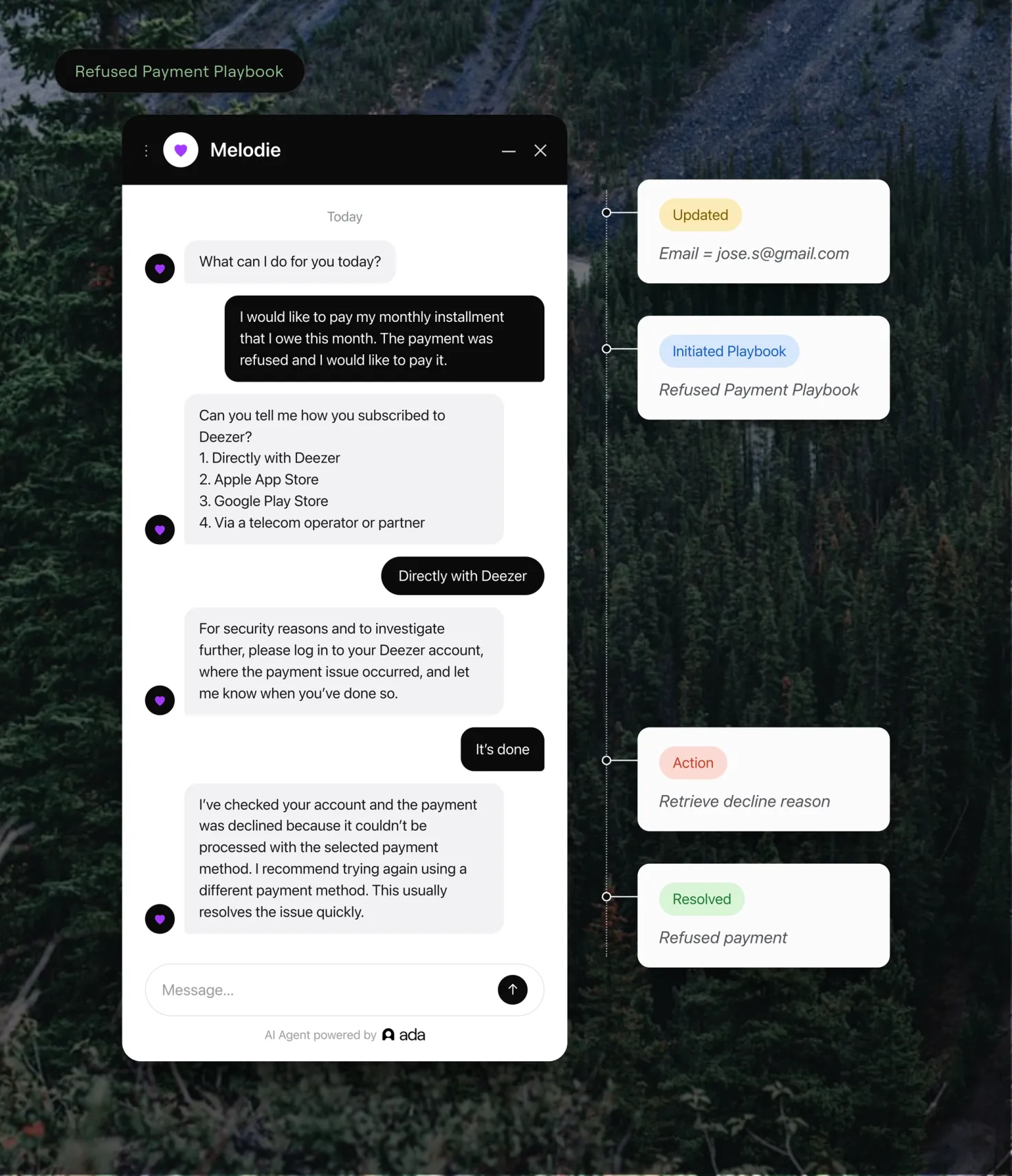
Where a straight answer is the right answer, Aline connects Melodie to Deezer's own systems. When a payment fails, an API integration pulls the actual decline reason from Deezer's back office, so the AI agent can tell the customer their card expired and how to fix it, a resolution that used to wait for a human to relay the same information. She built all of it from a customer service background, not an engineering one.
Two extra teammates
Deezer was one of the first customers to adopt Ada's MCP server, which lets Aline work on the AI agent through natural language from the AI tools she already uses. It has changed the scale she operates at.
Reviewing conversations manually, she could get through about 20 a day. With MCP, she reviews 100 or more, and the analysis comes with reasons attached. When automated resolution dips, she no longer pieces together a hunch from internal channels; she asks, and gets the driver. When a conversation breaks, she pastes the link and asks where in the configuration it went wrong, then approves the fix, a diagnosis that used to require a request to their Ada team. She runs sentiment analysis on each Playbook to find dead ends and missing conditions.
"It's like having two extra agents helping me. I spend much less time on manual work, going conversation by conversation, so I can improve the AI in the areas that really need attention."


Built together
Deezer sets a high bar for the companies it works with, and Neil states it plainly: "We always look for a partner rather than a tools vendor." Ada has had to clear that bar, and Deezer's influence runs in both directions: feedback the team has given on Playbooks has shaped the product they use today.
At a recent quarterly business review, their Ada Customer Success Consultant proactively brought a working proof of concept, built with Deezer's own branding, that worked around technical roadblocks the team was stuck behind.
"Our Customer Success Consultant put a plan together without us even prompting him. He understands what we're trying to achieve, he knows the roadblocks we're up against, and he came with a workaround: it won't get you all the way, but it'll get you some of the way. That's a partnership."

That orientation holds even when the obstacle sits outside Ada's platform. During a major migration in Deezer's support stack, "the limitation wasn't necessarily on Ada's side," Neil says, "but the Ada team was dedicated to finding solutions regardless of where the challenge originated from."
What comes next
Melodie was the beginning. Deezer now runs two more Ada-powered AI agents, Harmony for Deezer for Business and the newly launched Aria for Deezer for Creators, and the team is bringing what they've learned to other departments across the company.
Neil's ambition is an AI agent that knows the customer it's talking to. A subscriber who reached out about a problem a few days earlier would be greeted with that context, walked through the troubleshooting, and left with the issue resolved on the spot, even in the middle of the night when no human agent is on shift. Ada's End User API provides the path there, and the pace is set by Deezer's own high bar for protecting personal data, a roadblock Neil calls a necessary one. "Once we crack that," he says, "the sky's the limit."
For all the numbers, Aline measures the work by what she reads in the conversations. Subscribers get their answer in minutes instead of hours, and their music comes back. And it matters, because that one great conversation is often the only impression a subscriber will ever have of Deezer support.
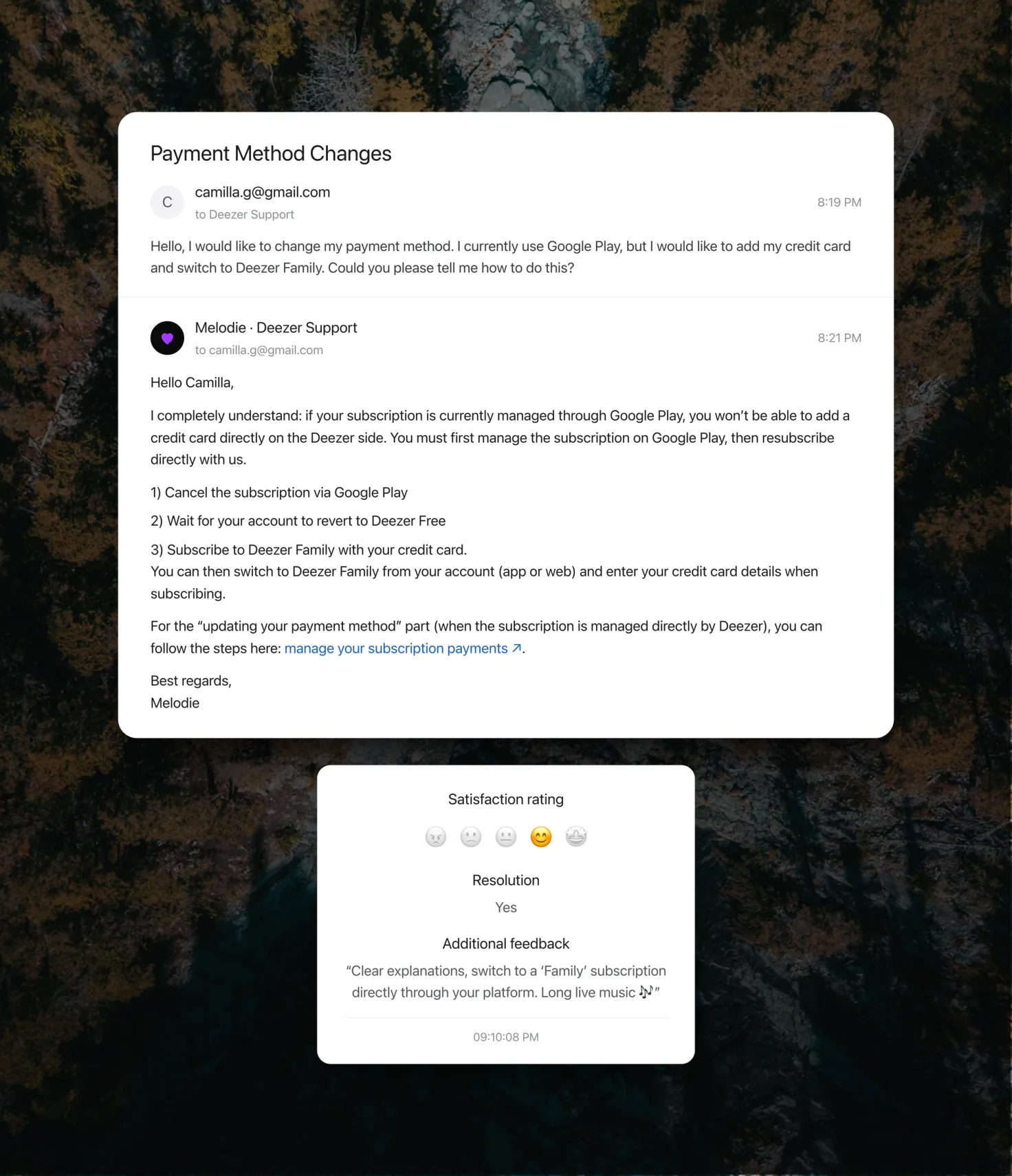
"Going through conversations, I see customers just say thank you. That's what I'm most proud of: the AI agent isn't creating a barrier, it's providing quick, efficient support."