

Key takeaways
- Containment rate fails as an AI agent metric because it measures whether customers stay in the automated conversation, not whether their problems are actually solved.
- Customer service leaders are shifting to metrics like Automated Resolution Rate (AR%) that account for accuracy, relevance, and safety.
- Adopting resolution-focused metrics improves ROI and delivers a more accurate picture of AI agent performance.
Chances are you've talked with a company's AI agent recently. But did it actually solve your problem?
That's the big question every company deploying AI agents for customer service is trying to answer. And as breakthroughs in AI transform customer service processes and unlock automation across new, more complex use cases, it's becoming more important than ever.
What is containment rate?
Containment rate is the percentage of customer interactions handled by an AI agent without escalating to a human agent. The idea is that if a customer doesn't escalate beyond the AI agent to get help from a human, the AI agent must have successfully solved their problem.
This is in part because the use of AI agents for customer service is increasingly taking center stage. Gartner projected in 2022 that 10% of customer service agent interactions would be automated by 2026, a sharp increase from their estimate that just 1.6% of interactions were automated at the time. Many companies are also looking to advance the technology to a level where it will be able to fully handle many customer issues without the need to escalate to a human, which makes measuring when an AI agent does so successfully paramount. The problem is, it's becoming ever more clear that the industry's go-to metric for measuring this, containment rate, is falling short.
“CS leaders have a positive future outlook for chatbots, but struggle to identify actionable metrics, minimizing their ability to drive chatbot evolution and expansion, and limiting their ROI."


Across the industry, customer service leaders are increasingly ringing the alarm about containment rate and working to establish new metrics for AI agent success. Here's a look at why containment rate fails as an automation metric, and measures of success that can be tapped instead, such as automated resolutions (AR%).
Why is containment rate a flawed metric?
Containment rate is flawed because it doesn't actually measure whether a customer's problem was resolved, only whether they stayed within the automated conversation.
But this line of thinking has a major blind spot: it doesn't actually account for resolution.
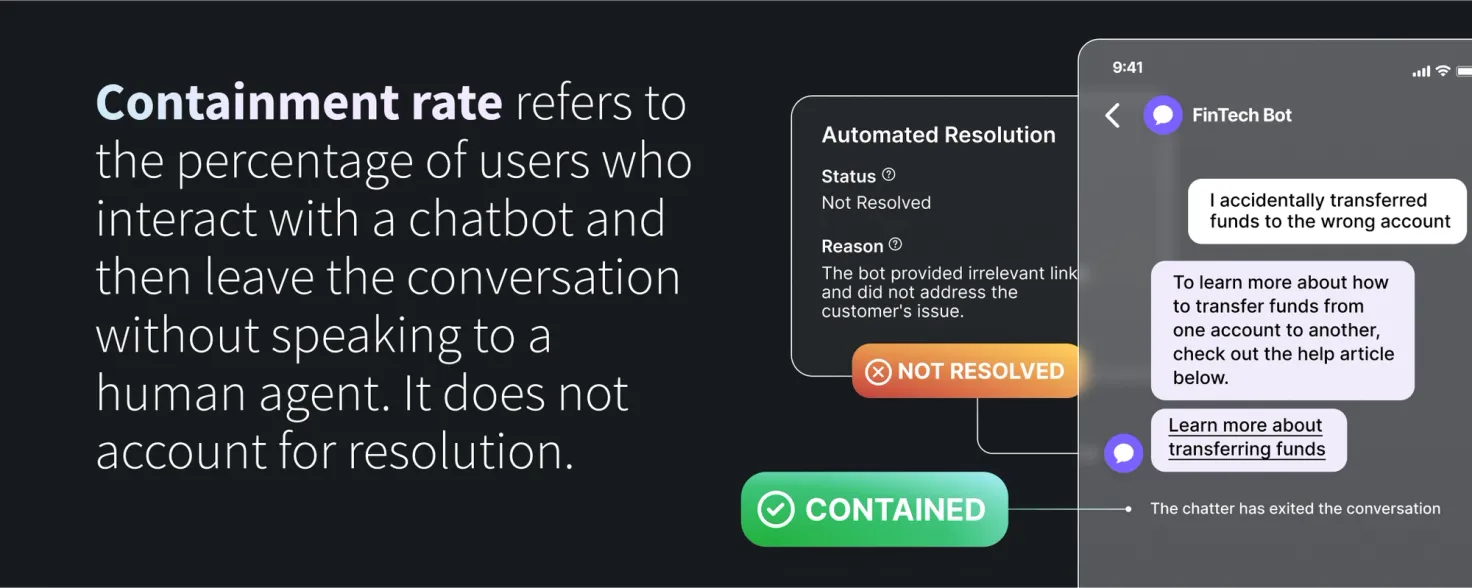
A customer might leave the conversation without having their issue resolved for a variety of reasons, such as if something important comes up that they have to attend to right away. But even more likely is a scenario where they leave the conversation because the AI agent failed to solve their problem. In this case, containment rate is not only a poor indicator of success, but one that's actually deeply misleading.
If a chatbot makes a customer repeat themselves multiple times, routes them through various menu options until they reach a dead end, or surfaces information that is unhelpful or irrelevant, it's easy to see why some customers might feel so frustrated that they give up and close the conversation. Containment rate as a metric, however, would count this interaction as a success.
The Gartner research behind Uma's warning further highlights this blind spot. In one section, the report breaks down various chatbot metrics and categorizes them by what they actually measure. While it lists some metrics (like escalation rate and goal completion rate) as measuring "effectiveness," it lists containment rate as measuring just that: containment.
Weizhe Yuan, a researcher at New York University whose work focuses on evaluating natural language processing (NLP) tasks, said that selecting appropriate metrics is one of the golden rules of evaluating the success of increasingly complex NLP-based technologies like AI agents.
“Previously, NLP techniques were focused on traditional NLP tasks such as text categorization, named entity recognition, etc., which usually had some easily measurable metrics. Now, however, NLP techniques are increasingly being applied to open-domain tasks that range from writing novels to rewriting financial documents.”


She added that as companies look to deploy technologies like AI agents for a wider range of uses, it's important to understand what they can and can't do, while also measuring the potential harm they could cause in new use cases.
Containment rate
What it measures: whether the customer stayed in the chatbot conversation
Limitations: doesn't account for resolution; can count frustrated drop-offs as successes
When to use: basic volume tracking
Automated Resolution Rate (AR%)
What it measures: whether the customer's issue was actually resolved
Limitations: requires AI-based filtering for accuracy, relevance, and safety
When to use: measuring true chatbot effectiveness and ROI
Why are CX leaders moving away from containment rate?
For years, Kane Simms, a conversational AI and chatbot consultant who works with companies on their customer service strategies, has been shouting from the rooftops that containment rate is the wrong metric.
"The containment rate doesn't tell you anything about whether your customer got what they needed from you. It tells you nothing about how well you're serving them and how effective your automated channels are," he wrote in a 2021 blog post (https://vux.world/why-containment-rate-is-not-the-best-way-to-measure-your-chatbot-or-voicebot/), a message he's since repeated in webinars, LinkedIn posts, and beyond. "It's also language that makes it sound like your customers are an inconvenient virus that need to be stopped dead in their tracks and isolated in your channels."
Not to suggest it's all because of his outspokenness on the topic, but many companies in the space have been drawing the same conclusion (Ada included). Several have started speaking out about the issues with containment rate and even declared they're moving away from it as a metric, showing the change is gaining momentum across the customer service industry.
Chatbot company Simplr called containment rate a "red flag metric," one that can even be "downright deceptive," in a recent blog post. The company says their data shows that up to 20% of "contained tickets" are instances where the customer dropped off because the bot was not helpful, rather than because it solved the customer's problem.
"The metric inflates bot performance and, worse, exposes the extent of customer frustration on a site," the blog continues.
LivePerson has also made the case that the industry needs to shift its perspective of key metrics in order to better measure automation performance.
"We need to assess chatbot success properly, but that doesn't always mean leaning on familiar key performance indicators," reads a blog post from the company, which goes on to argue that containment rate doesn't account for resolution.
Skit.ai has similarly called out containment rate as a problematic north star metric and argues that if the focus is on increasing it, this will actually end up damaging the customer experience.
"Customers may be ending the calls because the Automated Speech Recognition (ASR) engine is not recognizing their voice or words. It can also be that the conversation flows are not optimized, leading to customer frustration," reads a blog post from the company. "There are several other situations where customer queries are not resolved and causing them to hang up. Here, the containment rate may rise, but at the cost of CX."
ChatBot, another company in the space, maintains that containment rate is significant, but argues that it's essential to balance it out with other metrics that will provide a fuller picture, such as user satisfaction and resolution time.
This speaks to the fact that containment rate leaves too much up in the air, and also touches on what Weizhe said is one of the most important factors for successfully evaluating NLP-based technologies like AI agents: using multiple metrics.
"In many cases, it's beneficial to use multiple evaluation metrics to get a comprehensive view of your model's performance," she said. "Different metrics may highlight different aspects of performance."
What should you measure instead?
With containment rate starting to fade in prominence, it's clear the industry is entering a new era of customer service KPIs. And it's certainly a good time to reevaluate; thanks to advancements in AI (and especially generative AI), the AI agents of today are far ahead of the chatbots of just a few years ago, with even more room for improvement ahead.
Customer satisfaction scores (CSAT), for example, are one metric some companies are increasingly leaning on. Unlike containment rate which specifically rewards when customers' issues aren't escalated to a human, CSAT actually targets resolution.
CSAT does have its drawbacks, however. This metric has historically been calculated using data from customer surveys, typically prompted right after the interaction. But critics argue this is a flawed metric and doesn't paint a comprehensive picture. Many customers choose not to participate in these surveys, and when they do, the questions and methods for answering often lack the nuance needed to truly understand how customers feel. Future advances in how customers share their satisfaction could improve the value of CSAT, but many customer experience leaders believe it currently lacks the rigor necessary to be a central metric.
Ada is targeting Automated Resolution Rate (AR%) as a new north star KPI for AI agents, citing the foundational shift to an AI-first approach to customer service.
What is Automated Resolution Rate (AR%)?
Automated Resolution Rate (AR%) measures the percentage of customer conversations fully resolved by an AI agent without human involvement.
Formula: AR% = resolved conversations ÷ total conversations
A conversation counts as "resolved" when it is:
- Relevant: the response addresses the customer's actual question
- Accurate: the information provided is correct
- Safe: the response meets safety and compliance standards
- Contained: no human agent was required
Automated Resolutions are conversations between a customer and a company that are safe, accurate, relevant, and don’t involve a human.
Arnon Mazza, a staff machine learning scientist at Ada, defines automated resolutions as "conversations between a customer and a company that are safe, accurate, relevant, and don't involve a human" in a blog post discussing the metric. Rather than relying on a customer to provide honest insight after the fact, AR uses AI to run the conversation through a safety filter, an accuracy filter, and a relevancy filter in order to determine if the customer's inquiry was automatically resolved.
For the accuracy filter, for example, Arnon describes how this is determined by three steps: limiting the knowledge source that the AI distills information from to only the company's first-party support documentation; running an Elasticsearch index to search for and retrieve the most relevant documents that could contain the most accurate information; and then using several methods (including running a BERT-style natural language inference model on each of the documents and the generated answer) to determine the probability that what was generated is "logically entailed" from the first-party support documents.
With this approach, companies could set thresholds to dictate how confident the AI needs to be to serve an answer, even making it possible to separate the thresholds for relevance and accuracy. They can set higher thresholds for more sensitive questions, or lower ones for topics that may warrant a lower risk tolerance, according to Arnon.

In addition to selecting the right metrics and considering multiple metrics together, Weizhe also cited using fine-grained analysis that breaks data into parts as a golden rule of measuring NLP-based technologies like AI agents. AI has been known to have a "black box" issue, referring to the fact that often no one knows how any specific AI system actually arrives at its outputs (its creators included). Seeking to understand AI agent outputs in more granular ways can not only help understand performance, but also what's going right, what's going wrong, and why.
"Instead of looking at the overall performance of the model on the whole dataset, break down the dataset into multiple subsets and see how the model performs in different subsets," she said. "This will better reveal the strengths and weaknesses of the model."
Key AI agent metrics beyond containment rate
- Automated Resolution Rate (AR%): percentage of conversations resolved by the AI agent without human involvement, verified for accuracy, relevance, and safety.
- Customer satisfaction score (CSAT): measures customer happiness with the interaction, typically gathered via post-conversation surveys.
- Customer effort score (CES): assesses how easy it was for the customer to get their issue resolved.
- Intent resolution rate: tracks whether the AI agent correctly identified and addressed the customer's intent.
- Escalation rate: percentage of conversations that required handoff to a human agent.
Frequently asked questions
What is a good automated resolution rate?
A good AR% varies by industry, use case, and the complexity of the inquiries an AI agent handles. Rather than chasing a universal benchmark, measure your baseline and track improvement over time as you expand what your AI agent can resolve.
How do you measure AI agent success?
AI agent success is best measured using multiple metrics, including AR%, CSAT, CES, and intent resolution rate, to capture both efficiency and customer experience.
What's the difference between deflection and resolution?
Deflection (or containment) measures whether a customer stayed in the automated conversation; resolution measures whether their problem was actually solved.
Why is containment rate misleading?
Containment rate counts frustrated drop-offs as successes, inflating performance numbers without reflecting true customer outcomes.
Key AI customer service metrics leaders need to be tracking
Our experts put together this guide with all the info you need about tracking and measuring customer service success in an AI-first organization.
Get the report