
Most airlines have piloted AI in customer service. Far fewer have taken a pilot into production across a flag carrier's passenger base, and the ones that stall rarely stall on the technology. They stall on sequencing, on governance, and on the people who have to run the program after go-live.
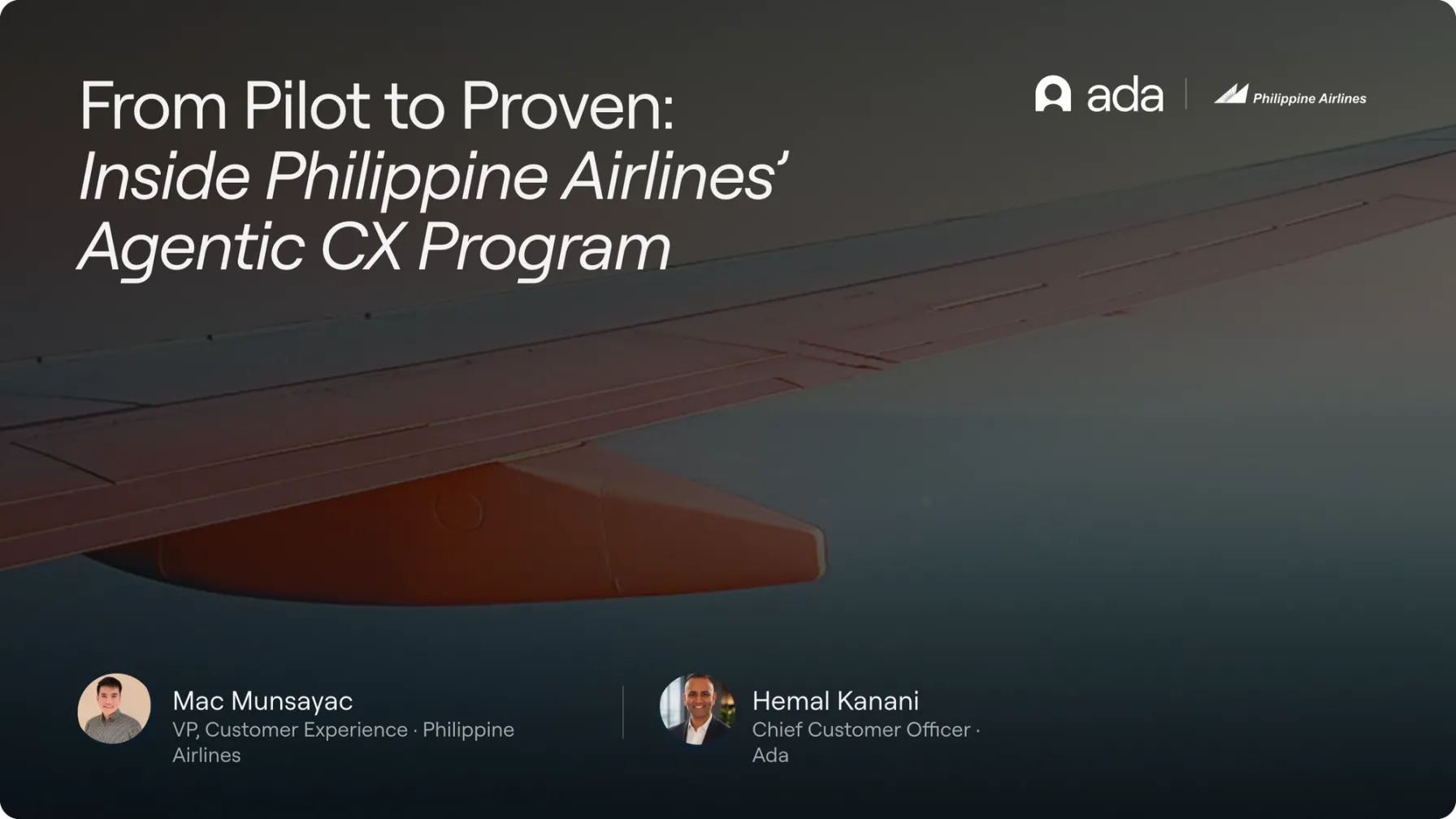
In the second session of our airline series, Mac Munsayac, VP and Head of Customer Experience at Philippine Airlines, walked Ada's Chief Customer Officer Hemal Kanani through how PAL did it: a three-month pilot, containment climbing in steps to 50% on messaging, and a passenger base that hasn't complained about the agent once since launch. If you lead CX, operations, or digital at an airline and you're somewhere between pilot and scale, this is for you.
Start with the problem, not the tool
PAL's project began with disruption. When a typhoon or an airport closure grounded flights, the contact center flooded, hold times stretched from 30 minutes to an hour, and nearly doubling the team over six years hadn't fixed it. "You could promote self-service options," Mac said, "but there are so many things that could not be solved by those tools." His team wanted a channel that scaled with the disruption instead of behind it.
They shortlisted six or seven partners, piloted three for about three months, and chose Ada. Mac called it "a runaway winner" on three counts: ease of use, because a coach could fix a response and see it live two minutes later; intent recognition, which at the time nobody else came close on; and the people, who were responsive and flexible. It's a useful reminder that a pilot is a test of the partnership as much as the product.
Why the pilot was deliberately small
Mac's advice to anyone starting out is blunt. "You wouldn't want to spend six months just working on an API. It will delay the entire project." PAL picked the three easiest use cases that would still produce real numbers: website integration, answers grounded in the knowledge base, and flight status with booking retrieval. That was enough to prove the agent worked and to gather the data the board would later ask for.
From there, containment grew one use case at a time: 20% at launch, then 30, 40, and 50. On the morning of the session, PAL went live with miles balance and loyalty status, and kicked off implementation of Amadeus APIs for new bookings, itinerary changes, voluntary and involuntary rebooking, and refunds. Mac's target once those land is 70 to 80%.
Containment tells you how many conversations didn't need a person. It doesn't tell you how many passengers were actually helped, and Mac's team doesn't treat it as if it does. PAL created a new role, the AI coach, to monitor conversations hourly and daily, retrain the agent, and score sampled conversations against a quality form for resolution, accuracy, and customer satisfaction. That discipline started in the pilot and never stopped.
The governance bar every passenger-facing AI has to clear
Mac tested the agent himself before any passenger did, and his bar was specific. It has to be effortless, which means the passenger never repeats themselves. It has to be grounded only in PAL's internal knowledge base, with guardrails, so that, in his words, "hallucination is almost nil." It has to be transparent about what it can't do, and offer a self-service route or a live agent the moment it hits a limit. And the live agent is never hidden.
That last rule comes from experience. Six years ago PAL launched a scripted bot and pulled it after a month in production, because passengers told them they hated canned answers. This time nobody is forced into AI. The agent is offered proactively and passengers keep using it because it works for them.
The result Mac watches most closely isn't a survey score. PAL's social media team monitors every public complaint around the clock, and since the agent launched they've logged zero negative comments about it. Passengers aren't anti-AI. They're anti-being-asked-the-same-question-twice, and PAL built for that.
How the board conversation went
"It was not a difficult conversation at all," Mac said. The efficiency case was straightforward math on pilot containment data. But the argument that carried the room was customer experience during disruption, and future-proofing the airline: doing the governance work now so the next agentic use case is business as usual rather than a crisis.
The change management mattered as much as the numbers. Mac's team was explicit with agents that the AI was there to help them serve passengers better, not to replace them, and the AI coach roles were new jobs created by the program. His three rules for anyone piloting: start with a problem, start small, and don't forget you're managing people as well as a tool. One more, learned the hard way: pilot with one partner, not three. Three pilots cost PAL resources they wouldn't spend again.
What comes next: from containment to a concierge
Once the Amadeus integrations are live, PAL's next priority is a travel concierge on WhatsApp with persistent memory. It knows who you are without re-verification, reminds you your flight is tomorrow, tells you when to leave for the airport, and lets you book, rebook, or request a refund in the same thread. "You really won't need to call," Mac said. "You really won't need to go to the website."
The session closed with a concept demo of that pattern: a typhoon 18 hours out, thousands of passengers inside the closure window, and one of them rebooked in a single tap with her seats, bags, and her mother's wheelchair assistance carried over to the new flight, before the airline had cancelled anything. It's a concept, not PAL in production today. But it's the same sequencing Mac described, taken to its conclusion.
Watch the session
The full recording is on demand here: From Pilot to Proven: Inside Philippine Airlines' Agentic CX Program. If you missed part one, From Cancelled to Confirmed shows the disruption workflow end to end.
And if your airline is between pilot and scale, we'd like to compare notes on how PAL sequenced it. Everything's here, including a way to book time with the team: https://www.ada.cx/departures/acx-for-airlines/