
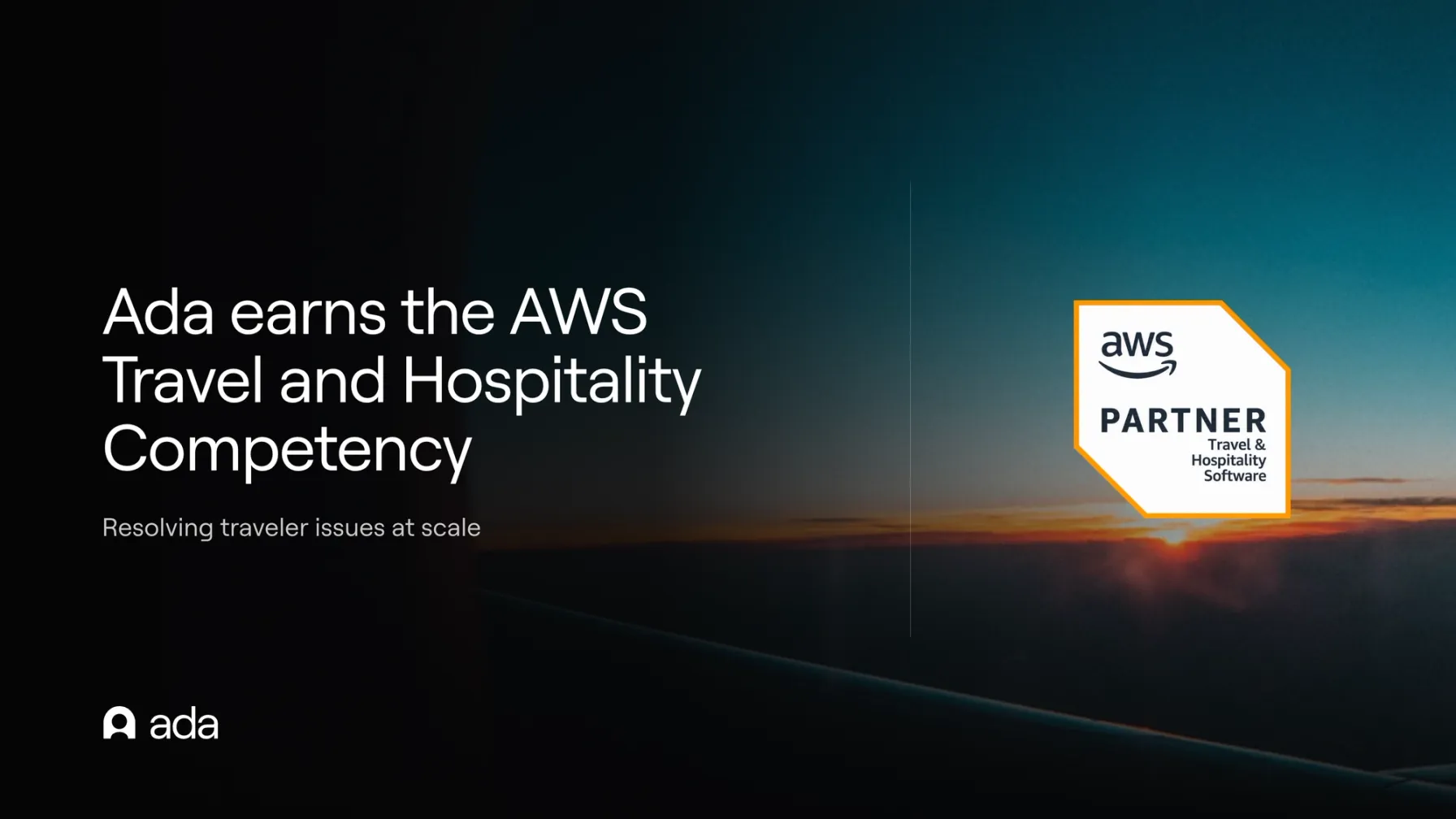
Today, Ada has achieved the Amazon Web Services (AWS) Travel and Hospitality Competency. AWS grants this designation to a select group of partners, 58 as of this announcement, that have demonstrated technical proficiency and proven customer success in travel and hospitality. For airlines, hotel groups, and travel brands already building on AWS, it means there’s now an AWS-validated, procurable path to AI customer service built for this industry’s hardest moments.
If you lead CX, operations, or digital at an airline or travel brand running on AWS, this is for you.
The moments that test every travel brand
A flight is cancelled at 11 p.m. A loyalty upgrade doesn’t carry over to the rebooked itinerary. A connection is missed by six minutes.
These moments rarely arrive one at a time, and almost never during business hours. They come in surges, to travelers who are tired, stressed, and far from home. For a CX leader, the real work is running a program that resolves thousands of these conversations reliably on the worst night of the quarter, and that keeps getting better long after launch.
What is the AWS Travel and Hospitality Competency?
The AWS Competency Program recognizes AWS Partners with demonstrated expertise in a specific industry. To earn the Travel and Hospitality Competency, a partner has to show technical proficiency on AWS and documented outcomes for travel and hospitality customers. A working integration or a successful demo isn’t enough on its own.
That’s the same bar a travel brand’s procurement and security teams would otherwise have to verify themselves.
Why it shortens diligence for travel brands on AWS
Evaluating an AI customer service partner usually means confirming three things independently: that the integrations actually work, that the infrastructure meets your compliance requirements, and that the partner has delivered results in travel specifically. For brands standardized on AWS, the competency lets that review start from AWS’s own validation, so your team can spend its time on the questions only it can answer.
Ada CX is also listed in AWS Marketplace. Travel and hospitality teams can find and procure it the same way they procure other AWS-validated solutions, inside approval processes they already run.
Built on AWS, not just compatible with it
Ada runs on AWS infrastructure, including Amazon Bedrock and Amazon SageMaker for AI. It connects to Amazon Connect to hand chat and voice conversations off to human agents with full context intact, so a traveler never has to repeat themselves. Regional hosting is available in the US, Canada, and the EU, which helps travel brands meet their GDPR and other compliance obligations without building that infrastructure themselves.
For a brand already on AWS, that means extending a stack its security and procurement teams already trust, rather than bringing in a new system to review from scratch.
What Ada-powered AI agents do for travelers
Ada-powered AI agents connect to a brand’s reservation, inventory, loyalty, and CRM systems, so they can understand what a traveler needs and act on it directly. When a flight is disrupted, the AI agent accesses the reservation system, makes the change, and confirms it in the conversation. That’s deep resolution: doing the work the traveler needed, rather than simply closing the conversation.
Resolution at peak volume
AI agents handle disruption surges, rebookings, and pre-departure questions without adding hold times or headcount, at 11 p.m. as reliably as at noon.
Every language, every channel
Travel brands serve guests in 60 languages across Messaging, Voice, and Email, in their own brand voice, without building separate workflows for each market.
Continuous improvement with Performance Center
Playbooks, coaching, and simulations help customer teams see where their AI agent can improve next, and test changes before they reach travelers.
Why launch is the starting line
Travel policies change by the hour and operations shift by the season. An AI agent that was accurate in June can fall behind by October. The travel brands getting real value from AI customer service run it as an ongoing program, improving it every week.
Cebu Pacific is one of the airlines working this way. Candice Iyog, Chief Marketing and Customer Experience Officer at Cebu Pacific, explained it like this:
“AI is not a one-time implementation. It has to keep learning and improving. For Cebu Pacific, that means continuously helping our AI agents better understand customer intent, so they can respond more accurately and resolve issues more effectively. The real value is not simply in handling more interactions, but in delivering better-quality resolutions at first contact and improving the customer experience at scale.”
— Candice Iyog, Chief Marketing and Customer Experience Officer, Cebu Pacific
Candice’s team improves Cebu Pacific’s AI agent continuously, and that discipline shows up in the quality of every resolution, especially on the nights that matter most.
What the competency does and doesn’t tell you
The competency confirms that Ada fits technically on AWS and has a track record in travel and hospitality. It doesn’t replace your own requirements. Your policies, your systems, and the experience you want travelers to have are still yours to define. What changes is where your diligence starts.
For travel and hospitality brands building on AWS, the infrastructure and the procurement path are now in place. What’s left is the decision to run AI customer service as a program that gets better every quarter.
Find Ada in AWS Marketplace, or learn more about Ada for travel and hospitality at ada.cx/industry/travel.
Deliver extraordinary customer experiences with AI agents
Meet with our team of experts to explore how agentic customer experience can lift CSAT, scale support, and drive new revenue. Then see what a best-in-class agentic experience looks like tailored to your top use cases.
Speak to an expert